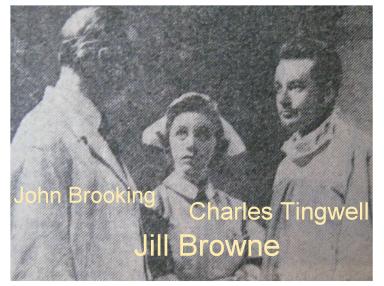
1 (Feb 19th 1957) - Iris Russell (Nurse Mary Stevenson) Rosemary Miller (Probationary Nurse Pat Roberts), Jill Browne (Probationary Nurse Carole Young), also Glyn Owen (Dr O'Mera), and Charles Tingwell (Alan Dawson). Appearing as well was Douglas Ives (George Potter, the head porter) who stated, "I was in the very first scene of the series." TAM rated 1,834,000 homes watched this programme. Script: Tessa Diamond. Director: Antony Keary.
2 (Feb 22nd 1957) - Also, as a patient was Carmel McSharry (Mrs Wilson) the distraught mother of an injured boy.
3 (Feb 26th 1957): with Rosemary Miller, Jill Browne, Iris Russell, Glyn Owen, Frederick Bartman (Simon Forrester), Douglas Ives, Aline Waites (Nurse Edwards), Alexander Beaumont (Mr Wilson) and Carmel McSharry. Script: Tessa Diamond. Director: Rex Firkin.
4 (Mar 1st 1957): with Rosemary Miller, Jill Browne, Glyn Owen, Douglas Ives, Aline Waites,
Alexander Beaumont, Carmel McSharry and Dandy Nichols (Mrs Hill). Script: Tessa Diamond. Director: Antony Keary.
5 (March 5th 1957): with Rosemary Miller, Iris Russell, Charles Tingwell, John Brooking (Mr Brooks, senior consultant) and Julie Webb (Susan Brooks). Script: Tessa Diamond. Director: Rex Firkin.
6 (Mar 8th 1957): with Rosemary Miller, Jill Browne, Elizabeth Kentish (Sister Cowley), Glyn Owen, Frederick Bartman, Douglas Ives and Dandy Nichols. Script: Tessa Diamond. Director: Antony Keary.
7 (now on Monday, March 11th 1957, 7pm): with Rosemary Miller, Jill Browne, Charles Tingwell, Frederick Bartman, Glyn Owen, Douglas Ives and John Brooking. Script: Tessa Diamond. Director: Rex Firkin.
8 (Mar 15th 1957): with Rosemary Miller, Jill Browne, Charles Tingwell, Frederick Bartman, Glyn Owen, Douglas Ives and Julie Webb. Script: Tessa Diamond. Director: Antony Keary.
11 (Mar 25th 1957): with Rosemary Miller, Jill Browne, Charles Tingwell, Frederick Bartman, Glyn Owen, Douglas Ives. Script: Tessa Diamond. Director: Rex Firkin.
12 (Mar 29th 1957): with same main cast of 6. Script: Tessa Diamond. Director: Antony Keary.
13 (April 1st 1957): with Rosemary Miller, Jill Browne, Frederick Bartman, Douglas Ives, and Charles Houston (Reg Lever). Script: Rachel Grieve. Director: Christopher Morahan (who had been floor manager on episodes 2,4,6 and 8)
14 (April 5th 1957): with Rosemary Miller, Jill Browne, Glyn Owen, Frederick Bartman, Charles Tingwell and Douglas Ives. Also appearing though not credited in TV Times was Ruth Kettlewell (Mrs Hackett). Script: Rachel Grieve. Director: Rex Firkin.
15 (Apr 8th 1957): with Rosemary Miller, Jill Browne, Charles Tingwell, Frederick Bartman, Glyn Owen, Douglas Ives and Dandy Nichols. Script: Tessa Diamond. Director: Christopher Morahan.
16 (Apr 12th 1957): with Rosemary Miller, Jill Browne, Charles Tingwell, Frederick Bartman, Glyn Owen, Douglas Ives, Peter Howell (Peter Cunningham), and Ruth Kettlewell. Script: Rachel Grieve. Director: Rex Firkin.
17 (Apr 15th 1957): with Rosemary Miller, Jill Browne, Charles Tingwell, Frederick Bartman, Glyn Owen, Douglas Ives and Dandy Nichols. Script: Tessa Diamond. Director: Christopher Morahan.
18 (Apr 18th 1957): with Rosemary Miller, Jill Browne, Charles Tingwell, Frederick Bartman, Glyn Owen, Douglas Ives. Script: Rachel Grieve. Director: Antony Keary.
21 (Apr 29th 1957): with Rosemary Miller, Jill Browne, Charles Tingwell, Frederick Bartman, Glyn Owen, Douglas Ives. Script: Hazel Adair. Director: Rex Firkin.
22 (May 3rd 1957): with Rosemary Miller, Jill Browne, Charles Tingwell, Frederick Bartman, Glyn Owen, Douglas Ives. Script: Hazel Adair. Director: Christopher Morahan.
25 (May 13th 1957): with same main cast of 6. Script: Hazel Adair. Director: Rex Firkin.
26 (May 17th 1957): with same main cast of 6. Script: Hazel Adair. Director: Christopher Morahan.
29 (May 27th 1957): with Rosemary Miller, Jill Browne, Charles Tingwell, Frederick Bartman, Glyn Owen, Douglas Ives. Script: Rachel Grieve. Director: Rex Firkin.
30 (May 31st 1957): with Rosemary Miller, Jill Browne, Charles Tingwell, Frederick Bartman, Glyn Owen, Douglas Ives. Script: Rachel Grieve. Director: Christopher Morahan.
31 (June 3rd 1957): with Rosemary Miller, Jill Browne, Frederick Bartman, Glyn Owen, Douglas Ives. Script: Hazel Adair. Director: Rex Firkin.
32 (June 7th 1957): with Rosemary Miller, Jill Browne, Frederick Bartman, Glyn Owen, Douglas Ives. Script: Hazel Adair. Director: Antony Keary.
This episode was tenth in the Nielsen TV ratings for June 1957.
33 (Whit Monday June 10th 1957): with Rosemary Miller, Jill Browne, Frederick Bartman, Glyn Owen, Douglas Ives. Though not credited in TV Times, singer Diana Day appeared as a casualty. Script: Tessa Diamond. Director: Rex Firkin.
34 (June 14th 1957): with Rosemary Miller, Jill Browne, Frederick Bartman, Glyn Owen, Douglas Ives. Also Diana Day. Script: Tessa Diamond. Director: Antony Keary.
35 (now on Tuesdays 7.30pm, June 18th 1957): with Rosemary Miller, Jill Browne, Frederick Bartman, Glyn Owen, Douglas Ives. Also Diana Day. Script: Rachel Grieve. Director: Rex Firkin.
36 (now on Fridays 7.30pm, June 21st 1957): with Rosemary Miller, Jill Browne, Frederick Bartman, Glyn Owen, Douglas Ives. Script: Rachel Grieve. Director: Antony Keary.
37 (June 25th 1957): with Rosemary Miller, Jill Browne, Frederick Bartman, Glyn Owen, Douglas Ives. Script: Hazel Adair. Director: John Dinsdale.
38 (June 28th 1957): with Rosemary Miller, Jill Browne, Frederick Bartman, Glyn Owen, Douglas Ives. Script: Hazel Adair. Director: Antony Keary.
39 (July 2nd 1957): with Rosemary Miller, Jill Browne, Frederick Bartman, Glyn Owen. Script: Tessa Diamond. Director: Christopher Morahan.
40 (July 5th 1957): with Rosemary Miller, Jill Browne, Frederick Bartman, Glyn Owen, Douglas Ives. Script: Tessa Diamond. Director: Antony Keary.
41 (July 9th 1957): with Rosemary Miller, Jill Browne, Frederick Bartman, Glyn Owen, Charles Tingwell. Script: Rachel Grieve. Director: Christopher Morahan.
The cast lists from now until episode 100
are the same in TV Times for each story, then there are slight variations noted until the first major change with a new cast list in April 1958.
TV Times itself
admitted the cast did have holiday breaks, so without seeing these 'live' stories it will not be possible to be certain of the exact cast for a particular episode in this era. Also one suspects the
patients were not credited, probably because the show went out live.
So the episodes from now until episode 123 all have allegedly the same 5 in the cast.
42 (July 12th 1957): Script: Rachel Grieve. Director: Antony Keary.
43 (July 16th 1957): Script: Tessa Diamond. Director: Christopher Morahan.
44 (July 19th 1957): Script: Tessa Diamond. Director: Rex Firkin.
47 (July 30th 1957): Script: Tessa Diamond. Director: Christopher Morahan.
48 (August 2nd 1957): Script: Tessa Diamond. Director: Rex Firkin.
49 (Aug 6th 1957): Script: Rachel Grieve. Director: Christopher Morahan.
50 (Aug 9th 1957): Script: Rachel Grieve. Director: Rex Firkin. TV Times celebrated the fiftieth show with a double page spread. The cast celebrated with a party!
51 (Aug 13th 1957): Script: Tessa Diamond. Director: Christopher Morahan.
52 (Aug 16th 1957): Script: Rachel Grieve. Director: Rex Firkin.
53 (Aug 20th 1957): Script: Tessa Diamond. Director: Christopher Morahan.
54 (Aug 23rd 1957): Script: Rachel Grieve. Director: Antony Keary.
57 (Sept 3rd 1957): Script: Rachel Grieve. Director: Rex Firkin.
58 (Sept 6th 1957): Script: Rachel Grieve. Director: Christopher Morahan.
59 (Sept 10th 1957): Script: Jean Scott Rogers. Director: Rex Firkin.
60 (Sept 13th 1957): Script: Tessa Diamond. Director: Antony Keary.
61 (Sept 17th 1957): Script: Rachel Grieve. Director: Rex Firkin.
62 (Sept 20th 1957): Script: Jean Scott Rogers. Director: Antony Keary.
63 (Sept 24th 1957): Script: Tessa Diamond. Director: Rex Firkin.
64 (Sept 27th 1957): Script: Michael Ashe. Director: Christopher Morahan.
67 (Oct 8th 1957): Script: Michael Ashe. Director: Rex Firkin.
68 (Oct 11th 1957): Script: Jean Scott Rogers. Director: Antony Keary.
71 (Oct 22nd 1957): Script: Jean Scott Rogers. Director: Christopher Morahan.
72 (Oct 25th 1957): Script: Rachel Grieve. Director: Rex Firkin.
73 (Oct 29th 1957): Script: Michael Ashe. Director: Christopher Morahan.
74 (Nov 1st 1957): Script: Tessa Diamond. Director: Antony Keary.
75 (Nov 5th 1957): Script: Rachel Grieve. Director: Rex Firkin.
76 (Nov 8th 1957): Script: Michael Ashe. Director: Christopher Morahan.
81 (Nov 26th 1957): Script: Tessa Diamond. Director: Christopher Morahan.
82 (Nov 29th 1957): Script: Rachel Grieve. Director: Rex Firkin
83 (Dec 3rd 1957): Script: Jean Scott Rogers. Director: Christopher Morahan.
84 (Dec 6th 1957): Script: Michael Ashe. Director: Rex Firkin.
During this month's storyline, one patient was seen in a diabetic coma.
89 (Dec 24th 1957): Script: not known. Director: Rex Firkin.
TV Times celebrated the Christmas edition with a picture of head porter Potter (who had not been credited in the magazine for half a year, but is still clearly in the series!). Douglas Ives, who played Potter, later said, "For three years I appeared regularly."
This TV Times also showed a picture of matron, played by Enid Lindsey, who joined the cast around June 1957, and another of patient Mrs Good played by Peggyann Clifford.
Some of the EW10 cast also participated in the Boxing Day 1957 special 'A Santa for Christmas' in which they were filmed at Belgrave Hospital for Children Kensington.
90 (Dec 27th 1957): Script: Michael Ashe. Director: Christopher Morahan.
93 (Jan 7th 1958): Script: Rachel Grieve. Director: Christopher Morahan.
94 (Jan 10th 1958): Script: Jean Scott Rogers. Director: Rex Firkin.
95 (Jan 14th 1958): Script: Michael Ashe. Director: Christopher Morahan. This episode got a Nielsen rate of 70% of viewers
96 (Jan 17th 1958): Script: Rachel Grieve.
Director: Antony Keary.
97 (Jan 21st 1958): Script: Tessa Diamond. Director: Christopher Morahan.
98 (Jan 24th 1958): Script: Jane Scott Rogers.
Director: Antony Keary.
99 (Jan 28th 1958): Script: Rachel Grieve.
Director: Rex Firkin.
100 (Jan 31st 1958): Apart from the five stars, the cast also included John Paul (RSO Hughes). Script: Tessa Diamond.
Director: Antony Keary
101 (Feb 4th 1958): Cast as Jan 31st 1958. Script: Jean Scott Rogers. Director: Christopher Morahan.
102 (Feb 7th 1958): Cast as Jan 31st 1958. Script: Michael Ashe. Director: Rex Firkin.
103 (Feb 11th 1958): Cast as Jan 31st 1958. Script: Tessa Diamond. Director: Christopher Morahan.
104 (Feb 14th 1958): Cast as Jan 31st 1958. Script: Jean Scott Rogers. Director: Rex Firkin.
105 (Feb 18th 1958): Cast as Jan 31st 1958. Script: Michael Ashe. Director: Antony Keary
106 (Feb 21st 1958): Cast as Jan 31st 1958. Script: Tessa Diamond. Director: Christopher Morahan.
In this period actress Valerie Kirkbright was a regular for a while as Nurse Reece, though not credited in TV Times.
107 (Feb 25th 1958): Cast as Jan 31st 1958. Script: Jean Scott Rogers. Director: Rex Firkin.
108 (Feb 28th 1958): Cast as Jan 31st 1958. Script: Michael Ashe. Director: Christopher Morahan.
109 (Mar 4th 1958): Cast as Jan 31st 1958. Script: Tessa Diamond. Director: Rex Firkin.
110 (Mar 7th 1958): Cast as Jan 31st 1958. Script: Jean Scott Rogers. Director: Antony Keary
111 (Mar 11th 1958): Cast now: Rosemary Miller, Jill Browne, Glyn Owen, Frederick Bartman, Charles Tingwell, John Paul, and Peter Howell (Dr Harrison). Script: Rachel Grieve. Director: Christopher Morahan.
112 (Mar 14th 1958): Cast as Mar 11th 1958. Script: Rachel Grieve. Director: Rex Firkin.
113 (Mar 18th 1958): Cast as Mar 11th 1958. Script: Tessa Diamond. Director: Christopher Morahan.
114 (Mar 21st 1958): Cast as Mar 11th 1958. Script: Jean Scott Rogers. Director: Rex Firkin.
115 (Mar 25th 1958): Cast as Mar 11th 1958. Script: Rachel Grieve. Director: (?) Antony Keary.
116 (Mar 28th 1958): Cast as Mar 11th 1958. Script: Tessa Diamond. Director: Christopher Morahan.
117 (April 1st 1958): Cast now: Rosemary Miller, Jill Browne, Glyn Owen, Frederick Bartman, Charles Tingwell, John Paul, and Peter Howell. Script: Michael Ashe. Director: Rex Firkin.
118 (Apr 4th 1958): Rosemary Miller, Jill Browne, Glyn Owen, Frederick Bartman, Charles Tingwell, John Paul, and Peter Howell. Script: Jean Scott-Rogers. Director: Christopher Morahan.
Notes
Original cast member Glyn Owen left the cast during April 1958. He did return in December 1960.
It was about this time that Alan Dawson had an affair with radiographer June Jefferson, played by actress Patricia Salonika, though she is not credited in TV Times.
119 (Apr 8th 1958): Rosemary Miller, Jill Browne, Glyn Owen, Frederick Bartman, Charles Tingwell, John Paul, and Peter Howell. Script: Rachel Grieve. Director: Rex Firkin.
120 (Apr 11th 1958): same cast of 7. Script: Tessa Diamond. Director: (probably) Antony Keary.
123 (Apr 22nd 1958):
Cast: Rosemary Miller, Jill Browne, Frederick Bartman, Charles Tingwell, John Paul, and Peter Howell. Script: Rachel Grieve. Director: Christopher Morahan.
124 (Apr 25th 1958):
Cast as for Apr 22nd. Script: Rachel Grieve.
127 (May 6th 1958): Script: Jean Scott Rogers. Director: Rex Firkin.
128 (May 9th 1958): Script: Rachel Grieve. Director: Christopher Morahan
129 (May 13th 1958):
Cast as for Apr 22nd. Script: Jean Scott Rogers. Director: Rex Firkin.
Note: Though Iris Russell wasn't billed in TV Times, it is noted that she was appearing in May 1958, along with her cousin Maihri Russell, who played Jenny Stevenson, her sister.
130 (May 16th 1958):
Cast as for Apr 22nd. Script: Rachel Grieve. Director: not known.
131 (May 20th 1958): Cast as for Apr 22nd. Script: Tessa Diamond. Director: Christopher Morahan.
132 (May 23rd 1958): Cast as for Apr 22nd. Script: Jean Scott Rogers. Director: Rex Firkin.
133 (May 27th 1958):
same cast as Apr 22nd.
Script: Rachel Grieve. Director: Cecil Petty.
134 (May 30th 1958): same cast as Apr 22nd. Script: Tessa Diamond. Director: Christopher Morahan.
137 (June 10th 1958): same cast as Apr 22nd. Script: Rachel Grieve. Director: Antony Keary.
138 (June 13th 1958): same cast as Apr 22nd. Script: Jean Scott Rogers. Director: Rex Firkin.
141 (June 24th 1958): same cast as Apr 22nd. Script: Rachel Grieve. Director: Christopher Morahan
142 (June 27th 1958): same cast as Apr 22nd. Script: Peter Yeldham. Director: Cecil Petty
143 (July 1st 1958): Starring Rosemary Miller, Frederick Bartman, and Charles Tingwell, with John Paul, Norah Gorsen, Shaun O'Riordan (Jake O'Dowd) and Nicholas Meredith (Major Burt). Script: Peter Yeldham. Director: Christopher Morahan
144 (July 4th 1958): Starring Rosemary Miller, Frederick Bartman, and Charles Tingwell, with John Paul, Norah Gorsen, Shaun O'Riordan, John Brooking, and Walter Horsbrugh (Supt Wallace). Script: Tessa Diamond. Director: Anthony Keary?
145 (July 8th 1958, 8pm):
Starring
Rosemary Miller, Frederick Bartman and Charles Tingwell.
Also with: John Paul, Norah Gorsen (Nurse Ann Guthridge- she was intended to replace the leaving stars), Barbara Clegg (Nurse Jo Buckley), Shaun O'Riordan, and Nicholas Meredith.
Script: Rachel Grieve. Director: Cecil Petty.
146 (July 11th 1958):
with Rosemary Miller, Frederick Bartman and Charles Tingwell. Also John Paul, Norah Gorsen, Michael Duffield (George Henderson), and these who had certainly been in earlier stories: Enid Lindsey (Matron), Douglas Ives.
Script: Peter Yeldham. Director: Christopher Morahan.
Summer 1958 saw a fall out among the cast, resulting in changes. TV Times diplomatically explained that Rosemary Miller and Jill Browne "are leaving for professional as well as private reasons." One disappointed viewer wrote, "I regret the departure of Pat and Carole." Rosemary Miller as Pat Roberts on whom the series had originally centred, left for good, while Jill Browne as Carole Young disappeared for a year. Antony Keary hit on a good excuse, "there is a clear professional reason why Nurse Roberts, who is in her second year, might leave a hospital. After this training period she can take up a specialised course of work."
153 (Aug 5th 1958):
with Frederick Bartman and Charles Tingwell.
Also
Barbara Clegg,
Norah Gorsen,
Shaun O'Riordan,
Mackenzie Ward (Professor Beverley),
Yvette Wyatt (Staff Nurse Phillips),
Marianne Brauns (Nini Matt),
Edward Cast (Dr Crichton),
Ann Sears (Staff Nurse Morley),
and
Lisalott Goettinger (Mrs Matt).
Script: Peter Yeldham. Director: Christopher Morahan.
154 (Aug 8th 1958):
with Frederick Bartman and Charles Tingwell.
Also
Barbara Clegg,
Norah Gorsen,
Peter Howell,
Enid Lindsey,
Kenneth Watson (Senior house officer Graham),
Bryan Coleman (Dr Garnett-Avory),
Rosalind Knight (Nurse Johns),
Douglas Ives, and
Vic Wise (Jimmy Hogan).
Script: Jean Scott Rogers. Director: Rex Firkin.
155 (Aug 12th 1958):
with Frederick Bartman and Charles Tingwell.
Also Barbara Clegg, Peter Howell, Enid Lindsey, John Brooking, Norah Gorsen,
Mackenzie Ward,
Kenneth Watson,
Yvette Wyatt,
Marianne Brauns, and Shaun O'Riordan.
Script: Rachel Grieve. Director: Cecil Petty.
156 (Aug 15th 1958):
with Frederick Bartman and Charles Tingwell.
Also
Barbara Clegg,
Peter Howell,
Norah Gorsen,
Kenneth Watson,
Ann Sears,
and Marianne Brauns.
Script: Peter Yeldham. Director: Leonard Brett.
157 (Aug 19th 1958):
with Frederick Bartman and Charles Tingwell.
Also
Barbara Clegg,
Norah Gorsen,
Enid Lindsey,
John Brooking,
Liam Gaffney (Nolan),
Marianne Brauns, Shaun O'Riordan.
Script: Tessa Diamond. Director: Rex Firkin.
158 (Aug 22nd 1958):
with Frederick Bartman and Charles Tingwell.
Also
Barbara Clegg,
Norah Gorsen,
Peter Howell,
Enid Lindsey,
Kenneth Watson,
Ann Sears,
Liam Gaffney, and
Shaun O'Riordan.
Script: Jean Scott Rogers. Director: Leonard Brett.
161 (Sept 2nd 1958)
with Frederick Bartman and Charles Tingwell.
Also
Barbara Clegg,
Norah Gorsen,
John Brooking,
Violet Gould (Madame Lili),
Douglas Ives,
Carmel McSharry (Mrs Ford- she had been in an early EW10 story as a different character),
Gillian Owen (Emma Forrester),
Zena Howard (Lady Forrester),
and Philip Ashley (Basil Seldon).
Script: Jean Scott Rogers. Director: Antony Keary(?)
162 (Sept 5th 1958)
with Frederick Bartman and Charles Tingwell.
Also
Barbara Clegg,
Norah Gorsen,
Peter Howell,
Kenneth Watson,
Violet Gould,
Erica Houen (Karen Phipps),
Rita Webb (Mrs Baines),
Zena Howard, and
Philip Ashley.
Script: Rachel Grieve. Director: Rex Firkin
165 (Sept 16th 1958, now back in its most familiar slot of 7.30pm):
with Frederick Bartman and Charles Tingwell.
Also
Barbara Clegg,
Norah Gorsen,
Kenneth Watson,
Ann Sears,
Mary Wylie (Nurse Dixon),
Carmel McSharry,
Beckett Bould (Mr Birley),
Erica Houen, and
Violet Gould.
Script: Rachel Grieve. Director: Christopher Morahan.
166 (Sept 19th 1958):
with Frederick Bartman and Charles Tingwell.
Also
Barbara Clegg,
Norah Gorsen,
Kenneth Watson,
Beckett Bould,
Gabrielle Daye (Mrs Abbott),
Barbara New (Mrs Clarke), and
Ian Hendry (Mr Clarke, a patient suffering from polio).
Script: Tessa Diamond. Director: not known but likely to be Antony Keary.
167 (Sept 23rd 1958):
with Frederick Bartman and Charles Tingwell.
Also
Barbara Clegg,
Norah Gorsen,
Peter Howell,
Ann Sears,
Gillian Owen,
Victor Platt (Ted Sinker)
Valerie White (Dr Weston)
Barbara New and
Ian Hendry.
Script: Margot Bennett. Director: Christopher Morahan.
168 (Sept 26th 1958):
with Frederick Bartman and Charles Tingwell.
Also
Barbara Clegg,
Norah Gorsen,
Beckett Bould,
Yvette Wyatt,
Gabrielle Daye,
Valerie White,
Mary Steele (Clare Merrall), and
Geoffrey Adams (Dr Darren).
Script: Jean Scott Rogers. Director: not known but probably Antony Keary.
169 (Sept 30th 1958):
with Frederick Bartman and Charles Tingwell.
Also
Beckett Bould,
Ann Sears,
Geoffrey Adams,
Kenneth Watson,
Geoffrey Adams,
Yvette Wyatt,
Victor Platt,
Alex Scott ('Ham' Randall), and
Carmel McSharry.
Script: Tessa Diamond. Director: not known but probably A Keary.
170 (Oct 3rd 1958):
with Frederick Bartman and Charles Tingwell.
Also
Barbara Clegg,
Norah Gorsen,
Peter Howell,
Jerold Wells (Mr Bowles),
Gabrielle Daye,
Victor Platt,
Valerie White,
Barbara New and
Ian Hendry.
Script: Margot Bennett. Director: Christopher Morahan.
Note- Frederick Bartman as Simon Forrester left the cast, in the story line he returned to his teaching college.
173 (Oct 14th 1958):
with Charles Tingwell.
Also
Barbara Clegg,
Norah Gorsen,
Kenneth Watson,
Iris Russell (now Sister Stephenson, she had been in the very first stories as a nurse),
Victor Platt,
James Ottaway (Dr Pennington),
Desmond Carrington (Chris Anderson),
Kerry Marsh (Nurse O'Keefe).
Script: Margot Bennett. Director: Christopher Morahan.
174 (Oct 17th 1958):
with Charles Tingwell.
Also
Barbara Clegg,
Norah Gorsen,
Peter Howell,
Ann Sears,
Mary Steele,
Ian Hendry,
Barbara New,
Victor Platt, and
Desmond Carrington.
Script: Rachel Grieve. Director: Rex Firkin.
175 (Oct 21st 1958):
with Charles Tingwell and Peter Howell.
Also
Barbara Clegg,
Norah Gorsen,
Kenneth Watson,
Ann Sears,
Mary Steele,
Iris Russell,
Geoffrey Adams,
Victor Platt,
and Kerry Marsh.
Script: Tessa Diamond. Director: Christopher Morahan.
176 (Oct 24th 1958):
with Charles Tingwell and Peter Howell.
Also
Barbara Clegg,
Norah Gorsen,
Kenneth Watson,
Ann Sears,
Desmond Carrington,
Iris Russell,
Ian Hendry, and
Marianne Brauns.
Script: Margot Bennett. Director: Antony Keary(?)
177 (Oct 28th 1958): with Charles Tingwell and Peter Howell. Also Barbara Clegg, Norah Gorsen, Desmond Carrington, John Brooking, John Miller (Dr Gardner), Victor Platt, Ian Hendry, Josephine Stuart (Sylvia Grenfell) and James Ottaway. Script: Rachel Grieve. Director: Cecil Petty.
178 (Oct 31st 1958): with Charles Tingwell and Peter Howell. Also Barbara Clegg, Norah Gorsen, Kanneth Watson, Ann Sears, Douglas Ives, Yvette Wyatt, Marianne Brauns, Desmond Carrington, and Josephine Stuart. Script: Jean Scott Rogers. Director: Rex Firkin.
179 (Nov 4th 1958):
with Charles Tingwell, Iris Russell and Peter Howell.
Also
Barbara Clegg,
Norah Gorsen,
Douglas Ives,
Ian Hendry,
John Brooking, and
Erica Houen.
Script: Tessa Diamond. Director: probably Antony Keary.
180 (Nov 7th 1958):
with Charles Tingwell, Iris Russell and Peter Howell.
Also
Barbara Clegg,
Desmond Carrington,
Norah Gorsen,
Ian Hendry,
Josephine Stuart (Sylvia Grenfell),
Marianne Brauns, and
Jean Aubrey (Nurse Judy Wayne)- unusually, she had appeared in the feature film of EW10 as this nurse before making her appearance on tv.
Script: Margot Bennett. Director: Cecil Petty.
181 (Nov 11th 1958): with Charles Tingwell, Iris Russell and Peter Howell. Also Norah Gorsen, Barbara Clegg, Desmond Carrington, Kenneth Watson, Ann Sears, Nita Moyce (Sister Day), Marianne Brauns, Douglas Ives and Erica Houen. Script: Rachel Grieve. Director: Rex Firkin.
182 (Nov 14th 1958): with Charles Tingwell, Iris Russell and Peter Howell.
Also Norah Gorsen, Barbara Clegg, Kenneth Watson, Ann Sears, Josephine Stuart, Enid Lindsey, Jean Aubrey, Beatrix Mackey (Mrs Grenfell), Andre Maranne (Marcel Jacquin), and Frank Sieman (Tom Barnes). Script: Jean Scott Rogers. Director: Cecil Petty.
183 (Nov 18th 1958):
with Charles Tingwell, Iris Russell and Peter Howell.
Also
Barbara Clegg,
Norah Gorsen,
Kenneth Watson,
Ann Sears,
Desmond Carrington,
Marianne Brauns,
Josephine Stuart,
Nita Moyce,
Andre Maranne, and
Frank Sieman.
Script: Margot Bennett. Director: Rex Firkin.
184 (Nov 21st 1958):
with Charles Tingwell, Iris Russell and Peter Howell.
Also
Barbara Clegg,
Norah Gorsen,
Erica Houen,
Josephine Stuart,
Nita Moyce,
Andre Maranne,
Frank Sieman, and
Beatrix Mackey.
Script: Rachel Grieve. Director: Cecil Petty.
185 (Nov 25th 1958): with Charles Tingwell, Iris Russell and Peter Howell. Also Barbara Clegg, Norah Gorsen, Desmond Carrington, Ann Sears, Douglas Ives, and Jean Aubrey. Script: Jean Scott Rogers. Director: Rex Firkin.
186 (Nov 28th 1958): with Charles Tingwell, Iris Russell and Peter Howell. Also Barbara Clegg, Norah Gorsen, Desmond Carrington, Kenneth Watson, Ann Sears, Victor Platt, James Ottaway, Frank Sieman and Josephine Stuart. Script: Margot Boyd. Director: Cecil Petty.
187 (Dec 2nd 1958): with Charles Tingwell, Iris Russell and Peter Howell.
Also Barbara Clegg, Norah Gorsen, Desmond Carrington,
Kenneth Watson, Enid Lindsey, Dandy Nichols and Robert Macleod (Dr Whittaker). Script: Tessa Diamond. Director: Christopher Morahan.
Note: Robert Macleod had originally played a brain surgeon visiting Oxbridge. The producer decided he was ideal for the part of stern Dr Whittaker and so Robert played this new role with rimless spectacles, to hide his change of identity
188 (Dec 5th 1958): with Charles Tingwell, Iris Russell and Peter Howell.
Also Barbara Clegg, Norah Gorsen,
Kenneth Watson,
Ann Sears, Dandy Nichols
Douglas Ives, Shaun O'Riordan, Erica Houen, and Jean Aubrey. Script: Tessa Diamond. Director: Antony Keary (probably).
193 (Dec 23rd 1958):
with Charles Tingwell, Iris Russell and Peter Howell.
Also
Barbara Clegg,
Norah Gorsen,
Douglas Ives,
John Brooking,
Erica Houen,
Jean Aubrey,
Shaun O'Riordan,
Owen Holder (Philip Carter),
and David Butler (Dr Nick Williams) NB in 1963 Butler also wrote some scripts for the series.
This Script: Margot Bennett. Director: probably A Keary.
194 (Dec 26th 1958):
with Charles Tingwell, Iris Russell and Peter Howell.
Also
Barbara Clegg,
Norah Gorsen,
Desmond Carrington,
Kenneth Watson,
Ann Sears,
Nita Moyce,
and Kerry Marsh.
Script: Michael Ashe. Director: probably A Keary.
195 (Dec 30th 1958) with Charles Tingwell, Iris Russell, Peter Howell and Barbara Clegg. Also Desmond Carrington, Jean Aubrey, John Brooking, Julie Webb, Erica Houen, Owen Holder, Kerry Marsh, and Nancy Roberts (Winnie Gale). Script: Jean Scott Rogers. Director: Christopher Morahan.
196 (Jan 2nd 1959) with Charles Tingwell, Iris Russell, Peter Howell and Barbara Clegg. Also Desmond Carrington, Jean Aubrey, Erica Houen, Shaun O'Riordan, William Hodge (Captain Kennedy), and Yvette Wyatt. Script: Margot Bennett. Director: Antony Keary?
197 (Jan 6th 1959):
with Charles Tingwell, Iris Russell, Peter Howell and Barbara Clegg.
Also
Jean Aubrey,
Enid Lindsey,
Kerry Marsh,
Shaun O'Riordan,
William Hodge,
Hugh Cross (Emmett Cass), and
Nancy Roberts.
Script: Michael Ashe. Director: Leonard Brett.
198 (Jan 9th 1959):
with Charles Tingwell, Iris Russell, Peter Howell and Barbara Clegg.
Also
Desmond Carrington,
Enid Lindsey,
Kerry Marsh,
William Hodge,
Hugh Cross, and
Eleanore Bryan (Lucy Stoker).
Script: Rachel Grieve. Director: Hugh Rennie.
200 (Jan 16th 1959):
with Charles Tingwell and Barbara Clegg.
Also
Desmond Carrington,
Jean Aubrey,
Ann Sears,
Shaun O'Riordan,
John Carson (Donald Latimer),
Robert Macleod,
Iris Russell, and
Peter Howell.
Script: Margot Bennett. Director: Christopher Morahan.
201 (Jan 20th 1959):
with Charles Tingwell, Iris Russell, Peter Howell, and Barbara Clegg.
Also
John Brooking,
Julie Webb,
Robert MacLeod,
Mairhi Russell (Jenny Stevenson),
Hugh Cross, and
Noel Hood (Mrs Anderson).
Script: Michael Ashe. Director: Hugh Rennie.
202 (Jan 23rd 1959):
with Charles Tingwell, Iris Russell, Peter Howell, and Barbara Clegg.
Also
Desmond Carrington,
Enid Lindsey,
John Brooking,
Julie Webb,
Robert MacLeod,
Noel Hood, and
Kerry Marsh.
Script: Rachel Grieve. Director: Cecil Petty.
203 (Jan 27th 1959): with Charles Tingwell, and Barbara Clegg. Also Desmond Carrington, John Carson, John Brooking, Julie Webb, Noel Hood, Kerry Marsh, Monica MacLeod (Sister Walker), and Anna Turner (Night Sister later named as Sister Brinsley). Script: Jean Scott Rogers. Director: Christopher Morahan.
204 (Jan 30th 1959): with Charles Tingwell, Barbara Clegg and Albert Finney (starring role as Tom Fletcher). Also Desmond Carrington, John Carson,
Noel Hood, Monica MacLeod, Janet Barrow (Mrs Bluett) and Diane Aubrey (Elizabeth Fletcher- a patient who died after a few stories. Nevertheless Diane re-appeared in the series in two further parts, see #420 and #587). Script: Margot Bennett. Director: Hugh Rennie.
205 (Feb 3rd 1959) with Charles Tingwell, Barbara Clegg, and Robert Macleod, Kerry Marsh, John Brooking, Julie Webb, Diane Aubrey, Sydney Arnold (Richard Sainsbury), and Hilda Sennimore (sic Bessie Sainsbury).
Script: Michael Ashe. Director: Cecil Petty.
206 (Feb 6th 1959) with Charles Tingwell, Barbara Clegg and Albert Finney. With Desmond Carrington, John Brooking, Julie Webb, Diane Aubrey, Sydney Arnold, and Gene Anderson (Sister Shelley).
Script: Michael Ashe. Director: Christopher Morahan.
209 (Feb 17th 1959) This episode scored on the National TAM viewing ratings, a figure of 4,772,000 homes.
211 (Feb 24th 1959) with Charles Tingwell, Barbara Clegg, and Desmond Carrington. Also John Carson, Jean Aubrey, Anne Blake (Mrs Marsh), John Flexman (Paul Davies), Joe Melia (Bernie Lewis), Moira Redmond (patient Raine Travers), Brian Worth (Geoffrey Gray) and William Sherwood (Mr Carstairs).
Script: Michael Ashe. Director: Hugh Rennie.
212 (Feb 27th 1959) with Charles Tingwell, Barbara Clegg, and Desmond Carrington. With Jean Aubrey, Anne Blake, Moira Redmond, Brian Worth and Nita Moyce. Script: Michael Ashe. Director: Hugh Rennie. Synopsis: Donald tries to take Jo away from Chris.
213 (Mar 3rd 1959) with Charles Tingwell, Barbara Clegg, and Desmond Carrington. With Jean Aubrey, John Carson, Gene Anderson, Philip Latham (RSO Barnett), John Flexman, Moira Redmond, William Sherwood, Anne Blake, and Harriette Johns (Mrs Barnett). Script: Rachel Grieve. Director: Cecil Petty.
214 (Mar 6th 1959) with Charles Tingwell, Barbara Clegg, and Desmond Carrington.
With Gene Anderson, Kerry Marsh, John Brooking, Philip Latham, John Flexman, Moira Redmond, and Brian Worth. Script: Rachel Grieve. Director: Cecil Petty.
215 (Mar 10th 1959) with Charles Tingwell, Barbara Clegg, and Desmond Carrington.
Also with Jean Aubrey, Gene Anderson, John Brooking, John Richmond (Dr Duncan),
John Flexman, AJ Brown (Harry Wright),
Harriette Johns,
David Langford (Brian Reid), and Geoffrey Wearing (Mr Reid). Script: Jean Scott Rogers. Director: Christopher Morahan.
216 (Mar 13th 1959) with Charles Tingwell, Barbara Clegg, and Desmond Carrington.
Also with John Carson, Jean Aubrey, John Brooking, Philip Latham, John Richmond, AJ Brown,
Margery Weston (Amy Snaith),
Harriette Johns, and
David Langford. Script: Jean Scott Rogers. Director: Christopher Morahan.
217 (Mar 17th 1959):
with Charles Tingwell, Barbara Clegg and Desmond Carrington.
Also
Jean Aubrey,
John Carson,
Gene Anderson,
Shaun O'Riordan,
John Miller,
John Richmond,
David Langford,
Geoffrey Wearing,
Brenda Cowling (Mrs Reid),
George Roderick (Mr Haines), and
Noel Dyson (Mrs Haines).
Script: Michael Ashe. Director: Hugh Rennie.
218 (Mar 20th 1959):
with Charles Tingwell, Barbara Clegg and Desmond Carrington.
Also
Kerry Marsh,
John Carson,
Gene Anderson,
John Richmond,
David Langford,
Brenda Cowling,
Noel Dyson,
AJ Brown and
Katherine Parr (Joan Stringer).
Script: Michael Ashe. Director: Hugh Rennie.
219 (March 24th 1959): Jill Browne returned after her long absence.
221 (March 31st 1959): with Charles Tingwell, Barbara Clegg, Jill Browne and Desmond Carrington. Also Jean Aubrey (Julie Wayne),
Kerry Marsh, John Carson,
Shaun O'Riordan, Gene Anderson,
Nancy Roberts, Margaret Gordon (Miss Grant),
Patricia Healey (Katy England), and Sam Kydd (Rocky).
Frederick Bartman, absent since the previous October, rejoined the cast, I believe it was for this story.
Director: Cecil Petty.
222 (April 3rd 1959): with Charles Tingwell, Barbara Clegg, Jill Browne and Desmond Carrington. Rest of cast not known.
Script: Jean Scott Rogers. Director: Cecil Petty.
226 (April 17th 1959) with Charles Tingwell, Jill Browne, Frederick Bartman, Barbara Clegg and Desmond Carrington. Also John Carson, Shaun O'Riordan, Walter Horsbrugh, Lockwood West, Robert Macleod, and John Gabriel (Jack Finney). Script: Tessa Diamond. Director: Hugh Rennie.
227 (April 21st 1959)
with Charles Tingwell, Jill Browne, Frederick Bartman, Barbara Clegg and Desmond Carrington.
Also
Robert Macleod,
Shirley Thieman (Staff Nurse Craigie),
Renee Bourne Webb (Sister Grey),
James Raglan (Joseph Winnery),
Cavan Malone (Harry Granger),
Michael Newell (Derek Jones),
and Eric Francis (Rackman).
Script: Margot Bennett.
Director: Leonard Brett.
228 (April 24th 1959)
with Charles Tingwell, Jill Browne, Frederick Bartman, Barbara Clegg and Desmond Carrington.
Also
John Carson,
Shaun O'Riordan,
Lockwood West (Mr Cleveden-Sykes),
Frederick Leister (John Handon- later in #408 this actor is promoted to a Bishop!),
John Gabriel,
Cavan Malone, and
Michael Newell.
Script: Margot Bennett.
Director: Leonard Brett (his last directing as he died suddenly next month).
231 (May 5th 1959)
with Charles Tingwell, Jill Browne, Frederick Bartman, Barbara Clegg and Desmond Carrington.
Also
John Carson,
Philip Latham,
Douglas Ives,
Walter Horsbrugh,
Robert Macleod,
Shirley Thieman,
Lockwood West,
Richard Waring (Jeremy Cleveden-Sykes),
Frederick Leister, and
Donald Tandy (Mr Ferens).
Script: Michael Ashe.
Director: Hugh Rennie.
232 (May 8th 1959, seen in 3,854,000 homes according to TAM)
with Charles Tingwell, Jill Browne, Frederick Bartman, Barbara Clegg and Desmond Carrington.
Also
John Carson,
Philip Latham,
Lockwood West,
Richard Waring,
Frederick Leister,
James Raglan, and
Donald Tandy.
Script: Michael Ashe.
Director: Hugh Rennie.
233 (May 12th 1959):
with Charles Tingwell, Jill Browne, Frederick Bartman, Barbara Clegg and Desmond Carrington.
Also
John Carson,
Philip Latham,
Robert Macleod
James Raglan,
Shirley Thieman,
Jan Holden (Caroline Derby),
Shaun O'Riordan, and
Soraya Rafat (Shakuntalah Varmi).
Script: Margo Bennett. Director: Cecil Petty.
234 (May 15th 1959):
with Charles Tingwell, Jill Browne, Frederick Bartman, Barbara Clegg and Desmond Carrington.
Also
Shirley Thieman,
Robert Macleod,
Kerry Marsh,
Harriette Johns,
Noel Hood, and
Soraya Rafat.
Script: Rachel Grieve. Director: Cecil Petty.
235 (May 19th 1959):
with Charles Tingwell, Jill Browne, Frederick Bartman, Barbara Clegg and Desmond Carrington.
Also
Geoffrey Adams,
Kerry Marsh,
Jan Holden,
James Carroll (David Willis),
Jeanette Jacobs (Dinah Lowe),
Peter Bartlett (Rodney Lowe), and
Soraya Rafat.
Script: Tessa Diamond. Director: Christopher Morahan.
236 (May 22nd 1959):
with Charles Tingwell, Jill Browne, Frederick Bartman, Barbara Clegg and Desmond Carrington.
Also
John Carson,
Robert Macleod (Dr Whittaker),
Shirley Thieman,
Kerry Marsh,
Jan Holden,
Soraya Rafat,
James Carroll, and
Anthony Wilson Peter White).
Script: Margot Bennett. Director: Christopher Morahan.
237 (May 26th 1959):
with Charles Tingwell, Jill Browne, Frederick Bartman, Barbara Clegg and Desmond Carrington.
Also
Enid Lindsey,
Philip Latham,
Geoffrey Denton (Dr Hinchcliffe),
Shirley Thieman,
Monica MacLeod,
Jeanette Jacobs,
Peter Bartlett,
Soraya Rafat, and
Elizabeth Chambers (Nurse Rogers).
Script: Rachel Grieve. Director: Michael Redington.
238 (May 29th 1959):
with Charles Tingwell, Jill Browne, Frederick Bartman, Barbara Clegg and Desmond Carrington.
Also
John Carson,
Philip Latham,
Jeanette Jacobs,
Jan Holden,
James Carroll, and
Anthony Wilson (Peter White).
Script: Tessa Diamond. Director: Michael Redington.
241 (June 9th 1959): with Charles Tingwell, Jill Browne, Frederick Bartman, Barbara Clegg and Desmond Carrington. Also Shaun O'Riordan, Geoffrey Adams, John Forrest (Charles Wood), Charmian Eyre (Martgaret Saunders), David Steuart (Mr MacFee), Molly Lumley (Mrs MacFee), Stanley van Beers (Walter Lawson), Megan Latimer (Ena Lawson), and Paul Taylor (Rupert Lawson).
Script: Tessa Diamond. Director: Rex Firkin.
242 (June 12th 1959): with Charles Tingwell, Jill Browne, Frederick Bartman, Barbara Clegg and Desmond Carrington. Also Shaun O'Riordan, Kerry Marsh, Charmian Eyre, Elsie Wagstaff (Mrs Saunders), Paul Taylor, Stanley van Beers, Pat Sandys (Theatre Sister), and Anthony Woodruff (Peter Garrett).
Script: Tessa Diamond. Director: Rex Firkin.
243 (June 16th 1959):
with Charles Tingwell, Jill Browne, Frederick Bartman, Barbara Clegg and Desmond Carrington.
Also
John Carson,
John Miller,
Charmian Eyre,
Elsie Wagstaff,
Anthony Woodruff,
Raymond Mason (Mr Fortune), and
Frank Pemberton.
Script: Michael Ashe. Director: Cecil Petty.
244 (June 19th 1959):
with Charles Tingwell, Jill Browne, Frederick Bartman, Barbara Clegg and Desmond Carrington.
Also
John Carson,
Kerry Marsh,
Charmian Eyre,
Elsie Wagstaff, and
Raymond Mason.
Script: Michael Ashe. Director: Cecil Petty.
247 (June 30th 1959):
with Peter Howell,
Also
John Carson,
Shirley Thieman,
Geoffrey Denton,
Raymond Mason (Mr Fortune),
Judith Fellows (Mrs Fortune),
Maxine Holden (Mary Cunnngham),
Arthur Lawrence (Toby le Strange), and
Terence Knapp (Dr O'Reilly).
Script: Tessa Diamond. Director: Peter Sasdy.
248 (July 3rd 1959): with Peter Howell, Desmond Carrington, Barbara C;egg, Jill Browne, Frederick Bartman. Also John Carson, Kerry Marsh, Philip Latham, John Brooking, and Derek Benfield (Humphrey Silk).
Script: Michael Ashe.
249 (July 7th 1959):
with Barbara Clegg, Frederick Bartman, Desmond Carrington and Peter Howell.
Also
John Carson (this was his final appearance as Dr Lattimer),
Philip Latham,
Kerry Marsh,
Arthur Lawrence,
Raymond Mason,
Gene Anderson and
Terence Knapp.
Script: Jean Scott Rogers. Director: Rex Firkin.
250 (July 10th 1959):
with Barbara Clegg, Frederick Bartman, Jill Browne, Iris Russell, Desmond Carrington and Peter Howell.
Also
John Brooking,
Philip Latham and
Shirley Thieman.
Script: Jean Scott Rogers. Director: Rex Firkin
251 (July 14th 1959)- this may possibly be episode 252 or 253:
with Charles Tingwell, Jill Browne, Iris Russell, and Peter Howell.
Also
Rashid Karapiet (Sheik Saumail),
Shirley Thieman,
Terence Brook,
Arthur Lawrence,
John Forrest,
Gordon Phillott (Tom Grimes),
Edmund Ojero (Retainer), and
Mollie Maureen (Mrs Baker).
Script: Rachel Grieve. Director: Hugh Rennie.
254 (July 24th 1959):
with Barbara Clegg, Jill Browne, Frederick Bartman, Iris Russell, and Desmond Carrington.
Also
Enid Lindsey,
Bryan Pringle (Bill Whitby),
Douglas Ives,
Jocelyn Britton (Ruby Ellis),
Raymond Mason,
Felicity Ross (Joy Bates),
and
Brian Murray (Joe Masters).
Script: Jean Scott Rogers. Director: John Nelson Burton.
255 (July 28th 1959):
with Charles Tingwell, Jill Browne, Iris Russell, and Peter Howell.
Also
John Forrest,
Shirley Thieman,
Philip Ray (Mr Hadden, the padre)
Bryan Pringle,
Kenneth Mackintosh (Dr McAlpine),
Sonia Graham (Mrs Delphine Cutler),
Alexander Archdale (Col Turvey),
and
Norman Bird (Policeman).
Script: Tessa Diamond. Director: Peter Sasdy.
260 (Aug 14th 1959):
with Charles Tingwell, Barbara Clegg, Desmond Carrington, Jill Browne, Frederick Bartman, and Peter Howell.
Also
Kerry Marsh,
Philip Ray,
Noel Hood,
Nita Moyce,
Betty Henderson (Night Sister),
Colin Douglas (Archie Briggson),
David Williams (Sergeant Horner), and
Donald Churchill (Jim Ellis).
Script: Rachel Grieve. Director: Cecil Petty.
This episode showed the marriage of Jo Buckley and Chris Anderson.
261 (Aug 18th 1959 now at 8pm):
with Jill Browne, Frederick Bartman, and Iris Russell.
Also
John Barron (Harold de la Roux),
Alexander Archdale,
Colin Douglas,
John Forrest, and
Brian Murray.
Script: Michael Ashe. Director: Peter Sasdy.
262 (Aug 21st 1959):
with Charles Tingwell, Frederick Bartman, Iris Russell and Peter Howell.
Also
John Barron,
Kenneth Mackintosh,
Alexander Archdale,
Brian Murray,
Maureen Beck (Sue Campbell, Col Turvey's granddaughter, a nurse from Winchester visiting him. She is transferred to Oxbridge for a while),
Joan Phillips (Mrs Masters) and
Dandy Nicholls (returning as Mrs Hill, the character she'd played in early stories- see #4).
Script: Michael Ashe. Director: Peter Sasdy.
263 (Aug 25th 1959):
with Charles Tingwell, Jill Browne, Frederick Bartman, Iris Russell and Peter Howell.
Also
Colin Douglas,
Dandy Nicholls,
Maureen Beck,
David Williams (Sgt Horner), and
Bryan Pringle.
Script: Tessa Diamond. Director: John Nelson Burton.
264 (Aug 28th 1959):
with Charles Tingwell, Jill Browne, Frederick Bartman, Iris Russell and Peter Howell.
Also
Alexander Archdale,
Colin Douglas,
Dandy Nicholls,
John Forrest (Charles Wood), and
Robert MacLeod (Dr Whittaker).
Script: Rachel Grieve. Director: John Nelson Burton.
265 (Sept 1st 1959):
with Jill Browne, Frederick Bartman, Barbara Clegg, and Desmond Carrington.
Also
Colin Douglas,
Pauline Winter (Mrs Briggson),
Dandy Nicholls,
John Barron,
Robert MacLeod,
Wendy Hutchinson (Wendy Faulkner, she is suffering from polio), and
Stephen Hancock (John Faulkner).
Script: Michael Ashe. Director: Rex Firkin.
266 (Sept 4th 1959):
with Barbara Clegg, Desmond Carrington and Peter Howell.
Also
Colin Douglas,
Robert MacLeod,
John Barron,
John Brooking,
Wendy Hutchinson, and
Stephen Hancock.
Script: Jean Scott Rogers. Director: Rex Firkin.
267 (Sept 8th 1959):
with Charles Tingwell, Frederick Bartman, Barbara Clegg, and Peter Howell.
Also
Colin Douglas,
Maureen Beck,
Dandy Nicholls,
Douglas Ives,
Wendy Hutchinson, and
Stephen Hancock.
Script: Tessa Diamond. Director: Cecil Petty.
268 (Sept 11th 1959):
with Charles Tingwell, Frederick Bartman, and Peter Howell.
Also
Dandy Nicholls,
Dudley Jones (Lloyd Evans),
Margo Cunningham (Ethel Gibson- according to the storyline, she had been in the series previously),
Wendy Hutchinson,
and
Stephen Hancock.
Script: Michael Ashe. Director: Cecil Petty.
269 (Sept 15th 1959 now back to the familiar 7.30pm start):
with Charles Tingwell, Desmond Carrington and Barbara Clegg.
Also
John Barron,
Maureen Beck,
Margo Cunningham,
Richard Thorp (Dr Rennie),
Denise Seper - note the on screen titles have 'Betty le Beau' (Jacqueline Sablon), and
Barbara Mitchell (Mrs Garland).
Uncredited: Norman Mitchell (as Mr Sam Garland)
Script: Rachel Grieve. Director: John Nelson Burton.
270 (Sept 18th 1959):
with Frederick Bartman, Desmond Carrington, Barbara Clegg, and Peter Howell.
Also
John Barron,
Margo Cunningham,
Denise Seper,
Dandy Nicholls,
Barbara Mitchell,
Wendy Hutchinson, and
Stephen Hancock.
Script: Tessa Diamond. Director: John Nelson Burton.
271 (Sept 22nd 1959):
with Frederick Bartman, Jill Browne, Desmond Carrington, and Peter Howell.
Also
John Barron,
Margo Cunningham,
Richard Thorp,
Dandy Nicholls,
Trevor Reid (Insp Gort),
Wendy Hutchinson, and
David Lawton (Nick Hardy).
Script: Michael Ashe. Director: Rex Firkin.
272 (Sept 25th 1959):
with Frederick Bartman, Jill Browne, and Barbara Clegg.
Also
Margo Cunningham,
Richard Thorp,
Fred McNaughton (Mr Gibson),
Wendy Hutchinson, and
Stephen Hancock.
Script: Tessa Diamond. Director: Rex Firkin.
After this programme, Rex Firkin replaced Antony Keary as producer, Keary had been with the series since it had started.
273 (Sept 29th 1959):
with Charles Tingwell, Frederick Bartman, and Desmond Carrington
Also
John Barron,
Kenneth Mackintosh,
Edith Sharpe (Assistant Matron),
John Miller,
Maureen Beck,
Joan Hickson (Miss Knowles),
Tsai Chin (Bun-Mee), and
William Young (Alec Bannister).
Script: Jean Scott Rogers. Director: Cecil Petty.
274 (Oct 2nd 1959):
with Charles Tingwell, Jill Browne, Barbara Clegg, Desmond Carrington, and Peter Howell.
Also
Richard Thorp,
Margo Cunningham,
Wendy Hutchinson,
John Barron,
Edith Sharpe,
William Young,
Tsai Chin, and
Berry Cooke (Alice Knox).
Script: Michael Ashe. Director: Cecil Petty.
275 (Oct 6th 1959):
with Charles Tingwell, Jill Browne, and Frederick Bartman.
Also
Richard Thorp,
John Barron,
John Brooking,
Maureen Beck,
Julie Webb (Susan Brooks), and
Brian Hedley (Tom Fisk).
Script: Rachel Grieve. Director: Peter Sasdy.
276 (Oct 9th 1959):
with Charles Tingwell, Frederick Bartman, Barbara Clegg and Desmond Carrington.
Also
Richard Thorp,
John Barron,
Robert MacLeod, and
Julie Webb.
Script: Tessa Diamond. Director: Peter Sasdy.
277 (Oct 13th 1959):
with Frederick Bartman, Barbara Clegg and Desmond Carrington.
Also
John Brooking,
Kerry Marsh,
Douglas Muir (Sam Hasernan),
Alan Haywood (Paul Preston),
Robert MacLeod, and
Tony Quinn (Bill White).
Script: Michael Ashe. Director: not stated, probably Rex Firkin.
278 (Oct 16th 1959):
with Charles Tingwell, Jill Browne, Barbara Clegg and Desmond Carrington.
Also
John Brooking,
Alan Haywood,
Julie Webb, and
Maureen Beck.
Script: Jean Scott Rogers. Director: probably Rex Firkin.
279 (Oct 20th 1959):
with Charles Tingwell, Jill Browne, Frederick Bartman and Peter Howell.
Also
Robert MacLeod,
Wendy Hutchinson,
Stephen Hancock,
Pauline Preney (Mrs Matthews)
John Brooking,
Julie Webb,
Kerry Marsh, and
Elsie Arnold (?).
Script: Rachel Grieve. Director: Cecil Petty.
280 (Oct 23rd 1959):
with Jill Browne, Barbara Clegg, Frederick Bartman and Peter Howell.
Also
John Barron,
Richard Thorp,
Robert MacLeod,
Wendy Hutchinson,
Stephen Hancock,
Alan Haywood,
John Brooking,
Julie Webb, and
Anna Turner.
Script: Michael Ashe. Director: Cecil Petty.
281 (Oct 27th 1959):
with Charles Tingwell, Barbara Clegg, Frederick Bartman and Peter Howell.
Also
John Barron,
Richard Thorp,
Maureen Beck,
Wendy Hutchinson,
Alan Haywood,
Frank Burden (Brigadier Dickens) and
Anna Turner.
Script: Jean Scott Rogers. Director: Peter Sasdy.
282 (Oct 30th 1959):
with Charles Tingwell, and Jill Browne.
Also
Richard Thorp,
Manning Wilson (?)
Julie Webb,
John Brooking,
Robert MacLeod
Frank Burden and
Anna Turner.
Script: Rachel Grieve. Director: Peter Sasdy.
283 (Nov 3rd 1959):
with Charles Tingwell, Jill Browne, Barbara Clegg, Frederick Bartman and Peter Howell.
Also
John Barron,
Richard Thorp,
Wendy Hutchinson,
Stephen Hancock,
Frabk Burden,
Anne Ford (?)
Script: Michael Ashe. Director: probably Rex Firkin.
284 (Nov 6th 1959):
with Jill Browne, Barbara Clegg, Frederick Bartman and Peter Howell.
Also
John Barron,
John Brooking,
Julie Webb,
Elsa Arnold,
Wendy Hutchinson,
Kerry Marsh
Anne Ford, and
Robert MacLeod
Script: Jean Scott Rogers. Director: probably Rex Firkin.
285 (Nov 10th 1959):
with Charles Tingwell, Jill Browne, Barbara Clegg, and Peter Howell.
Also
John Barron,
Richard Thorp,
Wendy Hutchinson,
Stephen Hancock,
Nigel Lambert (Pringle),
Kathleen Byron (Mrs de la Roux),
Ewen MacDuff(?)
John Slavid (Mr Crawshaw), and
James Donnelly (?)
Script: Diana Morgan. Director: Cecil Petty.
286 (Nov 13th 1959):
with Charles Tingwell, and Barbara Clegg.
Also
Desmond Carrington,
plus
Richard Thorp,
Kerry Marsh,
Wendy Hutchinson,
Stephen Hancock,
(Miss Dennis)
Script: Michael Ashe. Director: Cecil Petty.
287 (Nov 17th 1959):
with Charles Tingwell, and Jill Browne.
Also
John Barron,
Kathleen Byron,
John Brooking,
Frank Burden,
Charles Morgan (Peter French),
Richard Thorp,
Stephen Hancock, plus
Yvette Wyatt and
David Butler -both returning after a years absence.
Script: Jean Scott Rogers. Director: Peter Sasdy.
TV Times explained Charles Tingwell would be away from the series for a while, as he was making a film in which he played an airline pilot (The film must have been Cone of Silence).
288 (Nov 20th 1959):
with Frederick Bartman, Barbara Clegg, and Peter Howell.
Also
John Barron,
Kathleen Byron,
Wendy Hutchinson,
John Brooking,
Julie Webb,
Charles Morgan and
Yvette Wyatt.
Script: Diane Morgan. Director: Peter Sasdy.
289 (Nov 24th 1959):
with Frederick Bartman, and Jill Browne.
Also
John Brooking,
Julie Webb,
Charles Morgan,
Ronnie Hill (James Hocking, a pathologist),
Sidney Monckton (Frank Birkett) and
Joy Webster (Deborah Knox-Naismith).
Script: Michael Ashe. Director: Geoffrey Nethercott.
290 (Nov 27th 1959):
with Barbara Clegg, and Peter Howell.
Also
John Barron,
Kathleen Byron,
Wendy Hutchinson,
Stephen Hancock,
Douglas Ives,
Robert MacLeod
Kerry Marsh, and
(Miss Dennis)
Script: Jean Scott Rogers. Director: probably Rex Firkin.
291 (Dec 1st 1959):
with Frederick Bartman, Jill Browne, Barbara Clegg, and Peter Howell.
Also
Douglas Ives,
Charles Morgan,
Errol MacKinnon (Arthur Voss),
Sidney Monckton,
Judy Cxxxx (Jennifer Sheehan),
Ronnie Hill, and
John xxx (Mr Sheehan).
Script: Rachel Grieve. Director: Cecil Petty.
292 (Dec 4th 1959):
with Frederick Bartman, Jill Browne, and Peter Howell.
Also
Kathleen Byron,
Douglas Ives,
Richard Thorp,
Ewan xxx (Dr Rhodes),
John Brooking,
Julie Webb and
Jerry Stovin (Carter Franklyn).
Script: Diana Morgan. Director: Cecil Petty.
293 (Dec 8th 1959):
with Frederick Bartman, and Jill Browne.
Also
Douglas Ives,
Jerry Stovin,
Jennifer Tafler (Marlene Woolley),
Brian O'xxx (Martin Hallett),
Margo Andrew (Penny Foster),
Mary Webster (Jill Reed),
Ronnie Hill, and
Nan xxx (Sister Spragge).
Script: Michael Ashe. Director: Peter Sasdy.
294 (Dec 11th 1959):
with Barbara Clegg and Peter Howell.
Also
Douglas Ives,
Jerry Stovin,
Stephen Hancock,
Nan ... -Sister Spragge.
Olive Sloane (Mrs Woolley),
Margo Andrew,
Mary Webster,
John Barrie (Sgt Woolley), and
Margaret xxx (Mrs Binns).
Script: Jean Scott Rogers. Director: Peter Sasdy.
295 (Dec 15th 1959):
with Frederick Bartman, Jill Browne and Barbara Clegg.
Also
Richard Thorp,
Margo Andrew,
Jennifer Tafler,
Olive Sloane,
John Barrie,
Ronnie Hill,
David Butler,and
Dorothy Smith (Sister Macnab).
Script: Rachel Grieve. Director: Geoffrey Nethercott.
296 (Dec 18th 1959):
with Frederick Bartman, Peter Howell and Barbara Clegg.
Also
Desmond Carrington
With
Mary Webster,
Jerry Stovin,
Douglas Ives,
Vanda Godsell (Mrs Rendell),
Honora Burke (Mrs Lane), and
John Barrie.
Script: Diana Morgan. Director: Geoffrey Nethercott.
297 (Dec 22nd 1959):
with Frederick Bartman, Jill Browne, Peter Howell and Barbara Clegg.
Also
Desmond Carrington
With
John Barron,
Margo Andrew,
Jerry Stovin,
Jennifer Tafler,
Joan Newell (Mrs Wilkins), and
Honora Burke.
Script: Michael Ashe. Director: Cecil Petty.
298 (Dec 25th 1959, this programme only scheduled for 7.45pm):
with Charles Tingwell, Frederick Bartman, Jill Browne, and Barbara Clegg.
Also
John Barron,
John Brooking,
Enid Lindsey,
Margo Andrew,
Mary Webster,
Honora Burke, and
Joan Newell.
Script: Rachel Grieve. Director: Cecil Petty.
299 (Dec 29th 1959):
with Peter Howell.
Also
Richard Thorp,
Margo Andrew,
Mary Webster,
Douglas Ives,
Edith Savil (Home Sister),
Fiona Duncan (Gillian Fletcher),
Ian Ainsley (Denis Brunton),
Honora Burke, and
Vi Stevens.
Script: Jean Scott Rogers. Director: probably Rex Firkin.
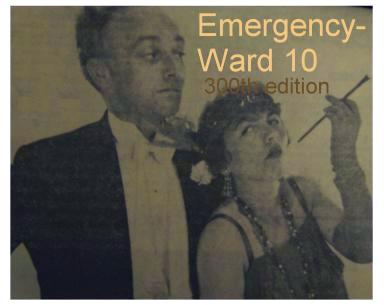
300 (Jan 1st 1960):
with Charles Tingwell, Frederick Bartman, Jill Browne, Barbara Clegg. Peter Howell.
Also
Stephen Hancock,
Jerry Stovin,
Richard Thorp,
John Barron,
Walter Horsbrugh,
Douglas Ives,
Ronnie Hill,
Kerry Marsh,
Yvette Wyatt,
Maureen Beck, and
Denise Hirst (Staff Nurse Gordon).
Script: Rachel Grieve, Jean Scott Rogers, Michael Ashe and Diana Morgan. Director: probably Rex Firkin.
This special three hundredth story was "virtually a revue," an entertainment by the staff.
TV Times revealed that to date 557 actors and actresses had had speaking parts to date, and that there had been eleven directors.
One person to miss this special programme was original creator Tessa Diamond- it was reported she was in South Africa, having been ordered a complete rest by her own doctor.
301 (Jan 5th 1960):
with Charles Tingwell, Jill Browne, Peter Howell.
Also
Jerry Stovin,
John Barron,
Kathleen Byron,
Margo Andrew,
Jennifer Tafler,
Ian Ainsley, and
Fiona Duncan.
Script: Diana Morgan. Director: Peter Sasdy.
302 (Jan 8th 1960):
with Charles Tingwell, Frederick Bartman, Jill Browne.
Also
John Barron,
Joan Newell,
Mary Webster,
Fiona Duncan,
and Betty le Beau (Jacqueline Sablon, a French girl Simon Forrester has picked up in Paris).
Script: Michael Ashe. Director: Peter Sasdy.
303 (Jan 12th 1960):
with Frederick Bartman, Peter Howell.
Also
Margo Andrew,
Ian Ainsley,
Fiona Duncan,
Mary Webster,
Robert MacLeod,
James Land (Bobby Took),
Alan McClelland (Francis Took),
Honora Burke, and
Joan Matheson (Sister Rhys).
Script: Rachel Grieve. Director: Geoffrey Nethercott.
304 (Jan 15th 1960):
with Charles Tingwell, Frederick Bartman.
Also
Richard Thorpe,
Douglas Ives,
James Land,
Alan McClelland, and
Joan Matheson.
Script: Jean Scott Rogers. Director: Geoffrey Nethercott.
305 (Jan 19th 1960):
with Charles Tingwell, Jill Browne.
Also
Jane Downs (Audrey Blake)
Richard Thorpe,
Ian Ainsley,
Fiona Duncan,
Ann Tirard
Pauline Letts (Sandham),
Dorothy Smith (Sister McNab),
Shirley Lawrence (Netley),
Robin Gammell (Dingle), and
Jerry Stovin.
Script: Diana Morgan. Director: Cecil Petty.
306 (Jan 22nd 1960):
with Frederick Bartman, Jill Browne.
Also
Mary Webster,
Jane Downs,
John Brooking,
Fiona Duncan,
James Land,
Ian Ainsley
Alan McClelland,
and
Hedger Walker (Patholgist).
Script: Michael Ashe. Director: Cecil Petty.
307 (Jan 26th 1960):
with Frederick Bartman, Jill Browne.
Also Peter Howell.
And
Fiona Duncan,
Margo Andrew,
James Land,
Stephen Hancock,
Wendy Hutchinson,
Roderick Lovell (Mr Powers), and
Joan Matheson.
Script: Rachel Grieve. Director: Peter Sasdy.
308 (Jan 29th 1960):
with Frederick Bartman.
And
Jane Downs,
James Land,
John Brooking,
Margo Andrew,
Mary Webster,
Joan Matheson, and
Ian Ainsley.
Script: Jean Scott Rogers. Director: Peter Sasdy.
309 (Feb 2nd 1960):
with Jill Browne.
And
Jerry Stovin,
Kathleen Byron,
Walter Horsbrugh,
Pauline Letts,
Doreen Keogh,
Amy Dalby (Mrs Watson), and
Margo Andrew,
Ian Ainsley.
Script: Diana Morgan. Director: Geoffrey Nethercott.
310 (Feb 5th 1960):
with Frederick Bartman, Jill Browne.
And
John Barron,
Kathleen Byron,
Richard Thorpe,
Mary Webster,
Kerry Marsh,
James Land,
Margaret ... (Mrs Daisy Took),
Alastair Speed (Harry Barton), and
Cavan ... (Tony Aight).
Script: Michael Ashe. Director: Geoffrey Nethercott.
311 (Feb 9th 1960):
with Frederick Bartman, Jill Browne.
And
Jerry Stovin,
Jane Downs,
Allan McClelland,
Anna Turner,
Amy Dalby,
Michael Bates (Joe Watson),
Kathleen Michael (Alice Watson),
Gerard Heinz(), and
William Sherwood- he'd played the character Mr Carstairs back in Feb 1959.
Script: Rachel Grieve. Director: Phil Brown.
312 (Feb 12th 1960):
with Frederick Bartman.
Also:
Jerry Stovin,
John Brooking,
Julie Webb,
Jane Downs,
Joan Matheson,
Allan McClelland,
Margaret Denyer (),
James Land,
Gerard Heinz, and
Richard Vernon (Forrester).
Script: Jean Scott Rogers. Director: Phil Brown.
313 (Feb 16th 1960):
with Jill Browne.
Also:
Richard Thorp,
John Barron,
Robert MacLeod,
Jerry Stovin,
Amy Dalby,
Michael Bates,
Alastair Speed,
Mary Law (Anne Franklyn),
Martin Lewis (Watson),
Gretchen Franklin (Mrs Parkin),
John Kelly (Mr Mulvaney) and
Josephine Stuart.
Script: Diana Morgan. Director: probably Rex Firkin.
314 (Feb 19th 1960):
with Frederick Bartman, Jill Browne.
Also:
Richard Thorp,
John Barron,
Alastair Speed,
David Lawton,
John Miller,
... (Deputy Superintendent), and
... (Charles Hignett).
Script: Michael Ashe. Director: probably Rex Firkin.
315 (Feb 23rd 1960):
with Frederick Bartman, Jill Browne.
Also:
John Barron,
Kathleen Byron,
Jerry Stovin,
Mary Law,
Dorothy Smith,
Beatrice Kane (Sister Mills),
Louisa Vaughan (),
Amy Dalby,
Kathleen Michael,
Alastair Speed, and
Ann Zane (Mary Newton).
Script: Rachel Grieve. Director: Peter Sasdy.
316 (Feb 26th 1960):
with Frederick Bartman.
Also:
John Barron,
John Brooking,
Jane Downs,
Dorothy Gordon (Joanne Blake, sister of Audrey),
Margo Andrew,
Kerry Marsh,
Anthony ... (Chaplain),
Janet Barrow (Miss Horne, previously in 204 as a different person),
Dorothy Smith, and
Ann Zane.
Script: Jean Scott Rogers. Director: Peter Sasdy.
317 (Mar 1st 1960):
with Jill Browne.
Also:
John Barron,
Kathleen Byron,
Richard Thorp,
Jane Downs,
Kerry Marsh,
Alastair Speed,
Dorothy Smith,
Beatrice Kane, and
Janet Barrow.
Script: Diana Morgan. Director: Geoffrey Nethercott.
318 (Mar 4th 1960):
with Frederick Bartman, Jill Browne.
Also:
John Barron,
Kathleen Byron,
Richard Thorp,
Jerry Stovin,
Mary Webster,
Walter Horsbrugh,
Alastair Speed, and
Pauline Letts.
Script: Michael Ashe. Director: Geoffrey Nethercott.
319 (Mar 8th 1960):
with Jill Browne.
Also:
John Barron,
Kathleen Byron,
Richard Thorp,
Robert MacLeod,
Joan Matheson,
Martin Lewis,
Kathleen Michael,
Michael Bates,
Alastair Speed,
John Miller, and
Barbara Archer (Susan Clay, Mrs de la Roux's helper, a kleptomaniac).
Script: Rachel Grieve. Director: James Ferman.
320 (Mar 11th 1960):
with
Jerry Stovin,
Mary Law,
Gretchen Franklin,
Robert MacLeod,
Kerry Marsh,
Douglas Ives, and
Annabelle ...(Sister).
Script: Jean Scott Rogers. Director: Rex Firkin (probably).
321 (Mar 15th 1960):
with Jill Browne.
Also:
Richard Thorp,
Michael Bates,
Kathleen Michael,
Robert MacLeod,
Joan Matheson,
Mary Webster,
Margo Andrew,
Alastair Speed,
Arnold Bell (Mr Barton),
Joan ... (Mrs Syme), and
Mary Hignett (Mrs Marjorie Chapman).
Script: Diana Morgan. Director: Peter Sasdy.
322 (Mar 18th 1960):
with Jill Browne.
Also:
Richard Thorp,
Michael Bates,
Kathleen Michael,
Robert MacLeod,
Barbara Archer,
Gillian ... (Staff Nurse Brewer),
Alastair Speed,
John Forbes... (Dr Edward Willis),
Mary ... (Edna Pirbeck),
Mary Hignett, and
Olive... (Anne Clay).
Script: Michael Ashe. Director: Peter Sasdy.
323 (Mar 22nd 1960):
with Jill Browne.
Also:
Richard Thorp,
Robert MacLeod,
John Brooking,
Jane Downs,
Joan Matheson,
Julie Webb,
Arnold Bell,
Alastair Speed,
Dorothy Gordon,
Mary Hignett and
Maureen Moore (Nurse White). Note: in real life Maureen Moore went on to marry Richard Thorp.)
Script: Rachel Grieve. Director: Geoffrey Nethercott.
324 (Mar 25th 1960):
with Frederick Bartman.
Also:
John Barron,
Richard Thorp,
Jane Downs,
Margo Andrew,
Joan Matheson,
Dorothy Gordon,
Maureen Moore,
Michael Martin (Alec Hammond), and
Charles Lamb (Mr Hubble).
Script: Diana Morgan. Director: Geoffrey Nethercott.
Note: Bartman returned to the cast after a three week break, even though his leg was in plaster. He had cracked a bone above his ankle while on a skiing holiday in Switzerland.
325 (Mar 29th 1960):
with Frederick Bartman, Jill Browne.
Also:
Richard Thorp,
Jane Downs,
John Brooking,
Kerry Marsh,
Mary Hignett,
Alastair Speed,
Keith Banks (Dr Carpenter),
David Nettheim (Dr John MacDermot).
Alexander Dore (Police sergeant),
Amelia Bayntun (Mrs Ethel Oakley) and
Jackie Moran who was currently singing nightly with her guitar at a restaurant in Beauchamp Place off Brompton Road (Jean Oakley- "swathed in bandages").
Script: Michael Ashe. Director: James Ferman.
326 (Apr 1st 1960):
with Frederick Bartman, Jill Browne.
Also:
John Barron,
Kathleen Byron,
Jane Downs,
Kerry Marsh,
Margo Andrew,
Maureen Moore,
Mary Hignett,
Alastair Speed,
Cicely Hullett (Sister Crawford),
Jackie Moran, and
Amelia Bayntun.
Script: Rachel Grieve. Director: James Ferman.
327 (Apr 5th 1960):
with Jill Browne.
Also:
John Barron,
Jane Downs,
Richard Thorp,
Jerry Stovin,
Rex Graham (Frederick Newton),
David Nettheim,
Cicely Hullett,
John G Heller (George Hamilton Blair),
Penelope Parry (Theatre sister), and
Pat Durkin (Policeman).
Script: Diana Morgan. Director: Peter Sasdy.
328 (Apr 8th 1960):
with Frederick Bartman.
Also:
John Barron,
Jane Downs,
Ann Zane,
Rex Graham,
Jackie Moran,
Amelia Bayntun,
Cicely Hullett, and
John G Heller.
Script: Michael Ashe. Director: Peter Sasdy.
329 (Apr 12th 1960):
with Charles Tingwell, Frederick Bartman, Jill Browne.
Also:
John Barron,
Kathleen Byron,
Richard Thorp,
Joan Matheson,
Robert MacLeod,
Jerry Stovin,
Cicely Hullett, and
Edward Burnham (Dr Danvers White).
Script: Rachel Grieve. Director: John Cooper.
330 (Apr 15th 1960):
with Charles Tingwell, Frederick Bartman, Jill Browne.
Also:
Jerry Stovin,
Richard Thorp,
Jane Downs,
David Nettheim,
Kerry Marsh,
Jackie Moran,
Rex Graham, and
Ann Zane.
Script: Jean Scott Rogers. Director: John Cooper.
331 (Apr 19th 1960):
with Charles Tingwell, Jill Browne.
Also:
Richard Thorp,
Robert MacLeod,
Walter Horsbrugh,
Margo Andrew,
Kerry Marsh,
Joan Matheson,
Maureen Moore,
John Dearth (James MacLeod), and
Annika Wills (Clarissa Wallace).
Script: Diana Morgan. Director: James Ferman.
332 (Apr 22nd 1960):
with Frederick Bartman.
Also:
John Barron,
Richard Thorp,
Jerry Stovin,
Robert MacLeod,
Kerry Marsh,
Maureen Moore,
John Dearth
Jackie Moran, and
Brian Nissen (Dr Ralph Bailey).
Script: Michael Ashe. Director: James Ferman.
333 (Apr 26th 1960):
with Charles Tingwell, Jill Browne.
Also:
John Barron,
Kathleen Byron,
Kerry Marsh,
Cicely Hullett,
David Butler,
Edward Burnham,
Cecil Brock (Patrick O'Sullivan),
Laidman Browne (Mr Jackson), and
Elsie Wagstaff (Miss Digby-in #243 she had played a different person).
Script: Rachel Grieve. Director: Peter Sasdy.
334 (Apr 29th 1960):
with Charles Tingwell, Jill Browne.
Also:
Enid Lindsey,
Douglas Ives,
David Butler,
Kerry Marsh,
Cicely Hullett,
Cecil Brock,
Laidman Browne, and
Elsie Wagstaff.
Script: Jean Scott Rogers. Director: Peter Sasdy.
335 (May 3rd 1960):
with Frederick Bartman, Jill Browne.
Also:
Enid Lindsey,
Margo Andrew,
John Brooking,
Kerry Marsh,
Cicely Hullett,
Gillian Muir (Staff Nurse Brewer),
Jacqueline Moran,
Maya Koumani (Dunstan), and
Edna Petrie (Page, a ward maid).
Script: Diana Morgan. Director: John Cooper.
336 (May 6th 1960):
with Charles Tingwell, Frederick Bartman.
Also:
John Barron,
Richard Thorp,
Kerry Marsh,
Yvette Wyatt,
Cicely Hullett,
Frederick Peisley (Edward Cathcart),
Elsie Wagstaff, and
Cecil Brock.
Script: Michael Ashe. Director: John Cooper.
337 (May 10th 1960):
with Charles Tingwell, Frederick Bartman, and Jill Browne.
Also:
Robert MacLeod,
Brian Nissen,
Joan Matheson,
Cicely Hullett,
Frederick Peisley,
Elsie Wagstaff,
Philip Ray,
(?) Jean Aubrey (Sister),
Erik Chitty (Ignatius Small), and
Ian ... (Dominic Grant).
Script: Rachel Grieve. Director: James Ferman.
338 (May 13th 1960):
with Charles Tingwell, and Jill Browne.
Also:
John Barron,
Jane Downs,
Richard Thorp,
John Brooking,
Enid Lindsey,
Douglas Ives,
Robert MacLeod,
Brian Nissen,
Joan Matheson,
Laidman Browne, and
Erik Chitty.
Script: Jean Scott Rogers. Director: James Ferman.
339 (May 17th 1960):
with Frederick Bartman, and Jill Browne.
Also:
John Barron,
Kathleen Byron,
Richard Thorp,
Maureen Moore,
Valerie Gearon (Lewis),
Cicely Hullett,
Elsie Wagstaff,
Kerry Marsh,
Annika Wills, and
Betty Cooper (Miss Roberts).
Script: Diana Morgan. Director: Rex Firkin.
340 (May 20th 1960):
with Charles Tingwell, Frederick Bartman.
Also:
Jane Downs,
John Brooking,
Robert... (Wilson)
Yvette Wyatt,
HM Beaufoy Milton (Henry Smith),
Larry ... (Stag Stanley),
Martin ... (Bill Hankin), and
Jonathan ... (Leonard Hankin).
Script: Michael Ashe. Director: Rex Firkin.
341 (May 24th 1960):
with Charles Tingwell, Frederick Bartman, Jill Browne and (now given star status) Jane Downs.
Also:
John Barron,
Richard Thorp,
John Brooking,
Elsie Wagstaff,
Frederick Peisley,
Edward Burnham,
Erik Chitty,
Roderick ... (Mr Bridges), and
Annette ... (Miss Penrose).
Script: Rachel Grieve. Director: John Cooper.
342 (May 27th 1960):
with Charles Tingwell, Jill Browne and Jane Downs.
Also:
John Barron,
Kathleen Byron,
Enid Lindsey,
John Brooking,
David Butler,
Yvette Wyatt,
Margo Andrew,
Erik Chitty, and
Betty Cooper.
Script: Jean Scott Rogers. Director: John Cooper.
343 (May 31st 1960):
with Frederick Bartman and Jane Downs.
Also:
John Barron,
Kathleen Byron,
Judith Furse (Octavia Spriggs)
Brian Nissen,
Valerie Gearon,
Barbara Archer,
Cicely Hullett,
Margaret Elliot (Staff Nurse Withers),
Jane Tann (Mrs Popplewell), and
Betty Cooper.
Script: Diana Morgan. Director: James Ferman.
344 (June 3rd 1960):
with Charles Tingwell, Frederick Bartman and Jill Browne.
Also:
John Barron,
Kathleen Byron,
Erik Chitty,
Judith Furse,
Barbara Archer, and
Ronald ... (Dr Jimmie Dickson).
Script: Michael Ashe. Director: John Cooper.
345 (June 7th 1960):
with Jill Browne and Jane Downs.
Also:
Brian Nissen,
Margaret Elliot,
John Kelly,
John Morris (Mr Barraclough),
Elizabeth James (Mrs Barraclough),
Noel Dryden (Dr Napper),
Langton Jones (Jimmy Driver),
Junia Crawford (Nurse), and
Richard Merson (Ambulance Man).
Script: Rachel Grieve. Director: Peter Sasdy.
346 (June 10th 1960):
with Charles Tingwell, Frederick Bartman and Jane Downs.
Also:
John Barron,
Kathleen Byron,
John Brooking,
Barbara Archer,
Anne Zane,
Betty Cooper,
Cicely Hullett,
Elizabeth Shepherd (Nurse Virginia Birley),
Sheila Doughty (Mrs Rayner) and
Robert Checksfield (Angus de la Roux).
Script: Diana Morgan. Director: Peter Sasdy.
347 (June 14th 1960):
with Charles Tingwell, Frederick Bartman and Jill Browne.
Also:
Richard Thorp,
Brian Nissen,
Judith Furse,
Erik Chitty,
Elizabeth Shepherd,
Barbara ... (Sister Pyatt),
Miranda Connell (Nurse Pat Dimble),
John W... (George Jimpson), and
Howard Pays (Jim Dobson).
Script: Michael Ashe. Director: John Cooper.
348 (June 17th 1960):
with Frederick Bartman, Jill Browne and Jane Downs.
Also:
Richard Thorp,
Brian Nissen,
Erik Chitty,
Valerie Gearon,
Judith Furse,
Elizabeth Shepherd,
Yvette Wyatt,
Patricia L... (Theatre sister), and
Margaret Withers (Mrs Pomfret).
Script: Rachel Grieve. Director: John Cooper.
349 (June 21st 1960):
with Charles Tingwell and Jane Downs.
Also:
Richard Thorp,
John Brooking,
Margo Andrew,
Erik Chitty,
Cicely Hullett,
Yvette Wyatt,
James Copeland (Cyril Simpson),
John Warwick (Rev Humphrey Pomfret), and
Margaret Withers.
Script: Diana Morgan. Director: James Ferman.
350 (June 24th 1960):
with Charles Tingwell and Frederick Bartman.
Also:
Richard Thorp,
Brian Nissen,
Kerry Marsh,
Elizabeth Shepherd,
James Copeland,
Rodney Burke (Jeremy Seymour),
Jocelyn James (June Seymour),
Jeremy Longhurst (Kit Simpson), and
Stephanie Voss (Nurse Mary Pratt).
Script: Michael Ashe. Director: James Ferman.
351 (June 28th 1960):
with Charles Tingwell, Frederick Bartman and Jane Downs.
Also:
Desmond Carrington,
Richard Thorp,
Robert MacLeod,
Joan Matheson,
Cicely Hullett,
Margaret Withers,
Elizabeth Shepherd,
Rodney Burke, and
Gladys Dawson (Mann).
Script: Rachel Grieve. Director: Peter Sasdy.
352 (July 1st 1960):
with Jane Downs.
Also:
Brian Nissen,
Yvette Wyatt,
Peter Hobbes (Mr Rayner),
David Brierley (Ted Carr),
Gillian Eddison (Dental Nurse),
Michael Crawford (Brian Kennedy),
Gillian Goodman (Linda Dawkins),
Prudence Hyams (Mrs Heath),
Fred Ferris (Mr Griffiths), and
Olga Dickie (Mrs Dawkins).
Script: Jean Scott Rogers. Director: Peter Sasdy.
353 (July 5th 1960):
with Charles Tingwell, Frederick Bartman, and Jane Downs.
Also:
Richard Thorp,
Desmond Carrington,
Robert MacLeod,
Joan Matheson,
James Copeland,
Jeremy Longhurst, and
Christopher Beeny (Nicholas Rhys).
Script: Diana Morgan. Director: James Ferman.
354 (July 8th 1960):
with Charles Tingwell, and Frederick Bartman.
Also:
Brian Nissen,
Kerry Marsh,
Elizabeth Shepherd (who appeared on the front cover of TV Times that week, alongside Frederick Bartman),
Rodney Burke,
James Copeland,
Jeremy Longhurst,
Tonie MacMillan (Thel Simpson),
Stephanie Voss, and
Jack Howarth (Bertie Walsall).
Script: Michael Ashe. Director: James Ferman.
355 (July 12th 1960)
With Frederick Bartman, Jill Browne, and Jane Downs.
Also:
Richard Thorp,
Brian Nissen,
Elizabeth Shepherd,
Philip Ray,
Robert MacLeod,
Joan Matheson,
Roderick Lovell,
Erik Chitty,
Rodney Burke and
John Dunbar (Dr Webster).
Script: Rachel Grieve. Director: John Cooper.
356 (July 15th 1960)
With Charles Tingwell, Jill Browne, and Jane Downs.
Also:
Richard Thorp,
Philip Ray,
Yvette Wyatt,
David Brierley,
Brenda Saunders (Mrs Smith),
and
Eddie Malin (Mr Hunt).
Script: Jean Scott Rogers. Director: John Cooper.
357 (July 19th 1960):
with Frederick Bartman.
Also:
Richard Thorp,
Brian Nissen,
Robert MacLeod,
Elizabeth Shepherd,
Marla Landi (Aurora Chase),
Tony Tanner (Jimmy Conners),
Rex Garner (Julian Wedderburn-Lane, a theatrical agent),
Endre Muller (Howard B Schloer),
Peggy Simpson (Sister Demayne) and
Joe Robinson (Dale Brookwood).
Script: Diana Morgan. Director: Peter Sasdy.
Note: Marla Landi played a flashy film star, taken ill on set. She has eye trouble, but also causes trouble among the male staff, turning the heads of the young houseman as well as the middle aged consultant.
358 (July 22nd 1960):
with Jill Browne and Frederick Bartman.
Also:
Desmond Carrington,
Elizabeth Shepherd,
Simon Lack (Mr Lawrence Harper),
Edith Sharpe,
Margaret Withers,
Jeremy Longhurst,
John Downing (Hamish Lindsey),
Jill Booty (Joan Lawson), and
Colin Campbell (Michael Pomfret).
Script: Michael Ashe. Director: Peter Sasdy.
359 (July 26th 1960):
with Charles Tingwell, Frederick Bartman, Jill Browne, and Jane Downs.
Also:
Desmond Carrington,
Elizabeth Shepherd,
Yvette Wyatt,
Gillian Muir,
John Downing,
Jill Booty,
Nancy Mitchell (Mrs Murdoch),
Maurice Hedley (Colonel Bretherton),
and Joan Ingram (Lady Smith).
Script: Rachel Grieve. Director: Rex Firkin.
360 (July 29th 1960):
with Charles Tingwell, Frederick Bartman, Jill Browne, and Jane Downs.
Also:
Desmond Carrington,
Elizabeth Shepherd,
Gillian Muir,
John Downing,
Jill Booty,
Nancy Mitchell,
Maurice Hedley, and
John Baker (Man in shop).
Script: Jean Scott Rogers. Director: Rex Firkin.
Note: Frederick Bartman left the series after this programme. (He'd already left once before in October 1958.) But he did return again in October 1962.
361 (Aug 2nd 1960):
with Jane Downs.
Now with Richard Thorp in a starring part.
Also:
Robert MacLeod,
Yvette Wyatt,
Maurice Hedley,
John Barrie (as Mr Miller- at the end of 1959 he'd played a different part),
Gwenda Ewen (Catherine Frazer), and
Vivian Pickles (Nurse Greer).
Script: Rachel Grieve. Director: James Ferman.
362 (Aug 5th 1960):
with Charles Tingwell, Jill Browne, Jane Downs.
and Richard Thorp.
Also:
Desmond Carrington,
Robert MacLeod,
Jill Tracey (Margery Lomax),
Viola Keats (Mrs Lomax),
Cicely Hullett,
Maureen Moore,
John Barrie,
Gwenda Ewen,
and Kerry Marsh.
Script: Diana Morgan. Director: James Ferman.
The first romance between members of the cast occurred in 1960 when Richard Thorp, who played John Rennie, married Maureen Moore who was Nurse White. Ironically producer Rex Firkin allegedly told them, "there'll be no flirting in the programme." In fact, the scripts "decreed that Maureen will flirt with everyone except Richard!" Firkin explained, "Maureen gives the impression of being a butterfly."
363 (Aug 9th 1960):
with Charles Tingwell, and Jill Browne
and Richard Thorp.
Also:
Robert MacLeod,
Mary Mackenzie (Pauline Brent),
Jill Tracey,
Gwenda Ewen,
Kerry Marsh and
Bunny May (Jim Harper).
Script: Michael Ashe. Director: John Cooper.
364 (Aug 12th 1960):
with Jill Browne and Richard Thorp.
Also:
Desmond Carrington,
Brian Nissen,
Robert MacLeod,
John Krooking,
Kerry Marsh, and
Maureen Moore.
Script: Rachel Grieve. Director: John Cooper.
365 (August 16th 1960)
With Charles Tingwell, Jill Browne, Jane Downs and Richard Thorp.
Also:
John Barrie (RSO Miller),
Kerry Marsh,
John Brooking,
Mary Mackenzie (Pauline Brent),
Bunny May (Jim Harper),
Viola Keats (Mrs Lomax),
David Cole (Gupta Upidore Travancore Sitje) and
Enid Lindsey.
Script: Diana Morgan. Director: Rex Firkin.
366 (August 19th 1960)
With Charles Tingwell and Jane Downs.
Also:
John Barrie,
Desmond Carrington,
Kerry Marsh,
Robert MacLeod,
John Brooking,
Mary Mackenzie,
Bunny May,
Viola Keats,
Maureen Moore, and
Patrick Connor (Mr Harper).
Script: Michael Ashe. Director: Rex Firkin.
367 (August 23rd 1960)
With Charles Tingwell, Jill Browne, Jane Downs and Richard Thorp.
Also:
John Brooking,
David Cole,
George Howe (Mr Richardson),
Coral Atkins (Marlene Jones, a bride),
Harvey Ashby (Mr Pringle), and
Roderick Cook (Mick).
Script: Rachel Grieve. Director: James Ferman.
Note: Coral Atkins appeared wearing a Baby Doll wedding dress
368 (August 26th 1960)
With Jill Browne and Richard Thorp.
Also:
Kerry Marsh,
Mary Hinton (Mrs Rennie),
David Cole,
Joan Matheson,
Harvey Ashby,
Henry Vidon (Vyvyan Lacey), and
Gwenda Ewen (Catherine Frazer).
Script: Diana Morgan. Director: James Ferman.
369 (August 30th 1960)
With Charles Tingwell, Jill Browne, Jane Downs and Richard Thorp.
Also:
John Barrie,
Desmond Carrington,
Mary Mackenzie,
Erik Chitty,
John Brooking,
Henry Vidon,
and Mike Hall (Guy Finnay).
Script: Michael Ashe. Director: John Cooper.
370 (September 2nd 1960)
With Charles Tingwell, Jane Downs and Richard Thorp.
Also:
John Barrie,
Brian Nissen,
Walter Horsbrugh,
Geoffrey Adams (pathologist, earlier in 1958 named as Dr Darren), and
John Wood (George Beringer).
Script: Rachel Grieve. Director: John Cooper.
371 (September 6th 1960)
With Charles Tingwell, Jill Browne, Jane Downs and Richard Thorp.
Also:
Desmond Carrington,
David Cole,
Gillian Muir (Staff Nurse Brewer),
Kerry Marsh,
Michael Bilton (George Beringer),
Ann Way (Phyllis Fielding),
John Longden (J Maxwell Rennie), and
Ann Patrick (Staff Nurse Brown).
Script: Diana Morgan. Director: Rex Firkin.
372 (September 9th 1960)
With Charles Tingwell, Jill Browne, and Richard Thorp.
Also:
Desmond Carrington,
Walter Horsbrugh,
Michael Bilton,
Ann Way,
John Longden,
Frank Shelley (Dr Moon), and
David Butler (Nick Williams).
Script: Michael Ashe. Director: Rex Firkin.
Producer Rex Firkin left the series after this programme, the new producer was Hugh Rennie.
373 (September 13th 1960) With Jane Downs. Also: John Barrie, Desmond Carrington, Peter Howell, Brian Nissen, Ann Way, Hal Dyer (Eunice Harrison), Neil Wilson (Jim, ambulance driver), Edmond Bennett (Sam, his co-driver), and Thomas Heathcote (Mr Mackie). Script: Rachel Grieve. Director: James Ferman.
374 (September 16th 1960) With Charles Tingwell, Richard Thorp, Jill Browne and Jane Downs. Also: John Barrie, Peter Howell, Mary Hinton, John Longden, Robert MacLeod, Thomas Heathcote, Brian Hankins (William Denton), Alan Browning (Norman Early) and Sheila Wynn (Sister in polio unit). Script: Diana Morgan. Director: James Ferman.
375 (September 20th 1960) With Charles Tingwell, Richard Thorp, Jill Browne and Jane Downs. Also: Peter Howell, Brian Nissen, John Longden, Yvette Wyatt, Thomas Heathcote, Alan Browning, and Margo Andrew. Script: Jean Scott Rogers. Director: John Cooper.
376 (September 23rd 1960) With Jill Browne and Richard Thorp. Also: Peter Howell, John Longden, Yvette Wyatt, Thomas Heathcote, Ann Way, and Michael Bilton. Script: Michael Ashe. Director: John Cooper.
377 (September 27th 1960) With Charles Tingwell and Jane Downs.
Also: John Barrie, Desmond Carrington, Peter Howell, John Longden,
Hal Dyer, Alan Browning,
Murray Hayne (Nigel S Harcourt), and Edward Harvey (Radiologist later identified as Dr Clarke). Script: Rachel Grieve.
378 (September 30th 1960) With Charles Tingwell, Jill Browne, Richard Thorp and Jane Downs.
Also: John Barrie, Mary Hinton, John Longden,
Alan Browning,
Murray Hayne, Yvette Wyatt, Robert MacLeod, and Tommy Godfrey (Ernest Begg). Script: Diana Morgan.
381 (October 11th 1960)
With Jane Downs.
Also:
John Barrie,
Desmond Carrington,
Robert Macleod,
Brian Nissen,
Rory MacDermot (Ronald Thornton),
Dorothy Smith,
Edgar Wreford (Dr Cooper), and
Anne Jameson (Daisy Milne).
Script: Rachel Grieve. Director: John Cooper.
382 (October 14th 1960)
With Jill Browne.
Also:
John Barrie,
Desmond Carrington,
John Barron,
Kathleen Byron,
Beatrice Kane,
Ann Zane (Mrs Newton),
Marjorie Lawrence (Pat Thornton),
Rory MacDermot,
Anne Jameson,
William Forbes (Mr Spettigue), and
Louise Dunn (Nurse Lorna Price).
Script: Diana Morgan. Director: John Cooper.
383 (Oct 18th 1960):
Douglas Ives (as Potter the porter) returned to the cast after an absence of five months (last appearance in #338).
Cast also included Ann Firbank (Miss Mary Nesbitt), the new hospital almoner
385 (Oct 25th 1960):
with Charles Tingwell, Jane Downs and
also
Peter Howell,
John Barrie,
Cicely Hullett,
Julia Foster (Anne Carson),
Katy Wild (Eileen Crawley),
Vera Lennox (Mrs Crawley),
Carole Ann Ford (Miss ffoulkes),
Patricia Haines (Miss Spinks), and
Malcolm Russell (Mr Amberson).
Script: Diana Morgan. Director: Hugh Rennie.
386 (Oct 28th 1960):
with
Margo Andrew,
John Barrie,
Julia Foster,
Stephen Hancock,
Murray Hayne,
Katy Wild,
Louise Dunn (Lorna Price),
David Rose (Tom Barrow), and
Ann Firbank.
Script: Jean Scott Rogers. Director: Hugh Rennie.
387 (Nov 1st 1960):
with Charles Tingwell, Jill Browne, Jane Downs.
Also:
Desmond Carrington,
Peter Howell,
Margo Andrew,
Stephen Hancock,
Enid Lindsey,
Louise Dunn, and
Sean Barrett (Martin Cole).
Script: Michael Ashe. Director: Geoffrey Stephenson.
388 (Nov 4th 1960):
with Charles Tingwell, Jane Downs.
Also:
Margo Andrew,
Ann Firbank,
Katy Wild,
Patricia Haines,
Janet Joy (Miss Faulkner),
Eileen Devlin (Mrs MacPhail),
Terence Soall (Mr Palgrave),
Lucy Griffiths (Mrs Crane),
and Susan Lyall Grant (Lily Barrow).
Script: Diana Morgan. Director: Geoffrey Stephenson.
389 (Nov 8th 1960):
with Charles Tingwell, Jill Browne, Jane Downs.
Also:
Brian Nissen,
Yvette Wyatt,
Christine Lander (Mrs Grierson),
Shelagh Fraser (Brownie Bevan),
Ann Firbank,
David Rose,
Olwen Brookes (Mrs Gregory),
and Anthony Woodruff (Chaplain).
Script: Jean Scott Rogers. Director: James Ferman.
390 (Nov 11th 1960):
with Jill Browne, Jane Downs.
Also:
Peter Howell,
Desmond Carrington,
Julia Foster,
Lucy Griffiths,
Robert Macleod,
Brian Nissen,
Yvette Wyatt, and
Shelagh Fraser.
Script: Michael Ashe. Director: James Ferman.
391 (Nov 15th 1960):
with Charles Tingwell, Jill Browne, Jane Downs and Richard Thorp.
Also:
Margo Andrew,
David Rose,
Susan Lyall Grant,
Julia Foster,
Katy Wild,
Sean Barrett,
Lucy Griffiths,
Erica Houen- not seen since the end of 1958, and
Shelagh Fraser.
Script: Diana Morgan. Director: John Cooper.
392 (Nov 18th 1960):
with Jane Downs.
Also:
Peter Howell,
Robert MacLeod,
Shelagh Fraser
Murray Hayne,
Douglas Ives,
Malcolm Russell,
Edward Harvey,
Rosemary Dorken (Sister Maddock), and
Tracy Reed (Primrose Ainley).
Script: Jean Scott Rogers. Director: John Cooper.
393 (Nov 22nd 1960):
with Charles Tingwell, and Jill Browne.
Also:
Peter Howell,
Robert MacLeod,
Shelagh Fraser,
Donald Bissett (Mr Benson),
Stephen Hancock,
Alister Williamson (Dr Rospin),
Ann Firbank, and
Malcolm Russell,
Script: Michael Ashe. Director: Geoffrey Stephenson.
394 (Nov 25th 1960):
with Charles Tingwell, Jane Downs, Richard Thorp, and Jill Browne.
Also:
Peter Howell,
Desmond Carrington,
Robert MacLeod,
John Brooking,
Dorothy Gordon,
Eileen Devlin,
Anthony Woodruff,
Louise Dunn, and
Patricia Haines.
Script: Diana Morgan. Director: James Ferman.
395 (Nov 29th 1960):
with Charles Tingwell, Jill Browne, Jane Downs and
and Richard Thorp.
Also:
Peter Howell,
Brian Nissen,
Peggyann Clifford (Miss Chapham- she had appeared as a different character in an earlier programme, #89),
Ann Firbank,
Julia Foster,
James Dyrenforth (Professor Broom),
Bessie Love (Mrs Broom), and
Brian Oulton (RW Smith).
Script: Jean Scott Rogers. Director: James Ferman.
396 (Dec 2nd 1960):
with Richard Thorp.
Also:
Edward Harvey,
Shelagh Fraser,
Douglas Ives,
Ann Firbank,
Margo Andrew,
John Brooking,
Donald Bissett, and
Brian Oulton.
Script: Michael Ashe. Director: John Cooper.
397 (Dec 6th 1960):
with Charles Tingwell, Jill Browne, Jane Downs and Richard Thorp.
Also: Glyn Owen.
And:
Yvette Wyatt,
Shelagh Fraser,
Ronnie Hill,
Brian Nissen,
Brian Oulton,
Gerard Heinz (Mr Mozart), and
Roderick Griifth (Naunton-Owen).
Script: Diana Morgan. Director: John Cooper.
398 (Dec 9th 1960):
with Jill Browne, Richard Thorp, and Desmond Carrington (now back again with star status).
And:
Yvette Wyatt,
Shelagh Fraser,
Lola Brooks (Christine Baxter),
David Webb (Tony Baxter),
Brian Nissen,
Robert MacLeod,
and
Elizabeth Ashley (Celia Wralford-Smith).
Script: Jean Scott Rogers. Director: Geoffrey Stephenson.
399 (Dec 13th 1960):
with Jill Browne, Glyn Owen, Richard Thorp, and Desmond Carrington.
And:
Ray Barrett (Don Nolan),
Lola Brooks,
David Webb,
Brian Oulton,
Margo Andrew,
Naomi Chance (Susan Harrap).
and
Elizabeth Ashley.
Script: Michael Ashe. Director: Geoffrey Stephenson.
400 (Dec 16th 1960):
with
Glyn Owen,
and Desmond Carrington.
And:
Brian Nissen,
Ray Barrett,
Lola Brooks,
Margo Andrew,
Vivian Pickles (Casualty Sister named in the programme as Sister Edwards- earlier she had been Nurse Greer),
Virginia Clay (Mrs Harbottle), and
David Webb.
Script: Rachel Grieve. Director: James Ferman.
401 (Dec 20th 1960):
with
Charles Tingwell,
Jill Browne,
Richard Thorp,
and Desmond Carrington.
And:
Yvette Wyatt,
Ray Barrett,
Shelagh Fraser,
Brian Nissen,
Ronnie Hill,
Vivian Pickles,
and
Douglas Livingstone (Jeremy Scrope).
Script: Diana Morgan. Director: James Ferman.
402 (Dec 23rd 1960):
with
Peter Howell.
And:
Margo Andrew,
Lola Brooks,
Roderick Lovell,
Barbara Leake (Mrs Parry),
Ann Firbank,
Robert MacLeod,
Brian Oulton,
Elizabeth Ashley, and
Naomi Chance.
Script: Jean Scott Rogers. Director: John Cooper.
403 (Dec 27th 1960): with Charles Tingwell, Jane Downs, Jill Browne, Peter Howell and Glynn Owen.
And: Lola Brooks, David Webb, Lewis Wilson (Frank Cattermole), Linda Bathurst (Zoe Faith), Ray Barrett, Henley Thomas (Sandy Lipton), and Louise Dunn. Script: Michael Ashe. Director: John Cooper.
404 (Dec 30th 1960): with Charles Tingwell, Jill Browne, Peter Howell and Richard Thorp.
And: David Butler, Barbara Leake, Yvette Wyatt, Henley Thomas, Roderick Lovell, Lola Brooks, Murray Hayne, and Enid Lindsay. Script: Rachel Grieve. Director: Geoffrey Stephenson.
405 (Jan 3rd 1961):
with
Charles Tingwell,
Jane Downs,
Glyn Owen,
and Desmond Carrington.
And:
David Cole ('Guts' Sitje)
Louise Dunn,
Lola Brooks,
Dorothy Gordon,
David Webb,
Henley Thomas, and
Eileen Atkins (Miss Ariane Spinks).
Script: Diana Morgan. Director: Geoffrey Stephenson.
406 (Jan 6th 1961):
with
Jane Downs,
and Desmond Carrington.
And:
Brian Nissen,
Lola Brooks,
Margo Andrew,
Dorothy Gordon,
David Webb,
Roderick Lovell (Mr Powers),
Rosemary Dorken,
and
Anthony Viccars (Der Needham).
Script: Jean Scott Rogers. Director: Hugh Rennie.
407 (Jan 10th 1961): with Jill Browne, Peter Howell, Glyn Owen, and Desmond Carrington. And:
Ray Barrett, Stephen Hancock, Margo Andrew, Linda Bathurst, Enid Lindsey, Lane Meddick (Frederick Weldon), and Anne Brook (Jill Craig).
Script: Michael Ashe. Director: John Cooper.
408 (Jan 13th 1961):
with
Jill Browne,
Jane Downs,
Peter Howell,
Richard Thorp,
Glyn Owen,
and Desmond Carrington.
And:
Robert MacLeod,
David Butler,
Dorothy Gordon,
Frederick Leister (Bishop of Oxbridge),
and Noel Hood- not seen since 1959,.
Script: Rachel Grieve. Director: John Cooper.
409 (Jan 17th 1961):
with
Jill Browne,
Peter Howell, and
Glyn Owen.
Also:
Yvette Wyatt,
Ray Barrett,
Dorothy Gordon,
John Flint (Professor Hippesley),
James Ray (Jackie Grover),
Annette Whiteley (Gladys Plater), and
Vivian Pickles.
Script: Diana Morgan. Director: Geoffrey Stephenson.
410 (Jan 20th 1961):
with
Glyn Owen.
And:
Brian Nissen,
Ray Barrett,
David Cole,
Louise Dunn,
Ann Firbank,
John Flint,
James Ray,
Annette Whiteley,
Betty England (Mrs Grover), and
Kevin Fraser (Frankie).
Script: Jean Scott Rogers. Director: Geoffrey Stephenson.
411 (Jan 24th 1961):
with
Jill Browne,
Jane Downs,
Peter Howell, and
Glyn Owen.
And:
Robert MacLeod,
David Cole,
Dorothy Gordon,
John Flint,
Anna Cropper (April Sands),
John Kidd (Mr King),
and Trevor Reid (Mr Baker).
Script: Michael Ashe. Director: Hugh Rennie.
412 (Jan 27th 1961):
with
Jane Downs, and
Glyn Owen.
And:
Robert MacLeod,
Dorothy Gordon,
Enid Lindsey,
Anna Turner,
Anna Cropper (April Sands),
Dorothy Summers (Mrs Small),
Anne Brooks, and
Felicity Young (Nurse Gegg).
Script: Rachel Grieve. Director: Hugh Rennie.
413 (January 31st 1961):
With Charles Tingwell, Jill Browne, Peter Howell, Jane Downs and Richard Thorp.
Also:
Dorothy Gordon,
John Flint,
Dorothy Batley (Mrs Hippesley),
Anna Cropper,
Bridget Armstrong (Nurse Protheroe),
John Ringham (George Stuart),
Gerald Holmes (Francis Howard),
and
Tim Parkes (Edward Sedgewick).
Script: Diana Morgan. Director: John Cooper.
414 (Feb 3rd 1961):
with
Jane Downs,
Desmond Carrington,
Richard Thorp, and Peter Howell.
And:
John Barron,
John Flint,
Anna Cropper,
Beckett Bould (Tim Crowther),
John Boxer (Mr Morfett),
Meadows White (Mr Dowling),
Norman Mitchell (Colin Jaffrey), and
Julie Milton (Marian Hooper).
Script: Michael Ashe. Director: John Cooper.
415 (Feb 7th 1961)
With Jill Browne, Peter Howell and Jane Downs.
Also:
Yvette Wyatt,
Hal Dyer,
Ann Firbank (Miss Nesbitt),
John Flint,
Anna Cropper,
Beckett Bould,
Anthony Dawes (Mr Harker) and
Clare Kelly (Irene Hardcastle).
Script: Rachel Grieve. Director: Vivian Matalon.
416 (Feb 10th 1961):
with
Jill Browne, Glyn Owen,
Desmond Carrington, and
Richard Thorp.
And:
Robert MacLeod,
John Flint,
Anthony Oliver (Iorwerth Pritchard),
Mary Jones (Myfanwy Pritchard),
Diana Coupland (Mrs Banks), and
Anne Robson (Staff Nurse Hutton).
Script: Diana Morgan. Director: Vivian Matalon.
417 (Feb 14th 1961):
with
Glyn Owen, Peter Howell,
Desmond Carrington, and
Richard Thorp.
And:
Robert MacLeod,
Ray Barrett,
Anthony Oliver,
Elisabeth Murray (Nurse Mary Cole),
Sally Layng (Sue Cornish),
Vanessa Thornton (Mrs Hare), and
Antonia Moss ('Tricia' Hare).
Script: Michael Ashe. Director: Geoffrey Stephenson.
418 (Feb 17th 1961):
with Jill Browne,
Glyn Owen, Peter Howell, and
Desmond Carrington.
And:
John Flint,
Anthony Oliver,
Beckett Bould,
Sally Layng,
Keith Marsh (Mr Harding),
Andrew Downie (Mr Macintyre), and
Benedicta Leigh (Sister Davies).
Script: Rachel Grieve. Director: Geoffrey Stephenson.
419 (Feb 21st 1961):
with Jill Browne,
Glyn Owen, Peter Howell, Richard Thorp, and
Desmond Carrington.
And:
John Barron,
Anthony Oliver,
Mary Jones,
Anna Cropper,
Rosemary Dorken,
Beatrice Kane,
Richard Mathews (Mr Curtis), and
Dorothea Phillips (Mrs Grimston).
Script: Diana Morgan. Director: John Cooper.
420 (Feb 24th 1961):
with Jill Browne,
Glyn Owen, and
Desmond Carrington.
And:
Ray Barrett,
Frederick Piper (Martin Parrish),
Patricia Plunkett (Joan Parrish),
Donald McKillop (Cedric Hunter),
Diane Aubrey (Mary Sim, in #204 as a different character),
Neil Hallett (Ben Bingle),
Janet Davies (Anne French), and
David King (Desmond French).
Script: Michael Ashe. Director: John Cooper.
421 (Feb 28th 1961):
with Peter Howell, and
Desmond Carrington.
And:
Anthony Oliver,
Mary Jones,
Frederick Piper,
Patricia Plunkett,
Rosemary Dorken,
David Butler,
Richard Mathews, and
Diane Aubrey.
Script: Rachel Grieve. Director: Vivian Matalon.
425 (Mar 14th 1961):
with
Glyn Owen and Peter Howell.
And:
John Barron,
Kathleen Byron,
Ray Barrett,
Anthony Oliver,
Frederick Piper,
Julia Arnall (Helge Short),
Grace Arnold (Mrs Hancock),
Felicity Young, and
Elisabeth Murray.
Script: Diana Morgan. Director: Hugh Rennie.
426 (Mar 17th 1961):
with
Jill Browne, Richard Thorp, Desmond Carrington and Peter Howell.
And:
John Barron,
Kathleen Byron,
Ray Barrett,
Angus Neil (Neill MacDonald),
Julia Arnall, and
Michael Harding (Tom Short).
Script: Michael Ashe. Director: Hugh Rennie.
427 (Mar 21st 1961)
With Jill Browne, Glyn Owen, and Desmond Carrington.
Also:
Ray Barrett,
Brian Nissen,
Kathleen Byron,
Beckett Bould,
Grace Arnold,
Yvette Wyatt,
Felicity Young and
Jaqueline Harrison (Casualty Nurse).
Script: Rachel Grieve. Director: Vivian Matalon.
428 (Mar 24th 1961)
With Jill Browne, Glyn Owen, Desmond Carrington and Richard Thorp.
Also:
John Barron,
Ray Barrett,
Kathleen Byron,
Julia Arnall,
David Ritch (Fred Saunders),
Anne Brooks,
Ann Martin (Nurse Black),
Danvers Walker (Chalfont Brooks), and
Dorothy Edwards (Mrs Ellis).
Script: Diana Morgan. Director: Vivian Matalon.
429 (Mar 28th 1961)
With Glyn Owen, Peter Howell, Desmond Carrington and Richard Thorp. Also: Ray Barrett, Grace Arnold, Danvers Walker, Patrick Connor (Jim Reynolds- in #366 as a different person), Maureen Pryor (Pat Reynolds), John Gray (Ian Reynolds), Frank Pettitt (Harry Jupe) and Sheila Beckett (Mrs Freer).
Script: Michael Ashe. Director: Geoffrey Stephenson
430 (Mar 31st 1961)
With Jill Browne, Glyn Owen, Peter Howell and Desmond Carrington. Also: Ray Barrett, Kathleen Byron, Patrick Connor, Maureen Pryor, David Ritch, Dorothy Edwards, Peter Halliday (Pathologist), Beatrice Kane and Pauline Taylor (Nurse Francis).
Script: Rachel Grieve. Director: Geoffrey Stephenson
431 (Apr 4th 1961):
with
Jill Browne, Glyn Owen, and Peter Howell.
And:
John Barron,
Kathleen Byron,
Desmond Llewelyn (Fergus de la Roux),
Brian Nissen,
Yvette Wyatt,
Pauline Taylor,
Peter Gray (David Marriner),
Julian Forbes (Leslie Parsons), and
Norman Shelley (George Halstead).
Script: Diana Morgan. Director: John Cooper.
432 (Apr 7th 1961):
with
Charles Tingwell, Jill Browne, Richard Thorp, and Desmond Carrington.
And:
Kathleen Byron,
Ray Barrett,
Brian Nissen,
Anne Brooks,
Patrick Connor,
Maureen Pryor,
John Gray, and
Basil Moss (Keith Adam).
Script: Michael Ashe. Director: John Cooper.
435 (Apr 18th 1961):
with
Charles Tingwell, Jill Browne, and Glyn Owen.
And:
Ray Barrett,
Brian Nissen,
Stephen Hancock,
Patrick Connor,
Maureen Pryor,
John Gray,
Basil Moss,
Laidlaw Dalling (Timothy Harker), and
Stafford Byrne (Mr Murray).
Script: Michael Ashe. Director: Geoffrey Stephenson.
436 (Apr 21st 1961):
with Jill Browne, Glyn Owen, Richard Thorp, and Desmond Carrington.
And:
Kathleen Byron,
Desmond Llewelyn,
John Longden (J Maxwell Rennie),
Annette Kerr (Miss Pearson),
Felicity Young,
John Miller,
and
Julia Foster (in #385 she had first appeared as patient Anne Carson with a spinal injury. Now she was applying to train as a nurse).
Script: Rachel Grieve. Director: Geoffrey Stephenson.
440 May 5th 1961: "the de la Roux were reconciled, Dr Rennie took his friends out for a picnic in his new car, and a patient was feeling sorry for herself, and another had a baby girl by Caesarian operation." Director: Geoffrey Stephenson. New producer now: John Cooper.
441 (May 9th 1961):
with Charles Tingwell, Jane Downs, Richard Thorp, and Desmond Carrington.
And:
Dorothy Smith,
Anne Brooks,
Bridget Armstrong (Nurse Protheroe),
Basil Moss,
Fern Warner (Claire Stephens), and
Terence Edmond (Trevor Justine).
Script: Michael Ashe. Director: Geoffrey Stephenson.
442 (May 12th 1961):
with Charles Tingwell, Jill Browne, Jane Downs, Richard Thorp, and Brian Nissen (now with star status).
And:
Robert MacLeod,
David Butler,
Stafford Byrne (Mr Murray),
Anne Brooks,
Joan Frank (Mrs Trimble),
Basil Moss, and
Graham Crowden (Mr Drummond).
Script: Rachel Grieve. Director: Geoffrey Stephenson.
445 (May 23rd 1961):
Synopsis: this showed Nurse Carson staring her preliminary nursing training.
With Charles Tingwell, Richard Thorp, and Desmond Carrington.
And:
David Butler,
Margaret Elliot,
June Peterson (Sister Tutor),
Anne Brooks,
Julia Foster,
Edwina Rendell (Nuse MacKay),
Joan Frank, and
Basil Moss,
Script: Rachel Grieve. Director: Vivian Matalon.
446 (May 26th 1961):
with Charles Tingwell, Jill Browne, Desmond Carrington and Brian Nissen.
And:
Ray Barrett,
Joan Carol (Night sister),
Ann Walford (Rosamund Bailey),
Colette Wilde (Mrs Bryan),
Janet Bruce (Miss Ashton),
Diana Kennedy (Myra Lennard),
Colin Pinney (Maitre d'hotel),
Eileen Atkins and
Erica Rogers (Amanda Ffrench-Thompson).
Script: Diana Morgan. Director: Vivian Matalon.
447 (May 30th 1961):
with Charles Tingwell, Richard Thorp and Brian Nissen.
And:
David Butler,
Anne Brooks,
Felicity Young,
Alister Williamson,
Colette Wilde (Mrs Bryan), and
Janet Bruce.
Script: Michael Ashe. Director: Geoffrey Stephenson.
448 (June 2nd 1961):
with Charles Tingwell, Jill Browne, Brian Nissen and Ray Barrett (now with star billing).
And:
Robert MacLeod,
Joan Matheson,
Felicity Young,
June Peterson,
Julia Foster,
Edwina Rendell,
Colette Wilde (Mrs Bryan), and
Basil Moss.
Script: Rachel Grieve. Director: Geoffrey Stephenson.
449 (June 6th 1961):
with Charles Tingwell and Brian Nissen.
Plus:
Robert MacLeod,
Joan Matheson,
David Butler,
Felicity Young,
Joan Frank,
Richard Burrell (Bill Dunbar), and
Faith Nichols (Phyllis Leyshon).
Script: Diana Morgan. Director: Dinah Thetford.
450 (June 9th 1961):
with Charles Tingwell, Jill Browne, Desmond Carrington and Ray Barrett.
David Butler,
Anne Brooks,
Felicity Young,
Colette Wilde,
Garfield Morgan (Frank Bryan),
Richard Burrell, and
Janet Bruce.
Script: Michael Ashe. Director: Dinah Thetford.
451 (June 13th 1961):
with Jill Browne, Desmond Carrington, Jane Downs, Richard Thorp, Brian Nissen and Ray Barrett.
With:
Anne Brooks,
Kerry Marsh,
Colette Wilde,
Garfield Morgan,
Richard Burrell, and
Simon Prebble (Kenneth Dunbar).
Script: Rachel Grieve. Director: Vivian Matalon.
452 (June 16th 1961):
with Jill Browne, Desmond Carrington, Jane Downs, Richard Thorp, and Ray Barrett. And:
David Butler,
Anne Brooks,
Kerry Marsh,
Colette Wilde,
Garfield Morgan,
Janet Bruce,
Noel Coleman (Prof Ribblesdale), and
Barbara Young (Maida Crosby).
Script: Rachel Grieve. Director: Vivian Matalon.
453 (June 20th 1961):
with Desmond Carrington, Jane Downs, Richard Thorp, and Ray Barrett. Plus
David Butler,
Anne Brooks,
Kerry Marsh,
Richard Burrell,
Simon Prebble,
Jamie Barnes (Martin Danks), and
Margery Mason (Lillie Danks).
Script: Michael Ashe. Director: Geoffrey Stephenson.
454 (June 23rd 1961):
with Jill Browne, Desmond Carrington, and Brian Nissen.
Robert MacLeod,
Dorothy Smith,
William Job (Sam Barton),
Jamie Barnes,
Angela Gouglas (Yvonne Carpenter), and
Anne Leon (Mrs Searle).
Script: Rachel Grieve. Director: Geoffrey Stephenson.
455 (June 27th 1961):
with Jill Browne, Jane Downs and Ray Barrett.
Robert MacLeod,
Kerry Marsh,
Joan Matheson,
William Job,
Susan Stranks (Melanie Barton),
Gabriel Woolf (Robert Emery, "unpopular and unpleasant"),
Jamie Barnes, and
Frank Singuineau (George Nathaniel Wilberforce Lewis).
Script: Diana Morgan. Director: John Cooper.
456 (June 30th 1961):
with Jill Browne, Desmond Carrington and Ray Barrett.
Also
David Butler,
Anne Brooks,
William Job,
Susan Stranks,
Gabriel Woolf,
Jamie Barnes,
Margery Mason,
Angela Douglas, and
Maureen Dormer (Diana Lucan).
Script: Michael Ashe. Director: John Cooper.
457 (July 4th 1961):
with Charles Tingwell, Jane Downs, Desmond Carrington and Ray Barrett.
Also
Kerry Marsh,
William Job,
Gabriel Woolf,
Margaret Elliot,
Anne Leon,
Lindsay Scott-Patton (James Searle),
and
Maureen Dormer (Diana Lucan).
Script: Rachel Grieve. Director: Vivian Matalon.
458 (July 7th 1961):
with Charles Tingwell, Jane Downs, Jill Browne, Desmond Carrington and Brian Nissen.
Also
William Job,
Gabriel Woolf,
Anne Leon,
Lindsay Scott-Patton,
Frank Singuineau,
Ann Walford, and
Peter Lloyd (Radio commentator).
Script: Diana Morgan. Director: Vivian Matalon.
459 (July 11th 1961):
with Charles Tingwell, Jane Downs, Jill Browne, Desmond Carrington, Brian Nissen and Ray Barrett.
Also
Kerry Marsh,
Ann Walford,
Susan Stranks,
Frank Atkinson (Mr Duffy) and
Alan Howard (Colin Mower).
Script: Michael Ashe. Director: Geoffrey Stephenson.
460 (July 14th 1961):
with Jill Browne, Desmond Carrington, and Ray Barrett.
Also
Kerry Marsh,
Gabriel Woolf,
William Job,
Jean Trend (Staff Nurse, later Nurse Webb),
Beckett Bould,
Lindsay Scott-Patton,
Anne Leon,
and
Alan Howard.
Script: Rachel Grieve. Director: Geoffrey Stephenson.
461 (July 18th 1961)
Storyline: the opening of the new accident wing. Set designer Lewis Logan created this new wing in the studio. The biggest ever cast of 22 was assembled for this episode.
These included the stars Charles Tingwell, Jane Downs, Jill Browne, Desmond Carrington, Richard Thorp, Brian Nissen and Ray Barrett.
Also with
Robert MacLeod,
John Barron,
David Butler,
Walter Horsbrugh,
Gabriel Woolf,
William Job,
Enid Lindsey,
Joan Matheson,
Kerry Marsh,
Douglas Ives,
Ann Walford,
Susan Stranks,
Erik Chitty,
Ian Rossiter (Charles York), and
Malcolm Russell (Mayor of Oxbridge, formerly Mr Amberson).
Script: Diana Morgan. Director: John Cooper.
462 (July 21st 1961):
with Jane Downs, and Ray Barrett.
Also
William Job,
Jean Trend,
Anne Brooks,
Colette Wilde,
Roy Purcell (John Forbes),
Julia Jones (Margaret Jones), and
Elsie Arnold (Ellen Miller).
Script: Michael Ashe. Director: John Cooper.
463 (July 25th 1961):
with Charles Tingwell, Jill Browne, and Brian Nissen.
Also
Gabriel Woolf,
Dorothy Smith,
Anna Turner,
Lindsay Scott-Patton,
Elsie Arnold,
Roy Purcell,
Jamie Barnes, and
Angela Douglas.
Script: Rachel Grieve. Director: Vivian Matalon.
464 (July 28th 1961):
with Charles Tingwell, Desmond Carrington, and Richard Thorp.
Also
Kerry Marsh,
Gabriel Woolf,
David Butler,
Anne Brooks,
Jennie Heslewood (Nurse Vane),
Carmen Silvera (Sister Robins),
Jamie Barnes,
Elsie Arnold,
Susan Stranks,
Margery Mason and
Angela Douglas.
Script: Diana Morgan. Director: Vivian Matalon.
465 (Aug 1st 1961):
with Desmond Carrington, Richard Thorp, Ray Barrett and Brian Nissen.
Also
Gabriel Woolf,
William Job,
David Butler,
Anne Brooks,
Elsie Arnold,
Susan Stranks,
and
Eric Dodson (Gordon Cray).
Script: Michael Ashe. Director: Quentin Lawrence.
466 (Aug 4th 1961):
with Charles Tingwell and Desmond Carrington.
Also
William Job,
David Butler,
Anne Brooks,
Anna Turner,
Roy Purcell,
Elsie Arnold,
Susan Stranks,
Stuart Saunders (Roger Grace),
and
June Shaw (Janice Grace).
Script: Rachel Grieve. Director: Quentin Lawrence.
467 (Aug 8th 1961):
with Richard Thorp and Ray Barrett.
Also
Kerry Marsh,
Gabriel Woolf,
Harry Shacklock (Alec Smith),
Brenda Cowling (Mrs Smith),
David Lander (Senor Maximilian Lopez),
Richard Coe (Rupert Blythe-Maddingley),
Doel Luscombe (Police sergeant),
Anna Burden (Miss Tennant),
Mollie Maureen (Mrs O'Connor- over two years earlier she had been Mrs Baker!), and
Douglas Livingstone (Harry Beasley).
Script: Diana Morgan. Director: John Cooper.
468 (Aug 11th 1961):
with Charles Tingwell, Desmond Carrington and Ray Barrett.
Also
Kerry Marsh,
Gabriel Woolf,
William Job,
Dorothy Smith,
Felicity Young,
John Horsley (Dr Misselden),
Roy Purcell,
Harry Shacklock,
Stuart Saunders,
June Shaw, and
Beckett Bould.
Script: Michael Ashe. Director: Bill Stewart.
469 (Aug 15th 1961):
with Jill Browne, Desmond Carrington, Richard Thorp and Ray Barrett.
Also
William Job,
Simone Lovell (Nurse Tressider- unusually, an unpopular nurse, "a real bitter mischief maker"),
Roy Purcell,
Elsie Arnold,
Harry Shacklock,
Stuart Saunders,
June Shaw,
Kim Tracey (Charlotte Lee), and
Edina Ronay (Veronica Hailey).
Script: Diana Morgan. Director: Bill Stewart.
470 (Aug 18th 1961):
with Charles Tingwell.
Also
Kerry Marsh,
Gabriel Woolf,
David Butler,
and Anne Brooks.
Script: Rachel Grieve. Director: Geoffrey Stephenson.
473 (Aug 29th 1961):
with Charles Tingwell, Jill Browne, Desmond Carrington, Richard Thorp, Ray Barrett and Brian Nissen.
Also
Robert MacLeod,
Gabriel Woolf,
William Job,
Joan Matheson,
Enid Lindsey,
Tony Garnett (Ronald Jackson),
Philip Garston-Jones (Mr Wentworth), and
Christopher Beeny (Nicholas Rhys).
Script: Diana Morgan. Director: Vivian Matalon.
474 (Sept 1st 1961):
with Charles Tingwell, Jill Browne, Desmond Carrington, Ray Barrett and Brian Nissen.
Also
Robert MacLeod,
Kerry Marsh,
Gabriel Woolf,
William Job,
David Butler,
Robert James (Pathologist),
Natalie Jordan (Mrs Brinton), and
Pamela Barrie (Mary Clark).
Script: Michael Ashe. Director: Vivian Matalon.
475 (Sept 5th 1961):
with Ray Barrett and Brian Nissen.
Also
Robert MacLeod,
Kerry Marsh,
Gabriel Woolf,
William Job,
Joan Matheson,
Simone Lovell,
Roy Purcell,
Stuart Saunders,
June Shaw, and
Tony Garnett.
Script: Rachel Grieve. Director: Dinah Thetford.
476 (Sept 8th 1961):
with Richard Thorp and Ray Barrett.
Also
William Job,
Clifton Jones (Jeremiah Sanders),
Paula Byrne (Frances Whitney),
Felicity Young,
Roy Purcell,
Anne Ridler (Rosemary Forbes),
Stuart Saunders,
June Shaw,
George Roderick (The Great Moroni),
Nuriel Zillah (Lady Eulalie), and
Joan Geary (Mrs Vereker).
Script: Diana Morgan. Director: Dinah Thetford.
Note: Richard Thorp left the series, having been a regular for two years, to star in the spin off Calling Oxbridge 2000 in which he continued to play Dr Rennie.
477 (Sept 12th 1961):
with Charles Tingwell, Jill Browne, Desmond Carrington, Brian Nissen, plus Robert MacLeod now with star billing.
Also
Kerry Marsh,
Gabriel Woolf,
David Butler,
Anne Brooks,
Walter Horsbrugh,
Susan Stranks,
Tony Garnett,
George Roderick (The Great Moroni), and
Lucinda Curtis (Jay Clinton).
Script: Michael Ashe. Director: Geoffrey Stephenson.
478 (Sept 15th 1961):
with Charles Tingwell, Jill Browne, Desmond Carrington and Brian Nissen.
Also
Gabriel Woolf,
Dorothy Smith,
Simone Lovell,
Susan Stranks,
Tony Garnett,
Lucinda Curtis and
Harvey Ashby (Michael Graves).
Script: Rachel Grieve. Director: Geoffrey Stephenson.
479 (Sept 19th 1961):
with Charles Tingwell, Jill Browne, Desmond Carrington, Ray Barrett and Robert MacLeod.
Also
William Job,
Paula Byrne,
Clifton Jones,
Susan Stranks,
George Roderick,
Tony Garnett,
Harvey Ashby, and
Joan Phillips (Mrs Graves, in #262 she played Mrs Masters).
Script: Diana Morgan. Director: Vivian Matalon.
480 (Sept 22nd 1961):
with Charles Tingwell, Jill Browne, Desmond Carrington, Ray Barrett and Robert MacLeod.
Also
Gabriel Woolf,
William Job,
David Butler,
Paula Byrne,
Susan Stranks,
Felicity Young,
George Roderick, and
Lucinda Curtis.
Script: Michael Ashe. Director: Vivian Matalon.
481 (Sept 26th 1961):
with Ray Barrett and Robert MacLeod.
Also
Kerry Marsh,
Gabriel Woolf,
William Job,
David Butler,
Clifton Jones,
Anne Brooks,
Simone Lovell,
Felicity Young,
George Roderick,
Muriel Zillah,
Lucinda Curtis,
Peter Grogatt (Reporter), and
Valerie Croft (Gwen Lloyd).
Script: Rachel Grieve. Director: Dinah Thetford.
482 (Sept 29th 1961):
with Ray Barrett and Robert MacLeod.
Also
Kerry Marsh,
Gabriel Woolf,
William Job,
Paula Byrne,
Susan Stranks,
Felicity Young,
Lucinda Curtis,
Valerie Croft,
Stuart Saunders (now as Inspector Grace) and
Hugh Futcher (Ron Clark).
Script: Diana Morgan. Director: Dinah Thetford.
487 (October 17th 1961)
With Desmond Carrington and Ray Barrett.
Also:
John Barron,
David Butler,
Beatrice Kane,
Richard Wakeley (Henry Bannerman, a younger house anaesthetist),
Ian Fairbairn (George Chaytor),
Lyn Ashley (Pat Eaton),
Nicholas Hawtry (Hugh Eaton),
Anne Padwick (Mrs Stevens),
Christopher Banks (Mr Stevens),
Ann Tempest (Mrs Grimshaw) and
George Little (Mr Grimshaw).
Script: Diana Morgan. Director: John Cooper.
488 (Oct 20th 1961)
With Robert MacLeod and Brian Nissen.
Also:
Kerry Marsh,
Paula Byrne,
Clifton Jones,
Ian Curry (Rev Edward Hardy),
Anna Turner,
Jo Crawford (Nurse Bryan),
John Lee (Mark Dene),
Annette Carell (Elaine Carr),
Margaretta Scott (Miss Davies),
Edward Higgins (Mr Mortlock),
Ricky Felgate (Police Constable)
and
Richard Pescud (Ambulance attendant).
Script: Jean Scott Rogers. Director: Dinah Thetford.
491 (Oct 31st 1961):
with Charles Tingwell, Desmond Carrington, Ray Barrett and Brian Nissen.
Also
Paula Byrne,
Clifton Jones,
Anna Turner,
Jo Crawford,
Douglas Ives,
Anthony Oliver (previously he had been a patient, see #425),
Erik Chitty (another returnee, see #337),
Annette Carell, and
Margaretta Scott.
Script: Jean Scott Rogers. Director: Geoffrey Stephenson.
Note: TV Times noted this was Douglas Ives' first appearance in the programme "since the end of June," though actually it was mid July.
492 (Nov 3rd 1961):
with Charles Tingwell, and Jill Browne.
Also
David Butler,
Alan White (Dick Vernon),
Graham McPherson (James Legge),
Peter Elliott (Frederick Tare)
Damaris Hayman (Monica Tare),
Alison Fraser (Susan Tare), and
Peter Gilmore (Policeman).
Script: Michael Ashe. Director: John Cooper.
493 (Nov 7th 1961)
With Desmond Carrington, Robert MacLeod, Ray Barrett and Brian Nissen.
Also:
Kerry Marsh,
Anne Brooks,
Margo Jenkins (Nurse Lewis-Jones),
Susan Stranks,
Anthony Oliver,
Eric Chitty,
Annette Carell,
Margaret Anketell (Allie Kintyre) and
Norah Blaney (Mrs Roper).
Script: Diana Morgan. Director: Bill Stewart.
494 (Nov 10th 1961)
With Charles Tingwell, Jill Browne, Robert MacLeod, Ray Barrett and Brian Nissen.
Also:
Kerry Marsh,
Paula Byrne,
Susan Stranks,
Anthony Oliver,
Eric Chitty,
Annette Carell,
Margaret Anketell and
Norah Blaney.
Script: Michael Ashe. Director: Bill Stewart.
This was the final programme as the series was brought to an enforced end, due to an Equity strike. It was an odd coincidence that this break proved to be at almost exactly the half way mark of the series.
However with the long strike settled, the series resumed, same times, Tuesdays and Fridays at 7.30pm:
495 (May 8th 1962):
with Charles Tingwell, Jill Browne and Desmond Carrington.
Also
David Butler,
Paula Byrne,
Clifton Jones,
Anne Brooks,
Dorothy Smith,
Anna Turner,
Walter Horsbrugh,
Richard Wakeley,
Anthony Oliver,
Aubrey Richards (Caradoc Barkway-Jones),
John Rolfe (Paul Wright),
Barbara Leigh-Hunt (Madge Wright), and
Tom Mulliss (Fire Inspector).
Script: Diana Morgan. Director: John Cooper?
496 (May 11th 1962):
with Charles Tingwell, Jill Browne and Desmond Carrington.
Also
David Butler,
Paula Byrne,
Clifton Jones,
Dorothy Smith,
Anna Turner,
Walter Horsbrugh,
John Line (Andrew Shaw),
Richard Wakeley,
Anthony Oliver,
Aubrey Richards,
John Rolfe, and
Patsy Smart (Mrs Yardley).
Script: Diana Morgan. Director: Geoffrey Stephenson.
Sister Brindsley thinks she'll probably die from injuries sustained in the last story. Nurse Carole Young faints in the ward as she is facing a break-up of the family at home. Aubrey Richards and Anthony Oliver provided an amusing scene in which they spoofed hypchondriacs and tv hospital dramas
499 (May 22nd 1962):
with Charles Tingwell and Desmond Carrington.
Also
Clifton Jones,
John Line,
Dorothy Smith,
Anne Brooks,
Richard Longman (Dr Hammond),
Anthony Oliver,
Aubrey Richards,
John Rolfe,
Rodney Bewes (Roger Mayne),
Marjorie Somerville (Mrs Mayne), and
Tommy Godfrey (Tom Harris- in #378 as a different character).
Script: Rachel Grieve. Director: Vivian Matalon.
500 (May 25th 1962):
with Charles Tingwell, Jill Browne, Desmond Carrington and Ian Colin (Rupert Marsden).
Also
Clifton Jones,
David Butler,
Kerry Marsh,
Paula Byrne,
Enid Lindsey,
Anne Brooks,
Jean Trend,
William Dysart (David MacLean),
Richard Bidlake (Dr Edward Bryan)
Robert Sansom (Deputy Supt),
Robert Scroggins (Jimmy Sales),
Tommy Godfrey,
Paul Farrell (Tommy Flynn)
Hilda Fenemore (Mary Harper),
John Murray Scott (Priest),
John Walters (Policeman), and
Richard Mayes (Factory manager).
Script: Michael Ashe. Director: Vivian Matalon.
501 (May 29th 1962):
with Jill Browne and Desmond Carrington.
Also
Kerry Marsh,
Paula Byrne,
Anthony Oliver,
Aubrey Richards,
Patsy Smart,
Robert Scroggins,
Philip Stone (Mr Sales)
Vivienne Burgess (Mrs Sales),
Benedicta Leigh and
Robert MacDermot (Radio Announcer).
Script: Rachel Grieve. Director: Geoffrey Stephenson.
502 (June 1st 1962):
with Charles Tingwell, Jill Browne and Desmond Carrington.
Also
Kerry Marsh,
David Butler,
Richard Bidlake,
Dorothy Smith,
Anthony Oliver,
Aubrey Richards,
Patsy Smart, and
Robert Scroggins.
Script: Diana Morgan. Director: Geoffrey Stephenson.
503 (June 5th 1962):
In this story were
David Butler,
John Line,
Anne Brooks,
Aubrey Richards,
Hilda Fenemore,
Geraldine Gwyther (Sister Talbot),
.. (Mr Moon),
.. (Henry Bannerman),
.. (Mr Yardley),
Patsy Smart,
Richard Bidlake,
Robert Scroggins, and
Vivienne Burgess.
Script: not known. Director: Dinah Thetford.
504 (June 8th 1962):
In this story were
Paula Byrne,
Clifton Jones,
Geraldine Gwyther,
Anthony Oliver,
Aubrey Richards,
Patsy Smart,
Robin Ford (Jerry White),
Peter Hoar (Sandy Granger),
Katharine Page (Peggy Granger),
Robert Scroggins, and
Denise Coffey (Nurse).
Script: Rachel Grieve. Director: Dinah Thetford.
505 (June 12th 1962):
with Charles Tingwell and Ian Colin.
Also:
Kerry Marsh,
Paula Byrne,
Clifton Jones,
Dorothy Smith,
William Dysart,
Ann Dickins (Nurse Todd),
Robin Ford,
Sylvia Davies (Dawn Davis),
Maurice Travers (Lennie Powers),
Terence Holland (Reg Bell),
Peter Hoar, and
Katharine Page,
Script: Rachel Grieve. Director: John Cooper.
506 (June 15th 1962):
with Charles Tingwell and Ian Colin.
Also:
David Butler,
Kerry Marsh,
John Line,
Richard Bidlake,
Dorothy Smith,
William Dysart,
Alvys Maben (Olivia Marsden),
Patsy Smart,
Sylvia Davies,
Maurice Travers,
Margaret Carlisle (Mrs Davies) and
Terence Holland.
Script: Rachel Grieve. Director: John Cooper.
507 (June 19th 1962): with Charles Tingwell, Jill Browne and Ian Colin.
Also: Paula Byrne, John Line,
Kerry Marsh, Richard Bidlake,
William Dysart, Patsy Smart, Sylvia Davies, Maurice Travers, and Walter Glennie (Paul Davis). Script: Robert Holmes. Director: Geoffrey Stephenson.
508 (June 22nd 1962): with Jill Browne and Ian Colin.
Also: John Line, Clifton Jones (Jeremiah Sanders), Richard Bidlake,
William Dysart, Ann Dickins, Terence Holland, Sylvia Davies, Walter Glennie, John Sharp (Dudley Bishop) and Harold Lang (Wilfred Adams). Script: Robert Holmes. Director: Geoffrey Stephenson.
509 (June 26th 1962):
with Charles Tingwell and Desmond Carrington.
Also:
John Barron,
Paula Byrne,
Dorothy Smith,
Anna Turner,
Ian Fairbairn,
Beatrice Kane,
Noel Hood- not seen for over a year,
Harold Lang,
John Sharp,
Jean Alexander (Mrs Nicholls), and
Aidan Turner (Mr Nicholls).
Script: Diana Morgan. Director: Dinah Thetford
510 (June 29th 1962):
with Charles Tingwell, Jane Downs, Jill Browne, Desmond Carrington and Ian Colin.
Also:
John Barron,
Kerry Marsh,
Richard Bidlake,
Anna Turner,
Colette Dunne (Nurse, later called Nurse Pat Lyle),
Patsy Smart,
Jean Alexander, and
Barbara Leake (Mrs Beeching, in #402 she had been Mrs Parry).
Script: Diana Morgan. Director: Dinah Thetford
513 (July 10th 1962):
with Charles Tingwell, Jill Browne, Desmond Carrington and Ian Colin.
Also:
John Line,
Paula Byrne,
Kerry Marsh,
Anna Turner,
Enid Lindsey,
Isobel Black (Lucy Marsden),
Brian Wright (Hugh Graves),
Sydney .. (Ernest Welling),
Barbara Leake.
Script: Diana Morgan. Director: Geoffrey Stephenson.
514 (July 13th 1962):
with Charles Tingwell, Jill Browne, Jane Downs, Desmond Carrington and Ian Colin.
Also:
Alvys Maben,
Paula Byrne,
Kerry Marsh,
Richard Bidlake,
Isobel Black,
Barbara Leake,
Eric Francis (Mr Beeching),
Brian Weske (Mr Parkin), and
Charlotte Selwyn (Telephone operator).
Script: Rachel Grieve. Director: Geoffrey Stephenson.
515 (July 17th 1962):
with Desmond Carrington.
John Line,
Paula Byrne,
Richard Bidlake,
Dorothy Smith,
Jean Trend,
Isobel Black,
Thomas Gallagher (Josef Andrenian)
Brenda Kaye (Anthea Gough),
Stuart Saunders Inspector Saunders, in #482 he'd been Insp Grace!),
Brian Wright and
Frederick Farley (Denis Graves).
Script: Robert Holmes. Director: John Cooper.
516 (July 20th 1962):
with Charles Tingwell, Jill Browne and Desmond Carrington.
John Line,
Paula Byrne,
Richard Bidlake,
Kerry Marsh,
Isobel Black,
Thomas Gallagher,
Barbara Leake,
Eric Francis, and
Brenda Kaye.
Script: Diana Morgan. Director: John Cooper.
517 (July 24th 1962)
With Charles Tingwell, Jill Browne, and Ian Colin.
Also:
John Line,
Paula Byrne,
Kerry Marsh,
Benedicta Leigh (Night Sister),
Thomas Gallagher (Mr Andrenian),
Sidney Vivian (Bill Yardley),
Barbara Leake (Mrs Beeching),
Conrad Monk (Douglas Beeching),
Brian Wright (Hugh Graves), and
Frederick Farley (Mr Graves).
Script: Rachel Grieve. Director: Bill Stewart.
518 (July 27th 1962)
With Charles Tingwell, Jill Browne, Desmond Carrington and Ian Colin.
Also:
John Line,
Paula Byrne,
Kerry Marsh,
Richard Bidlake,
Walter Horsbrugh,
Edith Sharpe (Assistant Matron),
Benedicta Leigh,
Barbara Leake,
Frederick Farley.
Script: Robert Holmes. Director: Bill Stewart.
519 (July 31st 1962):
with Jill Browne and Ian Colin.
John Line,
Paula Byrne,
Richard Bidlake,
Kerry Marsh,
Dorothy Smith,
Edith Sharpe,
Barbara Leake,
Elizabeth Saunders (Amanda Beeching),
Simon Lack (Captain Miller- in #358 he'd been a different character),
Gerald Harper (Captain French), and
Irene Prador (Mrs Snell).
Script: Diana Morgan. Director: Geoffrey Stephenson.
520 (Aug 3rd 1962):
with Jill Browne, Desmond Carrington and Ian Colin.
Alvys Mahen (Olivia Marsden),
John Line,
Paula Byrne,
Kerry Marsh,
Roberta Maxwell (Nurse Merritt),
Simon Lack,
Gerald Harper,
Isobel Black,
June Sylvaine (Jenny Shaw) and
Jacky Allouis (Delia).
Script: Rachel Grieve. Director: Geoffrey Stephenson.
521 (Aug 7th 1962):
with Charles Tingwell, and Desmond Carrington.
Plus Kerry Marsh,
Richard Bidlake,
Barbara Leake,
Roberta Maxwell,
Simon Lack,
Gerald Harper,
Isobel Black,
Jacky Allouis,
Robert Lanksheer (Mr Wolfrey), and
Paul Bacon (Mr Parker).
Script: Robert Holmes. Director: Dinah Thetford.
522 (Aug 10th 1962):
with Charles Tingwell, Jill Browne, Desmond Carrington and Ian Colin.
Also:
John Line,
Kerry Marsh,
Jean Trend,
Simon Lack,
June Sylvaine,
John Marquand (Walter Bridgman),
Bee Duffell (Miss Pettifer),
Gay Cameron (Mrs King), and
Jean Hardwicke (Miss Cartwright).
Script: Diana Morgan. Director: Dinah Thetford.
525 (Aug 21st 1962):
with Charles Tingwell, Jill Browne, Desmond Carrington and Ian Colin.
Also:
Alvys Maben,
Paula Byrne,
Jeremy Burnham (Tom Whitney),
Isobel Black,
Douglas Ditta (Sean Veysey),
Anthony Gardner (Desmond Bromilow),
William Morice (Mike),
Richard McNeff (Mr Jilkes), and
Pamela Hewes (Mrs Jilkes).
Script: Diana Morgan. Director: Vivian Matalon.
526 (Aug 24th 1962):
with Jill Browne, and Ian Colin.
Also:
John Line,
Paula Byrne,
Richard Bidlake,
Margaret Elliott (now promoted to Sister Withers),
Kerry Marsh,
Jeremy Burnham,
Delia Corrie (Angela Macgregor),
John Carlin (Angus MacGregor),
Richard McNeff, and
Amanda Coxell (Doreen Jilkes).
Script: Rachel Grieve. Director: Vivian Matalon.
527 (Aug 28th 1962):
with Charles Tingwell, Jill Browne, and Desmond Carrington.
Also:
Paula Byrne,
Kerry Marsh,
Richard Bidlake,
David Butler,
Jeremy Burnham,
June Sylvaine,
Delia Corrie,
Richard McNeff,
Patrick Newell (Dr Drew), and
David Browning (Sgt Wetherby).
Script: Robert Holmes. Director: Philip Dale.
528 (Aug 31st 1962):
with Charles Tingwell, and Jill Browne.
Also:
John Barron,
John Line,
Paula Byrne,
Kerry Marsh,
Richard Bidlake,
Ian Fairbairn,
Jeremy Burnham,
Richard McNeff,
Pamela Hewes,
Nancy Nevinson (Mrs Ricardo), and
Topsy Jane (Mavis Wayne).
Script: Diana Morgan. Director: Philip Dale.
529 (Sept 4th 1962):
with Charles Tingwell, Desmond Carrington and Ian Colin.
Also:
Kerry Marsh,
Richard Bidlake,
Anna Turner,
Patrick Newell,
Jeremy Burnham,
Isobel Black,
Delia Corrie,
John Carlin,
Nancy Nevinson, and
Topsy Jane.
Script: Rachel Grieve. Director: Bill Stewart.
530 (Sept 7th 1962):
with Jill Browne and Desmond Carrington.
Also:
John Line,
Paula Byrne,
Richard Bidlake,
Patrick Newell,
Alan Curtis (Dr Truscott),
Jeremy Burnham,
Isobel Black,
June Sylvaine,
Delia Corrie, and
John Carlin.
Script: Robert Holmes. Director: Bill Stewart.
531 (Sept 11th 1962):
with Charles Tingwell, Jill Browne, Peter Howell, Desmond Carrington and Ian Colin.
Also:
John Line,
Paula Byrne,
Kerry Marsh,
Enid Lindsey,
Jean Trend,
Nancy Nevinson,
Topsy Jane, and
Isobel Black.
Script: Diana Morgan. Director: Vivian Matalon.
532 (Sept 14th 1962):
with Charles Tingwell, Jill Browne, Desmond Carrington and Ian Colin.
Also:
Paula Byrne,
Kerry Marsh,
David Butler,
Richard Wakeley,
Nancy Nevinson,
Topsy Jane,
Isobel Black,
Delia Corrie,
John Carlin and
Judy Geeson (Joanne Phipps) -(Judy's first big tv role).
Script: Roger Marshall. Director: Vivian Matalon.
533 (Sept 18th 1962):
The students' clinical examination is in progress, and some of the patients agree to be examined, but for Joanne Phipps things become rather complicated. Dr Robert Hamilton, soon to go into general practice in the town of Oxbridge, pays a visit to the Residents' Common Room.
With Charles Tingwell.
Also:
Paula Byrne,
Kerry Marsh,
Isobel Black,
Delia Corrie,
John Carlin,
Judy Geeson,
Kenneth Keeling (Dr Robert Shadbolt),
Peter Elliott (Dr KP Rhamajhi),
Geoffrey Frederick (Dr Robert Hamilton),
John Carlisle (Dr Lester Large),
John Alderton (Richard Moone),
Donald Oliver (Derek Moberly), and
Diana Tullis (Jenny Sinclair).
Script: Robert Holmes. Director: Bill Stewart.
534 (Sept 21st 1962): Mavis Wayne is extremely worried about herself. She fears she'll never walk again. Carole Young has a showdown with Andrew Shaw.
With Jill Browne and Desmond Carrington.
Also:
John Line,
Kerry Marsh,
Richard Bidlake,
Nancy Nevinson,
Topsy Jane,
Isobel Black,
Judy Geeson,
John Crocker (Thompson),
Aithene Gover (Miss Wayne),
Zeph Gladstone (Miss Berry), and
John Frawley (Mr Ricardo).
Script: Diana Morgan. Director: Bill Stewart.
537 (Oct 2nd 1962): this story saw the return of Dr Simon Forrester, last seen in #360.
539 (Oct 9th 1962): Dr Chris Anderson is interviewed for a new position at Oxbridge Hospital. Later, he is called to Herbert Love's bedside.
With Charles Tingwell, Jill Browne and Desmond Carrington.
Also:
Paula Byrne,
Richard Bidlake,
Robert Sansom,
Christopher Coli (Donald Pearse),
Arthur Lovegrove (Herbert Love),
Vivienne Drummond (Rosemary Andrews),
Desmond Jordan (Mr Bob Coughlin),
(Sir) Campbell Cotts (Mr Cheyney),
Bill Horsley (Mr Abrahams), and
Christopher Banks (Mr Manders- earlier Banks had played a different charracter).
Script: Robert Holmes. Director: Dinah Thetford.
540 (Oct 12th 1962): Simon Forrester admits a new patient, Philip Ross, Frances Whitney, who is against the move, has words with him.
With Jill Browne and Frederick Bartman.
Also:
John Line,
Paula Byrne,
Kerry Marsh,
Christopher Coli,
Arthur Lovegrove,
Vivienne Drummond,
John Tate (Philip Ross)
Brian ... (Electrician), and
Toni ... (Night Nurse).
Script: Roger Marshall. Director: Dinah Thetford.
541 (Oct 16th 1962):
With Charles Tingwell, Desmond Carrington and Frederick Bartman.
Also:
John Line,
Paula Byrne,
Kerry Marsh,
Dorothy Smith,
Christopher Coli,
Arthur Lovegrove,
Vivienne Drummond,
John Tate,
Ambroisine Philipotts (Lady Arabelle Clooney), and
Louise Vaughan (Miss Pearse).
Script: Roger Marshall. Director: Bill Stewart.
542 (Oct 19th 1962):
With Charles Tingwell, Desmond Carrington and Frederick Bartman.
Also:
Paula Byrne,
Kerry Marsh,
Desmond Jordan,
Richard Bidlake,
John Alderton,
Jean Trend,
John Kidd,
John Tate,
and
Frank Lawless (Mr lucas).
Script: Robert Holmes. Director: Bill Stewart.
543 (Oct 23rd 1962): Herbert Love leaves hospital and Keith Adam is readmitted for a corneal graft. Andrew Shaw and Simon Forrester quarrel in the course of treating Rosemary Andrews, and Forrester tries a spot of his own analysis.
With Charles Tingwell, Jill Browne, Frederick Bartman and Desmond Carrington.
Also:
John Line,
Paula Byrne,
Desmond Jordan,
John Alderton,
Hazel Peters (Nurse Thomas),
Arthur Lovegrove,
Vivienne Drummond, and
Basil Moss.
Script: Robert Holmes. Director: Geoffrey Stephenson.
544 (Oct 26th 1962): A day in Outpatients and various ailments to be treated. Don Pearse returns for a checkup and Alan Dawson attends wrestler Jim Watson.
With Charles Tingwell and Jill Browne.
Also:
Desmond Jordan,
John Alderton,
Pat Nye (Sister Jenkins),
Jessica Cairns (Nurse Winters),
Ilona Rogers (Nurse Sarah Smith),
Christopher Coli,
Carmel McSharry (previously in the series as Mrs Wilson then as Mrs Ford, now as Mrs Singleton!)
Jackie Pallo (Jim Watson),
Edgar K Bruce (Mr Hervey),
Raymond Hodge (Mr Baker),
Barbara Burke (Mrs Litvos),
Nan Braunton (Mrs Mortimer) and
Harry Tardias (Chef).
Script: Roger Marshall. Director: Geoffrey Stephenson.
545 (Oct 30th 1962): Philip Ross returns to Oxbridge and is visited by a girlfriend Claire. He develops symptoms which give cause for alarm and Simon Forrester is called in.
With Jill Browne and Frederick Bartman.
Also:
Paula Byrne,
Kerry Marsh,
Richard Bidlake,
John Alderton,
John Kidd,
Noel Trevarthen (Ian Duncan),
Basil Moss,
John Tate,
Vivienne Drummond,
Jessica Dunning (Claire Benson-Brooke), and
Jerry Duggan (Mr Bagley).
Script: Diana Morgan. Director: Dinah Thetford.
546 (November 2nd 1962): Rosemary refuses to leave the hospital until she has spoken to Simon Forrester.
With Jill Browne, Frederick Bartman and Desmond Carrington.
Also:
John Line,
Paula Byrne,
Kerry Marsh,
Desmond Jordan,
John Alderton,
Basil Moss,
John Tate,
Vivienne Drummond,
Zena ... (Mrs Seldon),
Anne Godley (Emma Forrester), and
Olga ... (Mrs Andrews).
Script: Diana Morgan. Director: Dinah Thetford.
549 (November 13th 1962): Lucky Jones, a Jamaican carpenter, is brought into Casualty, his arm having nearly been severed. Dawson, Shaw and Harrison fight to try to save it. Carole Young discusses her future with Simon Forrester. Mrs Neilson has second thoughts about her baby.
With Charles Tingwell, Jill Browne, Frederick Bartman and Peter Howell.
Also:
John Barron,
John Line,
Paula Byrne,
David Butler,
Kerry Marsh,
John Carlisle,
Earl Cameron (Lucky Jones),
Sylvia Kay (Mrs Neilson), and
Anne Godley.
Script: Diana Morgan. Director: Dinah Thetford.
550 (November 16th 1962): Richard Moone receives bad news. Mrs Singleton has a surprise visitor.
With Jill Browne and Frederick Bartman.
Also:
John Barron,
Paula Byrne,
Kerry Marsh,
Richard Bidlake,
John Alderton,
John Carlisle,
Beatrice Kane,
Earl Cameron,
Sylvia Kay,
Carmel McSharry, and
Geoffrey Alexander (Mr Wardale).
Script: Diana Morgan. Director: Dinah Thetford.
553 (November 27th 1962): Richard Moone talks to Ted Bryan about whether he should give up his career in medicine. The hospital becomes involved in a drama on the Witchester racecourse.
With Charles Tingwell, Jill Browne and Desmond Carrington.
Also:
Kerry Marsh,
Richard Bidlake,
John Alderton,
Jean Trend,
Basil Moss,
Carol Davies (Nurse Bowen),
Gladys Henson (Mrs Horsey),
Geoffrey Matthews (Peter Craig),
Michael Collins (Insp Harris), and
Gordon Richardson (Lenny Silverman).
Script: Roger Marshall. Director: Bill Stewart.
554 (November 30th 1962): Lenny Silverman is being watched by the police. Carole Young is involved in a crisis in Men's Surgical.
With Charles Tingwell, Jill Browne and Desmond Carrington.
Also:
David Butler,
Richard Bidlake,
John Alderton,
Carol Davies,
Earl Cameron,
Michael Collins,
Gordon Richardson and
Richard Klee (Jackie Cole).
Script: Robert Holmes. Director: Bill Stewart.
559 (December 18th 1962)
The prospect of Christmas brings no respite to the hospital. Mrs Horsey has her operation, Mr de la Roux does an emergency, Janet Kendall's knee is still causing concern and young Alec Holmes is admitted with a mysterious illness.
With Charles Tingwell, Desmond Carrington and Jane Downs.
Also:
John Barron,
David Butler,
Kerry Marsh,
John Alderton,
Richard Bidlake,
Pat Nye (Sister Jenkins),
Toni Gilpin (Nurse Southwell),
Gladys Henson,
Maris Tant (Janet Kendall), and
Kenneth Nash (Alex Holmes).
Script: Roger Marshall. Director: Geoffrey Stephenson.
560 (December 21st 1962)
Janet Kendall needs an immediate operation, but the surgeons looking after her receive an unpleasant shock. They have left a mother's attitude out of their calculations. Meanwhile, another young patient is found to have meningitis.
With Jill Brown and Desmond Carrington.
Also:
John Line,
Paula Byrne,
Kerry Marsh,
Richard Bidlake,
Jean Trend (Ann Webb),
Pat Nye,
Gladys Henson,
Maris Tant,
Kenneth Nash,
Sheila Raynor (Mrs Kendall), and
Brian Hankins (Mr Holmes- he played a different character in #374).
Script: Robert Holmes. Director: Geoffrey Stephenson.
561 (December 25th 1962): Christmas Day is celebrated in traditional style by both staff and patients. The staff give a performance of Aladdin.
With Charles Tingwell, Jill Browne, Jane Downs and Desmond Carrington.
Also:
John Barron,
John Line,
Paula Byrne,
David Butler,
Desmond Jordan,
Kerry Marsh,
Richard Bidlake,
John Alderton,
Ilona Rogers,
John Carlisle,
Gladys Henson,
Maris Tant (Janet Kendall),
Kenneth Nash (Alec Holmes),
Brenda Dunrich (Miss Lumley), and
Brian Hankins (Mr Holmes).
Script: Diana Morgan. Director: John Cooper.
562 (December 28th 1962): RSO Shaw tries hard to convince Janet's parents that she needs an operation.
In this story:
John Barron,
John Line,
Paula Byrne,
Kerry Marsh,
Richard Bidlake,
John Alderton,
John Carlisle,
Gladys Henson,
Maris Tant,
Dennis Edwards (Mr Kendall),
Sheila Raynor (Mrs Kendall),
Betty Huntley-Wright (Mrs Gordon) and
Anne Godfrey (Mrs Matthews).
Script: Roger Marshall. Director: John Cooper.
563 (January 1st 1963): It is New Year's Eve in Oxbridge Hospital. Outside, two members of the staff are trying to earn some pin money.
With Jill Browne and Desmond Carrington. Also
John Barron, John Line, Paula Byrne, Walter Horsbrugh, John Alderton, Richard Bidlake, Jean Trend, Carol Davies, Robert Lang (Dr Griffiths), and Alistair Hunter (Mr Nicholson). Script: Robert Holmes. Director: Geoffrey Stephenson.
564 (January 4th 1963): Mr Pritchard, an old patient, brings the promised present sent from Chris Anderson's mother.
With Jill Browne, Desmond Carrington and Peter Howell. Also
John Line, John Alderton, Richard Bidlake, Jean Trend, Carol Davies, Noel Hood, Anthony Oliver- not seen since June 1962, Robert Lang, Peter Du Cros (Col Bright-Waterford), and Bill Thatcher (Georgie Lennard). Script: Diana Morgan. Director: Geoffrey Stephenson.
565 (Jan 8th 1963): Andrew Shaw receives a shock. Ted Bryan tries to patch up the rift between Sally and Richard.
With Jill Browne and Desmond Carrington.
Also
John Line,
Paula Byrne,
Kerry Marsh,
Richard Bidlake,
Jean Trend,
Robert Lang,
Bill Thatcher,
Gillian Hume (Mrs Hope),
Desmond Davies (Alan Jackson),
Susan Trower (Pat Morris),
and
Sarah Long (Moira Fellows).
Script: Roger Marshall. Director: Philip Barker.
566 (Jan 11th 1963): Two unconscious girls present the medical staff with a tricky problem.
With Desmond Carrington.
Also
Desmond Jordan,
Paula Byrne,
John Alderton,
Richard Bidlake,
Dorothy Smith,
Robert Lang,
Bill Thatcher,
Zeph Gladstone (Miss Berry),
Jacqueline Jones (Gladys),
Carol Davies,
Sarah Long, and
Susan Trower.
Script: Robert Holmes. Director: Philip Barker.
575 (Feb 12th 1963): Dr Wallace, the Superintendent, faces important changes in the hospital staff. Mrs de la Roux is worried by a threat.
With Jill Browne.
Also:
John Barron,
Kathleen Byron,
Paula Byrne,
Desmond Jordan,
Richard Bidlake,
John Alderton,
Walter Horsbrugh (Dr Wallace, previously he had been always just been named as the hospital superintendent),
John Carlisle,
Olive McFarland (Margot Clarke),
Arnold Bell (Henry Crane),
Robin Hunter (Lewis Starr), and
Peter Ashmore (Dr Throssell).
Script: Robert Holmes. Director: Bill Stewart.
576 (Feb 15th 1963): Mrs de la Roux causes a sensation at the presentation to Mr Braithwaite. Margot, Clarke's husband, turns up.
With Desmond Carrington.
Also:
John Barron,
Kathleen Byron,
Paula Byrne,
Desmond Jordan,
Hamlyn Benson (Mr Braithwaite),
Susan Richards (Mrs Braithwaite),
Richard Bidlake,
Carol Davies,
Walter Horsbrugh,
Olive McFarland,
David Neal (Dennis Clarke) and
Robin Hunter.
Script: Diana Morgan. Director: Bill Stewart.
577 (Feb 19th 1963): Dick Moone spends his first day on the medical wards. Chris Anderson has a hectic day in the accident wing dealing with anything from a car smash to a man with a fish bone in his throat.
With Jill Browne and Desmond Carrington.
Also:
John Barron,
Desmond Jordan,
Dorothy Smith,
Richard Bidlake,
John Alderton,
John Carlisle,
Jean Trend,
Valerie Sarruf (Elizabeth French an iron lung patient),
Nicholas Pennell (Ben Barnes),
Elizabeth Wallace (Mrs Maugham), and
Kenneth Watson (Bill Barron).
Script: Roger Marshall. Director: Jon Scoffield.
578 (Feb 22nd 1963): A crisis in the operating theatre, a mystery woman in the casualty department, and a threat of scandal.
With Jill Browne and Desmond Carrington.
Also:
John Barron,
Kathleen Byron,
John Line,
Paula Byrne,
John Alderton,
David Butler,
Roderick Lovell (Mr Powers),
Jean Trend,
Arnold Bell,
Elizabeth Wallace,
Kenneth Watson, and
Edna Landon (Mrs Fitch-Bullen).
Script: Robert Holmes. Director: Jon Scoffield.
583 (March 12th 1963): Dr Griffiths' first day as Senior House Officer in the accident wing.
With Desmond Carrington.
Also:
David Butler,
Robert Lang,
Jean Trend,
Benedicta Leigh,
Colette Dunne,
Barry Justice (Roger Harper),
Benjamin Whitrow (Bill Heald),
Elizabeth Forbes (Mrs Woods),
Anthea Holloway (Miss Yates),
Wilfred Carter (Mr Parnell),
William Forbes (Fox), and
John Waite (Warder).
Script: Roger Marshall. Director: Geoffrey Stephenson.
584 (March 15th 1963): Conflict between Dr Bryan and Dr Griffiths. Elizabeth French visits her boyfriend Roger Harper who has just been admitted.
With Jill Browne.
Also:
Paula Byrne,
John Alderton,
Robert Lang,
Jean Trend,
Carol Davies,
Richard Bidlake,
Valerie Sarruf,
Barry Justice,
Nicholas Pennell,
Reginald Pritchard (Mr Burroughs),
Jennie Linden (Judy Sinclair) and
John Downing (as Alan Turner, in #358 he had played a different person).
Script: Robert Holmes. Director: Geoffrey Stephenson.
585 (March 19th 1963): Linda Stanley performs her first emergency operation at the Oxbridge. Elizabeth French solves her problem. Dr Griffiths makes a startling discovery.
With Jill Browne, Desmond Carrington, Paula Byrne (now in a starring role), and Jennifer Wright (Linda Stanley).
Also:
John Line,
John Alderton,
Robert Lang,
Richard Bidlake,
Anna Churcher (Theatre Sister),
Valerie Sarruf,
Barry Justice,
Jennie Linden, and
John Downing.
Script: Diana Morgan. Director: Bill Stewart.
586 (March 22nd 1963): Richard Moone and Sally Bowen make a secret decision. Carole Young is in great pain. Will she be able to keep going?
With Jill Browne, Desmond Carrington, Paula Byrne, and Jennifer Wright.
Also:
John Alderton,
Robert Lang,
Jean Trend,
Richard Bidlake,
Carol Davies,
John Downing,
Alister Smart (Mr Riley),
Joan Heath (Mrs Morton), and
Eva Haddon (Mrs Burton).
Script: Roger Marshall. Director: Bill Stewart.
587 (March 26th 1963): An army troop carrier overturns and for a time the Casualty department is working at full stretch to treat all the injured.
With Jill Browne, Desmond Carrington, and Jennifer Wright.
Also:
John Line,
John Alderton,
Robert Lang,
Jean Trend,
Carol Davies,
John Downing,
Antony Webb (Pte Trotter),
Michael Rothwell (L/Cpl Felix Greene),
Diane Aubrey (Pte Janet Peters- in #204 and #420 she had played different characters), and
Philip Grout (Capt Crane).
Script: Robert Holmes. Director: Phil Brown.
588 (March 29th 1963): Sally Bowen's secret is discovered. Sister Young is admitted as a patient.
With Jill Browne, Peter Howell and Paula Byrne.
Also:
Dorothy Smith,
Ann Firbank (now described as The Almoner),
Richard Bidlake,
Carol Davies,
Rosemary Martin (Nurse Dale),
Pauline Collins (Nurse Elliott),
Illona Rogers (Sarah Smith),
Michael Rothwell,
Derek Tansley (Capt Qm Donelly),
and Aimee Delamain (Miss Edwardes).
Script: Diana Morgan. Director: Phil Brown.
590 (April 5th 1963): A delicate and dangerous artery grafting operation tests the ability of Oxbridge's new consultant surgeon, Linda Stanley. With Jill Browne, Desmond Carrington, Jennifer Wright and Paula Byrne. Also: John Alderton, Robert Lang, David Butler, Marian Diamond (Pauline Roberts),
Aimee Delamain, Derek Tansley. Script: Robert Holmes. Director: Bill Stewart.
591 (April 9th 1963): It is evident that Oxbridge is dividing into two camps, pro and anti Linda Stanley.
With Jill Browne, Desmond Carrington and Jennifer Wright.
Also:
John Line,
Roderick Lovell,
Robert Lang,
Richard Bidlake,
Illona Rogers,
Jean Trend,
Deborah Stanford (Nurse Dickson),
Barbara Ogilvie (Mrs Drummond),
Marian Diamond,
Dixon Adams (Tony Burriss), and
Graham Payn (Mr Pinker).
Script: Diana Morgan. Director: Phil Brown.
592 (April 12th 1963): Frances Whitney takes Chris Anderson to see a house she has her eye on. Lewis Griffiths turns the Accident Wing into a school for medical students.
With Jill Browne, Desmond Carrington and Paula Byrne.
Also:
Robert Lang,
John Alderton,
Patricia Regan (Nurse Warner),
Barbara Ogilvie,
Marian Diamond,
Dixon Adams,
Louise King (Sheree Bretson),
Adrian Ropes (Gordon Truke),
Frank Jarvis (Colin Parish),
Richard Burnett (Henry Fletcher), and
Peggy Aitchison (Doris Fletcher).
Script: Robert Holmes. Director: Phil Brown.
594 (April 19th 1963): With Jill Browne, Desmond Carrington, Jennifer Wright and Paula Byrne. Also: John Alderton, Robert Lang, David Butler, Dorothy Smith, Richard Bidlake, Ilona Rogers, Marian Diamond,
Dixon Adams, Gwynne Whitby (Mrs Roberts), Gordon Harris (Mr Roberts), Gerald Rowland (Timmy Baines), and Ian Curry (previously in #488).
Script: Diana Morgan.
595 (April 23rd 1963): Reaction to the news of Dr Edward Bryan's operation spreads through the hospital- in fact he had died in a dramatic episode of medical incompetence.
With Jill Browne, Desmond Carrington, Paula Byrne and Jennifer Wright.
Also:
Robert Lang,
David Butler,
Enid Lindsey,
Illona Rogers,
Frank Jarvis,
Ewan Roberts (Mr Bentley),
Fred Ferris (Mr Currie), and
Dora Dainton (Mrs Currie).
Script: Basil Dawson. Director: Dennis Vance.
596 (April 26th 1963): A tattooed girl brings variety to Lew Griffiths' work in the Accident Wing.
With Desmond Carrington and Jennifer Wright.
Also:
Robert Lang,
John Alderton,
David Butler,
Ewan Roberts,
Dora Dainton,
Gerald Rowland,
John Wentworth (Dr Dee),
Brian Haines (Mr Wallis),
Geoffrey Hibbert (Mr Furmer),
Elizabeth Murray (Mercia Twillow, in #417 she had been just described as a nurse!), and
Verity Edmett (Louise Short).
Script: Robert Holmes. Director: Dennis Vance.
597 (April 30th 1963)
Dick Moone tries to explain his worry to Sally Bowen.
With Jill Browne, and
John Alderton,
Robert Lang,
Carol Davies (Sally Bowen),
Hazel Peters (Nurse Thomas),
Ewan Roberts (Mr Bentley),
Verity Edmett (Louise Short),
Rick Jones (Mr Bray),
John McBride (Mr Macrory),
Kathleen Feenan (Mrs Pottinger),
Patrick Carter (Mr Pottinger),
and
Lesley Jackson (Mrs Garnett).
Script: Diana Morgan. Director: Phil Brown.
598 (May 3rd 1963)
Dr Griffith's last day at the Oxbridge. Mr Bentley is diagnosed and the result causes both alarm and great interest.
With Jill Browne, Paula Byrne, Jennifer Wright and
John Alderton,
Robert Lang,
David Butler,
Carol Davies,
Geoffrey Adams - I think this was his first appearance as Dr Darren since 1959, it was also his last-,
Michael McKevitt (Dr James Gordon- replacement for the late Dr Bryan),
Ewan Roberts,
Helena McCarthy (Mrs Bentley),
John McBride, and
Kathleen Feenan.
Script: Basil Dawson. Director: Phil Brown.
599 (May 7th 1963): The case of leprosy causes trouble in the men's surgical ward. Sister Young meets the new Senior House Officer.
With Jill Browne and Paula Byrne.
Also:
John Alderton,
Carol Davies,
Michael McKevitt,
David Plethean (Dr Braddock),
Ewan Roberts,
Helen McCarthy (Mrs Bentley),
Rick Jones (Mr Bray),
Verity Edmett,
John McBride (Mr Macrory),
Piers Stephens (Mr Lumley), and
George Little (Raymond Waterer- in autumn 1961 Little had played a Mr Grimshaw).
Script: Robert Holmes. Director: Bill Stewart.
600 (May 10th 1963): Mrs Garnett accuses Louise Short of injuring her. Chris Anderson has to cope with an emergency on his way back to Oxbridge from London.
With Jill Browne, Desmond Carrington and Paula Byrne
Also:
John Line,
John Alderton,
Carol Davies,
David Butler,
Michael McKevitt,
Verity Edmett,
John McBride,
George Little,
Lesley Jackson,
Joan Pearl (Mrs Cornish) and
Raymond Adamson (Mr Cornish).
Script: Diana Morgan. Director: Bill Stewart.
Jill Browne, the only original cast member left remarked, "six hundred? It doesn't seem like six weeks!"
For this programme a TAM rating was achieved of 6,482,000 homes.
601 (May 14th 1963): Chris Anderson and Frances Whitney disagree over a patient called Mrs Cornish, who receives a strange visitor.
With Desmond Carrington, Paula Byrne and Jennifer Wright.
Also:
John Line,
Carol Davies,
Ewan Roberts,
Helena McCarthy,
Joan Peart,
Raymond Adamson,
Derren Nesbitt (Campbell Goffin, a racing driver),
George Little,
Jack Cunningham (Paddy Ryan), and
Anne Lloyd (Nurse Jane Beattie- she stayed in the series for 4 years).
Script: Basil Dawson. Director: John Cooper.
602 (May 17th 1963): Richard Moone's father visits the hospital and finds his son in a troubled state of mind.
With Jill Browne.
Also:
John Line,
David Butler,
John Alderton,
Carol Davies,
John Carlisle,
Michael McKevitt,
Bert Palmer (Mr Moone),
Joan Peart,
George Little,
Derren Nesbitt,
Joe Greig (Mr Hartop), and
Geraldine Moffatt (Nurse White).
Script: Robert Holmes. Director: John Cooper.
603 (May 21st 1963): Mrs Cornish is diagnosed and learns alrming news from her husband. Chris Anderson springs a surprise on Frances Whitney.
With Jill Browne, Desmond Carrington and Paula Byrne.
Also:
John Alderton,
John Carlisle,
Michael McKevitt,
Vanessa Hill (Nurse Lomax),
Joan Peart,
Raymond Adamson,
Derren Nesbitt,
Frederick Treves (Mr Fenton), and
Graham Payn.
Script: Diana Morgan. Director: Hugh Rennie.
604 (May 24th 1963): Three patients have disturbing visitors... a police officer, a girl friend, a wife.
With Jill Browne, Paula Byrne and Jennifer Wright.
Also:
John Alderton,
Michael McKevitt,
David Phethean (Dr Braddock),
Joan Peart,
Raymond Adamson,
Derren Nesbitt,
Frederick Treves,
William Greene (Stuart Adler),
Hazel Terry (Mrs Fenton),
Sally Nesbitt (Brenda Millett) and
Michael Collins.
Script: Basil Dawson. Director: Hugh Rennie.
605 (May 28th 1963): Will Campbell Goffin have to lose his other leg? A Thamebridge psychiatrist visits Mr Fenton who has apparently lost more than his memory.A highly important document is missing.
With Jill Browne, Desmond Carrington and Jennifer Wright.
Also:
John Line,
John Carlisle,
David Butler,
Illona Rogers,
David Langton (Dr Corbyn),
Elizabeth Hunt (Sister Rennit)
Raymond Duparc (Mr Parsons),
Joan Peart,
Derren Nesbitt,
Frederick Treves,
Hazel Terry.
Script: Robert Holmes. Director: Bill Stewart.
606 (May 31st 1963): Campbell Goffin hears the result of his operation. Linda Stanley persuades Mrs Cornish to confess to her husband.
With Jill Browne, and Jennifer Wright.
Also:
John Alderton,
Michael McKevitt,
David Langton,
Joan Peart,
Raymond Adamson,
Derren Nesbitt,
Frederick Treves,
Hazel Terry,
William Greene,
Brian Badcoe (Garry Scott), and
Ivan Stafford (David Nairn).
Script: Diana Morgan. Director: Bill Stewart.
607 (June 4th 1963): Stuart Adler makes an embarrassing request.
With Jill Browne, and Paula Byrne.
Also:
John Alderton,
Roderick Lovell,
Michael McKevitt,
David Langton,
Geraldine Moffat,
Derren Nesbitt,
Frederick Treves,
William Greene,
Carole Boyer (Mrs Gosse),
Fraser Kerr (Simon Cave) and
Martin Friend (Sammy Dean).
Script: Basil Dawson. Director: John Cooper.
608 (June 7th 1963): Jamie Gordon takes time off from Casualty to organise deals- deal that turn out disastrous.
With Jill Browne, Desmond Carrington and Paula Byrne.
Also:
John Alderton,
Michael McKevitt,
David Langton,
Derren Nesbitt,
Frederick Treves,
William Greene,
Carole Boyer, and
Brian Badcoe.
Script: Robert Holmes. Director: John Cooper.
609 (June 11th 1963): Frances Whitney gets a big surprise. Is it going to affect her future?
With Desmond Carrington and Paula Byrne.
Also:
Roderick Lovell,
John Line,
John Carlisle,
Carol Davies,
Terence Longdon (Freddy Waters),
Carole Boyer,
Fraser Kerr,
Norman Mitchell (Mr Snelling, in #269 he was uncredited as Mr Garland, and in #414 he had played Colin Jaffrey),
Mary Fouracres (Staff Nurse), and
Cheslaw Grocholski (Marcel).
Script: Diana Morgan. Director: Cecil Petty.
610 (June 14th 1963): Frances spends a great deal of time outside the hospital. Dr Gordon's business affairs are still troublesome.
With Desmond Carrington and Paula Byrne.
Also:
Roderick Lovell,
David Butler,
Michael McKevitt,
Geoffrey Colvile (Dr Beckett),
Dorothy Smith,
Terence Longdon,
Carole Boyer,
Fraser Kerr,
Norman Mitchell,
Simon Oates (Mr Gosse) and
Paddy Ward (Mr Booker).
Script: Basil Dawson. Director: Cecil Petty.
611 (June 18th 1963): Jamie Gordon unearths a reluctant compatriot. Trouble develops for Richard Moone and Sally Bowen.
With Desmond Carrington and Paula Byrne.
Also:
John Line,
John Alderton,
Michael McKevitt,
Pat Nye,
Carol Davies,
Elisabeth Murray (Jean Twillow, different from earlier),
Terence Longdon,
Carole Boyer,
Norman Mitchell,
William Marlowe (Basil Gilroy), and
Georgina Patterson (Kay Whiting).
Script: Robert Holmes. Director: Bill Stewart.
612 (June 21st 1963): Sister Jenkins gives a word of advice to Richard Moone. One of Basil Gilroy's medical tests gives cause for concern.
With Desmond Carrington and Paula Byrne.
Also:
Roderick Lovell,
John Alderton,
Michael McKevitt,
John Carlisle,
Pat Nye,
Carol Davies,
Elisabeth Murray,
Terence Longdon,
William Marlowe,
Christopher Guinee (George Simpson, a student teacher with a German wife), and
Michael Bilton (Mr Hambling).
Script: Diana Morgan. Director: Bill Stewart.
613 (June 25th 1963): George Simpson faces a difficult personal problem. Sarah Smith has a taste of ward discipline after her spell in the theatre.
In this story:
John Alderton,
Michael McKevitt,
Pat Nye,
Peter Ashmore,
Carol Davies,
Illona Rogers,
William Marlowe,
Christopher Guinee,
Jan Conrad (Jan Szczepanski),
Christa Bergman (Gretchen Simpson),
Carole Boyer,
Simon Oates, and
Clifford Cox (Mr Beccles).
Script: Basil Dawson. Director: Eric Price.
614 (June 28th 1963): George Simpson's personal problems explode into a crisis. Mr Powers helps Richard Moone out in a difficult situation.
With Desmond Carrington.
Also:
Roderick Lovell,
John Alderton,
John Carlisle,
Pat Nye,
Carol Davies,
Illona Rogers,
Anne Lloyd,
William Marlowe,
Christopher Guinee,
Jan Conrad,
Christa Bergman, and
June Ellis (Mrs Pruett).
Script: David Butler. Director: Eric Price.
615 (July 2nd 1963): Dr Wallace the Superintendent gets a mysterious call from Spain.
With Paula Byrne.
Also:
John Alderton,
Peter Ashmore,
Walter Horsbrugh,
Pat Nye,
Vanessa Hill (now promoted to Sister Lomax),
Terence Longdon,
John Bernard (Bill Collins),
Christopher Guinee,
Christa Bergman,
Carol Boyer
Simon Oates and
William Marlowe.
Script: Diana Morgan. Director: Philip Dale.
616 (July 5th 1963): Sister Young is still mysteriously absent.
With Desmond Carrington, Paula Byrne.
Also:
Roderick Lovell,
John Alderton,
Peter Ashmore,
Walter Horsbrugh,
Pat Nye,
Christopher Banks,
Terence Longdon,
Christopher Guinee,
Christa Bergman,
Jan Conrad,
and
William Marlowe.
Script: Basil Dawson. Director: Philip Dale.
617 (July 9th 1963): Carole Young returns unexpectedly. George Simpson hears about his operation.
With Jill Browne, Desmond Carrington, Paula Byrne.
Also:
John Line,
Dorothy Smith,
Illona Rodgers,
Vanessa Hill (now Nurse Lomax again!),
Christopher Guinee,
Carole Boyer,
Helen Fraser (Caroline Baker),
Christa Bergman,
Jan Conrad,
and Winifred Hill (Mrs Armstrong).
Script: David Butler. Director: Bill Stewart.
618 (July 12th 1963): Frances is blaming herself for Mrs Gosse's deafness. Richard Moone and Sally Bowen get ahead with their future plans.
With Jill Browne, Desmond Carrington, Paula Byrne.
Also:
John Alderton,
Michael McKevitt,
Carol Davies,
Elisabeth Murray,
Carole Boyer,
Simon Oates,
Helen Fraser,
Victor Brooks (Hal Barlow),
Patsy Fagan (Noreen Barlow) and
Patricia Clapton (Lily Scales).
Script: Diana Morgan. Director: Bill Stewart.
619 (July 16th 1963): A crisis on the day of George Simpson's operations raises a problem of conduct for the doctors.
With Jill Browne.
Also:
John Alderton,
Roderick Lovell,
John Carlisle,
Carol Davies,
Pat Nye,
John Garvin (Dr Morris),
Vanessa Hill,
Christopher Guinee,
Helen Fraser,
Victor Brooks,
Christa Bergman and
Jan Conrad.
Script: Basil Dawson. Director: Eric Price
620 (July 19th 1963): The truth is still being held from George SImpson. Frances is forced to make a decision about her future with Freddy Waters.
With Jill Browne, Desmond Carrington, Paula Byrne.
Also:
John Alderton,
Peter Ashmore,
Michael McKevitt,
Pat Nye,
Geraldine Moffatt,
Terence Longdon,
Christopher Guinee,
Victor Brooks,
Christa Bergman and
Patsy Fagan,
Jan Conrad and
Caroline Blakiston (Susan Chambers).
Script: David Butler. Director: Eric Price
621 (July 23rd 1963): George SImpson accuses Mr Powers of lying to him about his wife. Still no news about Mrs Baker's husband.
With Jill Browne, Desmond Carrington, Paula Byrne.
Also:
Roderick Lovell,
Cameron Hall (Dr Hutton),
Dorothy Smith,
Christopher Guinee,
Victor Brooks,
Christa Bergman,
Patsy Fagan,
Helen Fraser,
Caroline Blakiston, and
Hilary Wyce (Ellen Blake).
Script: Diana Morgan. Director: Philip Dale.
622 (July 26th 1963): Richard Moone has a plan, but Sally isn't so keen on it.
With Desmond Carrington.
Also:
John Alderton,
Roderick Lovell,
Michael McKevitt,
Pat Nye,
Carol Davies,
Vanessa Hill,
Christopher Guinee,
Victor Brooks,
Christa Bergman,
Helen Fraser,
Jan Conrad, and
Jenny Laird (Mary Szczepanski).
Script: Basil Dawson. Director: Philip Dale.
623 (July 30th 1963): Richard Moone is brought face to face with his personal problems. Caroline Baker has to make her decision.
With Jill Browne.
Also:
John Alderton,
Michael McKevitt,
John Garvin,
Dorothy Smith,
Geraldine Moffatt,
Victor Brooks,
Helen Fraser,
Caroline Blakiston,
June Ellis,
Patsy Fagan,
Wilfred Downing (Charlie Fitch), and
Richard Bebb (Mr Venner).
Script: David Butler. Director: Gordon Reece.
624 (Aug 2nd 1963): Two major problems for Richard Moone.
With Jill Browne and Paula Byrne.
Also:
John Alderton,
Michael McKevitt,
John Carlisle,
Carol Davies,
Cameron Hall,
Geoffrey Toone (Sir William Isaacs),
Anne Hardcastle (Staff Nurse Ramsden),
Ian Cullen (Mr Staines),
Helen Fraser,
Wilfred Downing, and
Julie Samuels (Queenie).
Script: Diana Morgan. Director: Gordon Reece.
625 (Aug 6th 1963): definite news received of Caroline Baker's husband. Richard and Sally are still at loggerheads.
With Jill Browne and Desmond Carrington.
Also:
John Alderton,
David Butler,
John Carlisle,
Carol Davies,
John Garvin,
Helen Fraser,
June Ellis,
Wilfred Downing,
Julie Samuels,
Katie Fitzroy (Helen Dean), and
James Kerry (Harry Decker).
Script: Basil Dawson. Director: Phil Brown.
626 (Aug 9th 1963): A police cosntable is admitted having been savagely beaten by unknown assailants. Is there a link between this and Charlie Fitch's case?
With Jill Browne and Desmond Carrington.
Also:
John Line,
David Butler,
Michael McKevitt,
John Carlisle,
Elisabeth Murray,
June Ellis,
Wilfred Downing,
James Kerry,
Charles Rea (Inspector Nelson) and
Fredric Abbott (Simon Cobbold).
Script: Robert Holmes. Director: Phil Brown.
627 (Aug 13th 1963): Harry Decker's wife visits him, much to his surprise. Richard Moone springs a surprise on his collegaues and his fiancee Sally.
With Desmond Carrington.
Also:
John Alderton,
Michael McKevitt,
John Carlisle,
Graham Lines (Henry Stafford),
Carol Davies,
Elisabeth Murray,
Beatrice Kane,
June Ellis,
Wilfred Downing,
James Kerry,
Margo Croan (Mrs Decker), and
Peggy Marshall (Mrs O'Brien).
Script: Diana Morgan. Director: Philip Dale.
628 (Aug 16th 1963): Insp Nelson upsets hospital routine with results which surprise him. Richard and Sally take a step nearer the brink.
With Jill Browne and Desmond Carrington.
Also:
John Alderton,
Carol Davies,
Michael McKevitt,
Graham Lines,
Beatrice Kane,
Wilfred Downing,
James Kerry,
Charles Rea,
Julie Samuel,
Peggy Marshall and
Simon Taylor (Frankie).
Script: Basil Dawson. Director: Philip Dale.
629 (Aug 20th 1963): Moone tells large he is getting married and invites him to attend the ceremony. Decker is operated on, the prognosis is not as good as it could be. A new patient is admitted with an unusual injury.
With Jill Browne and Paula Byrne.
Also:
Roderick Lovell,
John Alderton,
Carol Davies,
Michael McKevitt,
John Carlisle,
Geoffrey Colvile,
Elisabeth Murray,
Wilfred Downing,
James Kerry,
Charles Rea,
Julie Samuel,
and Antony Linford (John Armstrong).
Script: Bob Holmes. Director: Gordon Reece.
630 (Aug 23rd 1963): Sally becomes Mrs Moone. Mrs O'Brien has her baby prematurely. Armstrong shows a sign of local infection.
With Jill Browne.
Also:
John Alderton,
Carol Davies,
John Carlisle,
Graham Lines,
Illona Rodgers,
Beatrice Kane,
Laurel Mather (Sister Hunter),
Peggy Marshall,
Antony Linford,
Hazel Banbridge (Mrs Armstrong), and
Edward Ogden (Mr Blenkinsop).
Script: Diana Morgan. Director: Gordon Reece.
Cecil Petty replaced John Cooper as producer. John had been producer on the series for over two years.
631 (Aug 27th 1963): Richard and Sally prepare to embark on married life. Disturbing developments in Sister Young's ward.
With Jill Browne and Paula Byrne.
Also:
John Alderton,
Carol Davies,
Michael McKevitt,
John Carlisle,
Graham Lines,
Beatrice Kane,
Peggy Marshall,
Antony Linford,
Charles Carson (George Ryder),
Hilary Bamford (Emily Salt), and
Kathleen Williams (Mrs Beresford).
Script: Basil Dawson. Director: Phil Brown.
634 (Sept 6th 1963): A viewer to TV Times wrote, "the closing scene was quite moving. Dr Shaw, realising the truth about the old tramp, allowed him to take his secret to the grave, with great dignity."
637 (Sept 17th 1963): George Ryder goes for his operation, and his children get a shock. Gilliane Blaine's future is still in doubt.
With Jill Browne, Desmond Carrington and Paula Byrne.
Also:
Geoffrey Colvile,
Charles Carson,
Hilary Bamford,
Derek Blomfield,
Jean Kent (Gillian Blaine),
Brian McDermott (Denzil Croft),
Susan Clark (Phyllis Armour),
Tom Gill (Terry Beecham),
Edmund Warwick (Dr Varley) and
Kristine Howarth (Nurse Wheeler).
Script: Basil Dawson. Director: Phil Brown.
638 (Sept 20th 1963): Carole Young is very worried about George Ryder's future. Gillian Blaine has two visitors.
With Jill Browne and Desmond Carrington.
Also:
Roderick Lovell,
Michael Godfrey (Michael Cave),
Charles Carson,
Hilary Bamford,
Derek Blomfield,
Jean Kent,
Brian McDermott,
Kerry Jordan (Guy Merrick),
Peter Barkworth (Jack Denbigh), and
Marilyn James (Beryl Denbigh).
Script: Basil Dawson. Director: Phil Brown.
639 (Sept 24th 1963): Gillian Blaine, former film star, lies seriously ill in Oxbridge Hospital. Why has she lost the will to live? This is the vital question doctors must answer.
With Paula Byrne.
Also:
John Carlisle,
Michael McKevitt,
Roderick Lovell,
Elizabeth Murray,
Geoffrey Colville,
Michael Godfrey,
John Line,
Jean Kent,
Brian McDermott,
Susan Clark,
Peter Barkworth, and
Hugh McDermott (Dave Ringel).
Script: Robert Holmes. Director: Geoffrey Stephenson.
640 (Sept 27th 1963):
To the surgeons at Oxbridge it's an end-to-end 'anastomosis.' But to Dave Ringel, it's a 'lousy fifty-fifty chance as he waits tensely for news of Gillian Blaine.
With Jill Browne and Paula Byrne.
Also:
John Carlisle,
Michael McKevitt,
Elizabeth Murray,
Geoffrey Colville,
Michael Godfrey,
John Line,
Jean Kent,
Brian McDermott,
Hugh McDermott,
Pamela Duncan (Sister Doughty),
Marilyn James, and
Morna Reid (Ringel's secretary).
Script: Robert Holmes. Director: Geoffrey Stephenson.
641 (Oct 1st 1963): Gillian Blaine moves at last and leaves a few surprises.
With Desmond Carrington and Paula Byrne.
Also:
Michael McKevitt,
Juliet Harmer (Annabelle Read),
Elisabeth Murray,
Anne Lloyd,
John Line,
Jean Kent,
Hugh McDermott,
Kerry Jordan,
Peter Barkworth, and
Marilyn James.
Script: David Butler. Director: Gordon Reece.
642 (Oct 4th 1963): Four student nurses arrive to train at the Oxbridge (see photo). In their first 24 hours of training there are surprises in store...
With Desmond Carrington.
Also:
Michael McKevitt,
Elisabeth Murray,
Enid Lindsey,
Juliet Harmer,
Anne Lloyd,
Peter Barkworth,
June Petersen (Sister Tutor),
Jane Rossington (Katherine Ford),
Sheila Fearn (Elizabeth Benskin),
Harriet Harper (Victoria Gibbs),
Tricia Money (Michaela Davies),
Hajni Biro (Elena Bourine), and
Brian Hawksley (Dr Sullivan).
Script: David Butler. Director: Gordon Reece.
Picture left: a behind-the-scenes photo when auditions were held to find a suitable dog for Dr Anderson. Bottom right is director Geoffrey Stephenson, who is stroking the successful Welsh collie, named Morag, who became 'Mr Bickerstaff' in the story #645
645 (October 15th 1963)
Should a doctor sue a patient? At a time of sorrow for Chris Anderson, he has to face a difficult ethical question.
With Desmond Carrington and Paula Byrne.
Also with:
John Carlisle,
Michael McKevitt (James Gordon),
Michael Godfrey (Michael Cave),
Geoffrey Colvile,
Carla Challioner (Wendy Miller),
Madi Hedd (Doris Miller),
Michael Corcoran (Jack Rafferty),
Tricia Money (Michaela Davies),
Hajni Biro,
Noel Hood and
John Line.
Script: Robert Holmes. Director: Geoffrey Stephenson.
646 (October 18th 1963)
James Gordon is hoping for a quick profit from his latest speculation, while jack Denigh has his career threatened by a moral blackmailer.In neither case do things turns out quite as expected.
With Desmond Carrington.
Also with:
John Carlisle,
John Line,
Michael McKevitt,
Pamela Duncan,
Carla Challioner,
Tricia Money,
Hajni Biro,
Morris Perry (Harry Miller),
Peter Barkworth (Jack Denbigh),
Peter Stephens (Wesley Freeman), and
Jeffry Wickham (Det Const Holt).
Script: Robert Holmes. Director: Geoffrey Stephenson.
647 (Oct 22nd 1963): Wendy Miller lies in bed, lost and lonely- without a visitor. But Harry Miller is waking up to his responsibilities.
With Paula Byrne.
Also:
John Line,
Geoffrey Colvile,
Pamela Duncan,
Tricia Money,
Hajni Biro,
Harriet Harper,
Morris Perry,
Madi Hedd (Doris Miller),
Carla Challoner (Wendy Miller),
Reg Lye (Mr Anstruther),
Peter Barkworth, and
Marilyn James.
Script: David Butler. Director: Gordon Reece.
648 (Oct 25th 1963): A new arrival at the Oxbridge causes Shaw some embarrassment, much to the delight of James Gordon and Lester Large.
This cast:
John Carlisle,
Michael McKevitt,
John Line,
John Arnatt (Dr Fitzgerald),
Reg Lye,
Pamela Duncan,
June Petersen,
Ruth Wynn Owen (Mrs Anstruther),
Tricia Money,
Hajni Biro,
Harriet Harper,
Jane Rossington and
Sheila Fearn.
Script: David Butler. Director: Gordon Reece.
649 (Oct 29th 1963): Katherine Ford's secret is out and the Nurses' Training School is full of suspicion and mistrust, accusations and quarrels.
With Desmond Carrington.
Also:
Michael McKevitt,
Pamela Duncan,
June Petersen,
Tricia Money,
Hajni Biro,
Jane Rossington,
Harriet Harper,
Douglas Ives,
Peter Barkworth,
Marilyn James,
Michael Corcoran (Rafferty), and
Jeffrey Wickham (Dt Constable Holt).
Script: Basil Dawson. Director: Phil Brown.
650 (Nov 1st 1963): An episode in which Jack Denbigh's future is settled, Wendy Miller's future is in doubt, and James Gordon's future is in jeopardy.
With Desmond Carrington.
Also:
John Line,
Michael McKevitt,
Robert Sansom,
Audrey Muir (Alison Plummer),
Sylvia Marriott (Polly Gregg),
Pamela Duncan,
Peter Barkworth,
Carla Challoner,
Morris Perry,
Madi Hedd,
Reg Lye, and
Ruth Wynn Owen.
Script: Basil Dawson. Director: Phil Brown.
651 (Nov 5th 1963): Bonfire Night- and a busy time for Casualty as firework casualties flock in.
With
Michael McKevitt,
John Arnatt,
Sheila Fearn,
Elizabeth Murray (Jean Twillow, in 596 she is billed as Mercia Twillow),
Pamela Duncan,
Carla Challoner,
Madi Hedd,
Reg Lye,
Ruth Wynn Owen,
Barry Boys (Daniel Wyatt),
Margot Thomas (Mr Penn sic),
Ann Grace (Mrs Kershaw),
Julie Ross (Gail Kershaw) and
Paul Holdway (Billy Kershaw).
Script: Robert Holmes. Director: Geoffrey Stephenson.
652 (Nov 8th 1963): Dr Whitney invites the new surgeon, Fitzgerald, home to lunch- and Dr Beckett suspects a rival.
Starring Paula Byrne.
With
John Carlisle,
Geoffrey Colville,
John Line,
John Arnatt,
Sheila Fearn,
Pamela Duncan,
Harriet Harper,
Tricia Money,
Reg Lye,
Ruth Wynn Owen,
Barry Boys, and
Jennifer Jayne (Rhena Wyatt).
Script: Robert Holmes. Director: Geoffrey Stephenson.
653 (Nov 12th 1963): Daniel Wyatt is worried about his future. Will his injuries prevent him from resuming his old job? But there is a greater shock in store for him. Starring Desmond Carrington and Paula Byrne. With Pamela Duncan, Reg Lye, Ruth Wynn Owen, Barry Boys, John Arnatt, Geoffrey Colville, Michael McKevitt, Noel Hood, Ilona Rogers, Royston Tickner (Herbert), and Judith Fellows (Mrs Harris- in #247 as a different character). Script: David Butler. Director: Gordon Reece.
654 (Nov 15th 1963): What is the secret from her past that Michaela Davies has hidden from her fellow student nurses for so long? Lester Large finds out. Starring Desmond Carrington. With John Carlisle, Pamela Duncan, Reg Lye, Barry Boys, Jennifer Jayne, John Line, Ilona Rogers, Tricia Money, John Arnatt, Audrey Muir, Peter Welch (Gunner Clark), and John Harvey (Eddie Forest). Script: David Butler. Director: Gordon Reece.
655 (Nov 19th 1963): Jean Twillow has another driving lesson from Lester Large- a nerve shattering experience for both!
Starring Paula Byrne, With John Carlisle, John Arnatt, Elisabeth Murray, Tricia Money, Harriet Harper, Douglas Ives, Barry Boys, Jennifer Jayne, Peter Welch, John McCarthy (Barney), John Abineri (Mario), and Marguerite Stephens (Anna).
Director: Phil Brown.
656 (Nov 22nd 1963): Rhena Wyatt has received a letter from her husband telling her the extent of his injuries. Shocked and worried, she seeks advice from Barney. But both realise that she must make her decision- alone.
Starring Desmond Carrington and Paula Byrne, With John Carlisle, John Arnatt, Geoffrey Colvile, Pamela Duncan, Tricia Money, Barry Boys, Jennifer Jayne, Peter Welch, John Abineri, Marguerite Stephens and John McCarthy.
Director: Phil Brown.
659 (Dec 3rd 1963): Lester Large has an interview for a new job- and meets an old friend.
With
John Carlisle,
Michael McKevitt,
John Line,
John Arnatt,
Pamela Duncan,
Tricia Money,
Douglas Ives,
Barry Boys,
Peter Welch,
Illona Rogers,
Alice Fraser (Rose Keeley), and
John White (Dr Farmer).
Script: David Butler. Director: Gordon Reece.
660 (Dec 6th 1963): Gunner Clark is finally discharged, but Sister Doughty has not seen the last of him.
Starring Paula Byrne.
With
John Carlisle,
John Line,
Pamela Duncan,
Tricia Money,
Douglas Ives,
Margot Stephens (Anna),
Peter Welch,
John Abineri (Mario),
June Petersen,
Enid Lindsey,
Harriet Harper,
Jane Rossington and
Sheila Fearn.
Script: David Butler. Director: Gordon Reece.
663 (Dec 17th 1963): Examination time: the girls at the Preliminary Training School wait anxiously for results.
Starring Desmond Carrington and Paula Byrne.
With
John Carlisle,
Michael McKevitt,
John Line,
Pamela Duncan,
John Abineri,
Harriet Harper,
Jane Rossington,
Frazer Hines (Tim Birch),
Hazel Coppen (Mrs Birch),
Patricia Heneghan (Helen Granger), and
Peter Welch.
Script: Robert Holmes. Director: probably Cecil Petty.
664 (Dec 20th 1963): Dr Beckett and Frances Whitney form a united front against the new surgeon, until Dr Beckett meets her.
Starring Paula Byrne.
With
John Carlisle,
Michael McKevitt,
John Line,
Geoffrey Colville,
John Arnatt,
Enid Lindsey,
Tricia Money,
Harriet Harper,
Frazer Hines,
Patricia Heneghan,
Olive Milbourne (Kit Maitland) and
Dorothy Primrose (Dottie).
Script: Robert Holmes. Director: Bill Stewart. Contemporary report: One good scene had Dr James Gordon gradually induced, between the mouthfuls of turkey, to describe all the facts of his new job. Harriet Harper as Victoria Gibbs acted very well as the listener, trying and failing to catch the waitress' attention. The only character that did not quite ring true was the new patient's friend Dottie, I thought she would have been better cast as a nurse or somebody else's friend, but not that of an ardent animal lover"
665 (Dec 24th 1963): Christmas Eve, and television comes to the Oxbridge! The large cast of 30 included several returning patients, though most welcome was the return of Carole Young after being away for three months (in fact she'd been touring with the stage play Rattle of a Simple Man).
Starring Desmond Carrington, Jill Browne and Paula Byrne.
With
John Carlisle,
Michael McKevitt,
John Line,
Pamela Duncan,
John Arnatt,
Frazer Hines,
Illona Rogers,
Noel Hood,
Patricia Heneghan,
Jane Rossington,
Peter Welch,
Peter Reeves (Bill Pettigan),
Derek Royle (Steve Compton),
Robert Lang,
Charles Carson,
Jean Kent,
John Abineri,
Douglas Ives,
Reg Lye,
Peter Howell,
Jean Trend,
Anne Lloyd,
Elisabeth Murray,
Enid Lindsey,
Geoffrey Colville,
Anne Brooks and
David Butler.
Script: David Butler. Director: Gordon Reece.
666 (Dec 27th 1963): Back from her Ward Sisters' course in London, Carole Young expects to take over Ward 10 again. However Matron calls her in for an interview.
Starring Jill Browne and Desmond Carrington.
With
Michael McKevitt,
John Line,
Tricia Money,
Frazer Hines,
Geoffrey Colville,
Patricia Heneghan,
Olive Milbourne,
John Carlisle,
Jane Rossington,
Enid Lindsey, and
Pamela Duncan.
Script: David Butler. Director: Gordon Reece.
671 (Jan 14th 1964): Michaela Davies opens her heart to Mr Fitzgerald. Is Frances Whitney jealous?
Starring Paula Byrne.
With
John Arnatt,
John Line,
Pamela Duncan,
Tricia Money,
Jane Rossington,
John White,
Frazer Hines,
Hazel Coppen,
Ronald Chudley (Mike Hewson),
Amanda Murray (Philippa Draycott) and
John Glyn-Jones (John Draycott).
Script: David Butler. Director: Gordon Reece.
672 (Jan 17th 1964): A visitor for Tim Birch.
Starring Jill Browne, Desmond Carrington and Paula Byrne.
With
John Arnatt,
John Line,
Jane Rossington,
John White,
Frazer Hines,
Sheila Fearn,
Michael McKevitt,
Ronald Chudley,
Amanda Murray,
Peter Madden (Mr Birch Sr),
Gerald McAllister (First workman) and
Leonard Kayne (Second workman).
Script: David Butler. Director: Gordon Reece.
673 (Jan 21st 1964): Carole Young has a strange visitor.
Starring Jill Browne and Desmond Carrington.
With
John Arnatt,
John Line,
Peter Howell,
Jane Rossington,
Frazer Hines,
Ronald Chudley,
Amanda Murray,
John Glyn-Jones, and
Richard Carpenter (Mr Victor,a hairdresser).
Script: Basil Dawson. Director: Phil Brown.
674 (Jan 24th 1964):
Mike Hewson has disturbing news about his operation and his fiancee.
Starring Jill Browne and Paula Byrne.
With
John Arnatt,
John Line,
John Carlisle,
Tricia Money,
Geoffrey Colville,
Peter Madden,
Frazer Hines,
Ronald Chudley,
Amanda Murray,
John Glyn-Jones,
Hazel Coppen and
John Moore (Simon Deakin).
Script: Basil Dawson. Director: Phil Brown.
675 (Jan 28th 1964): Frances Whitney finds out more about two of her colleagues and their approach to medicine.
Starring Jill Browne, Desmond Carrington and Paula Byrne.
With
John Arnatt,
John White,
Pamela Duncan,
Tricia Money,
Frazer Hines,
Michael McKevitt,
Ronald Chudley,
Amanda Murray,
John Glyn-Jones, and
Pauline Yates (Mrs Estelle Waterman).
Script: Martin Woodhouse. Director: Geoffrey Stephenson.
676 (Jan 31st 1964):
Starring Desmond Carrington and Paula Byrne.
With
John Line,
John Carlisle,
John Arnatt,
John White,
Pamela Duncan,
Tricia Money,
Jane Rossington,
Frazer Hines,
Peter Madden,
John Moore, and
Michael Atkinson (Paddy Fitzgerald).
Script: Martin Woodhouse. Director: Geoffrey Stephenson.
679 (February 11th 1964)
Mike Hewson and Philipps Draycott make their final decision.
With Jill Browne, Desmond Carrington and Paula Byrne.
Also with:
John Carlisle,
John Arnatt,
Jane Rossington,
Michael McKevitt,
Tricia Money,
Richard Carpenter,
Ronald Chudley,
Amanda Murray,
John Glyn-Jones, and
Pauline Yates.
Script: Basil Dawson. Director: Geoffrey Nethercott.
680 (February 14th 1964)
An emergency call for Dr James Gordon.
With Jill Browne, and Paula Byrne.
Also with:
John Line,
John Carlisle,
John Arnatt,
Geoffrey Colvile,
Michael McKevitt,
John Moore,
Pauline Yates,
Michael Atkinson,
Marie Burke (Mrs Fitzgerald),
Arthur Pentelow (Will Croft) and
Doreen Andrew (Janet Croft).
Script: Basil Dawson. Director: Geoffrey Nethercott.
681 (February 18th 1964)
Mr Waterman makes his presence felt.
With
John Line,
John Carlisle,
John Arnatt,
Geoffrey Colvile,
John White,
Richard Carpenter,
Tricia Money,
Pauline Yates,
Mark Powell (Mr Gittings),
Robert Brown (Mr Waterman) and
Pamela Holmes (Theatre Sister).
Script: Martin Woodhouse. Director: Geoffrey Stephenson.
682 (February 21st 1964)
Simon Deakin brings disturbing news.
Starring Desmond Carrington and Paula Byrne.
With
John Line,
Pamela Duncan,
Jane Rossington,
Geoffrey Colvile,
John White,
Richard Carpenter,
Michael Atkinson,
Arthur Pentelow,
Doreen Andrew,
Mark Powell and
John Moore.
Script: Martin Woodhouse. Director: Geoffrey Stephenson.
685 (March 3rd 1964) Andrew Shaw talks to Carole Young's new friend and causes a crisis. With Jill Browne, Desmond Carrington and Paula Byrne.
Also with:
John Line,
John Carlisle,
Pamela Duncan,
Tricia Money,
Richard Carpenter,
Pauline Yates,
Robert Brown,
Arthur Pentelow,
Doreen Andrew, and
Robert Dorning (Major Trumper).
Script: Basil Dawson. Director: Geoffrey Nethercott.
686 (March 6th 1964)
With Jill Browne and Desmond Carrington.
Also with:
John Line,
Geoffrey Colvile,
Michael Godfrey (Mr Cave),
John Carlisle,
Richard Carpenter,
Pauline Yates,
Jane Rossington,
Robert Brown,
Arthur Pentelow, and
Doreen Andrew.
Script: Basil Dawson. Director: Geoffrey Nethercott.
687 (March 10th 1964) Frances Whitney is worried about Dr Paul Beckett. With Desmond Carrington and Paula Byrne. Also with: John Line, Geoffrey Colvile, John Carlisle, John White, Pamela Duncan, Tricia Money, Richard Carpenter, Pauline Yates, Robert Brown, Arthur Pentelow, Doreen Andrew, Ewan Roberts and Jennie Paul (Elsie Saddler). Director: Alastair Reid.
688 (March 14th 1964) Mr Victor achieves an appetising coup. With Jill Browne, Desmond Carrington and Paula Byrne. Also with: John Line, John Carlisle, John White, Jane Rossington, Tricia Money, Richard Carpenter, Pauline Yates, Robert Brown and Jennie Paul. Director: Alastair Reid.
689 (March 17th 1964)
Mr Victor gets cold feet.
With Jill Browne, Desmond Carrington and Paula Byrne.
Also with:
John Line,
John Carlisle,
Pamela Duncan,
Richard Carpenter,
Jane Rossington,
John White,
Dorothy Smith,
Jennie Paul,
Ewan Roberts and
Margaret John (Almoner).
Script: Basil Dawson. Director: prob Cecil Petty.
690 (March 20th 1964) Lester Large and Michaela Davies land in trouble.
With
John Line,
John Carlisle,
Pamela Duncan,
Richard Carpenter,
Jane Rossington,
Frazer Hines,
Elisabeth Murray,
Sheila Fearn,
Tricia Money,
Joan Hooley (Louise Mahler)
and
Douglas Livingstone (Charlie Turner- in #467 he'd played a different character).
Script: Basil Dawson. Director: prob Cecil Petty.
691 (March 24th 1964) Another polio case is admitted.
With Jill Browne, Desmond Carrington and Paula Byrne.
With
John Carlisle,
Pamela Duncan,
Richard Carpenter,
Tricia Money,
Joan Hooley,
Douglas Livingstone,
Mela White (Eileen Turner) and
Janina Faye (Susan Fields).
Script: David Butler. Director: Geoffrey Nethercott
692 (March 27th 1964) Matron and Mr Harrison interview Michaela Davies and Kate Ford.
With Desmond Carrington and Paula Byrne.
With
John Line,
John Carlisle,
Peter Howell,
John White,
Pamela Duncan,
Tricia Money,
Joan Hooley,
Enid Lindsey,
Jane Rossington,
Douglas Livingstone,
Mela White,
Annabelle Lee (Miriam Watt) and
Janina Faye.
Script: David Butler. Director: Geoffrey Nethercott
695 (April 7th 1964) Harrison makes his decision about Charlie Turner's arm.
With Jill Browne and Desmond Carrington.
With
John Line,
Peter Howell,
Geoffrey Colvile,
Pamela Duncan,
Richard Carpenter,
Douglas Livingstone,
Mela White,
Annabelle Lee and
Reg Lye.
Script: Basil Dawson. Director: Shaun O'Riordan
696 (April 10th 1964) Susan Fields is improving.
With Desmond Carrington.
With
John Line,
John Carlisle,
Peter Howell,
John White,
Joan Hooley,
Tricia Money,
Elizabeth Murray,
Douglas Livingstone,
Mela White,
Janina Faye,
Harry Fowler (Perry Davies) and
Walter Sparrow (Mr Funnell).
Script: Basil Dawson. Director: Shaun O'Riordan
697 (April 14th 1964) Michaela Davies has an unpleasant surprise.
With Jill Browne and Desmond Carrington.
With
John Carlisle,
John White,
Joan Hooley,
Tricia Money,
Elizabeth Murray,
Douglas Ives,
Annabelle Lee,
Janina Faye,
Harry Fowler and
Frank Henderson (Jim Ritchie).
Script: David Butler. Director: Geoffrey Nethercott
698 (April 17th 1964) Friendly relations are re-established between Giles and Louise.
With Jill Browne and Desmond Carrington.
With
Peter Howell,
John Carlisle,
John White,
Joan Hooley,
Tricia Money,
Elizabeth Murray,
Janina Faye,
Jane Barrett (Mrs Fields),
Harry Fowler,
Ronald Leigh-Hunt (Brian Rogers) and
Michael Stainton (Henry Jessop).
Script: David Butler. Director: Geoffrey Nethercott
699 (April 21st 1964) A busy evening in Casualty.
With Jill Browne and Paula Byrne.
With
Peter Howell,
John Carlisle,
John White,
Dorothy Smith,
Tricia Money,
Janina Faye,
Ronald Leigh-Hunt,
Peter Craze (Peter Trench) and
Margaret Don "her first big television break" (16 year old patient Linda Martin).
Script: Jean Scott-Rogers. Director: Alastair Reid
700 (April 24th 1964) Sister Young indulges in a little reminiscing.
With Jill Browne, Desmond Carrington and Paula Byrne.
With
Peter Howell,
John Carlisle,
John White,
Dorothy Smith,
Tricia Money,
Harry Fowler,
Janina Faye,
Jane Barrett,
Ronald Leigh-Hunt,
Peter Craze and
Margaret Don.
Script: Jean Scott-Rogers. Director: Alastair Reid
701 (April 28th 1964) Perry Davies turns nasty, but finds an unexpected opponent.
With Paula Byrne.
With
Michael Baxter (Dr Grant),
John Carlisle,
John White,
Enid Lindsey,
Tricia Money,
Harry Fowler,
Peter Craze and
Margaret Don.
Script: Basil Dawson. Director: Shaun O'Riordan
702 (May 1st 1964) Frances Whitney performs a gastroscopy with alarming results.
With Paula Byrne.
With
John Carlisle,
John Barron,
Frank Barrie (William Cook),
Peter Butterworth (Herbert Evans),
Beatrice Kane,
Michael McKevitt,
John White,
Peter Craze,
Margaret Don,
Janet Kelly (Amy Trasler),
Jane Hylton (Margaret Harley), and
Brian Oulton (John Harley- he played a different character in #395).
Script: Basil Dawson. Director: Shaun O'Riordan
705 (May 12th 1964) Herbert Evans sends for his solicitor.
With
John Barron,
John Carlisle,
John White,
Frank Barrie,
Pamela Duncan,
Peter Butterworth,
Beatrice Kane,
Jeffrey Segal (Mr Keen),
Janet Kelly,
Jane Hylton,
Brian Oulton, and
Frazer Hines.
Script: Jean Scott Rogers. Director: Alastair Reid
706 (May 15th 1964) Frances Whitney gets a disturbing letter.
With Desmond Carrington and Paula Byrne.
Also with
John Barron,
Joan Hooley,
Frank Barrie,
Pamela Duncan,
Peter Butterworth,
Beatrice Kane,
Richard Carpenter,
Annabelle Lee,
Jane Hylton,
Brian Oulton,
Frazer Hines and
Geoffrey Russell (Mr Barrett- "Bill").
Script: Jean Scott Rogers. Director: Alastair Reid
707 (May 19th 1964) Mr Evans is the odd man out.
With Jill Browne, Desmond Carrington and Paula Byrne.
Also with
John Barron,
Michael Baxter,
John White,
Peter Butterworth,
Beatrice Kane,
Jane Hylton,
Richard Carpenter and
Annabelle Lee.
Script: Basil Dawson. Director: Shaun O' Riordan
708 (May 22nd 1964) A big day for the Watt family.
With Jill Browne, Desmond Carrington and Paula Byrne.
Also with
John White,
Joan Hooley,
Peter Butterworth,
Beatrice Kane,
Jane Hylton,
Brian Oulton,
Jeffrey Segal,
Richard Carpenter,
Annabelle Lee,
Chips Rafferty (Mick Doyle, an Australian newpaperman in England to cover the test matches),
Tom Adams (Guy Marshall),
and
Elizabeth Bradley (Mrs Tardy).
Script: Basil Dawson. Director: Shaun O' Riordan
709 (May 26th 1964) A day of surprises for the Harleys.
With Jill Browne, Desmond Carrington and Paula Byrne.
Also with
John Barron,
Geoffrey Colvile,
John Carlisle,
John White,
Tom Adams,
Joan Hooley,
Pamela Duncan,
Beatrice Kane,
Illona Rogers,
Colette Dunne - her first appearance for a year, but to be a regular for the coming year,
Jane Hylton,
Brian Oulton,
Chips Rafferty,
George Betton (Albert Thrush, an old man),
and
Edmund Bennett (Mr Brightman).
Script: David Butler. Director: Bill Stewart
710 (May 29th 1964) Problems for Mick Doyle.
With Desmond Carrington.
Also with
Michael Baxter,
John Carlisle,
John White,
Joan Hooley,
Tom Adams,
Pamela Duncan,
Colette Dunne,
Tricia Money,
Chips Rafferty,
George Betton,
and
Anthony Collin (Mr Unwin).
Script: Jean Scott Rogers. Director: Alastair Reid
711 (June 2nd 1964) First day in the Oxbridge operating theatre for the new Senior Surgical Registrar.
With Jill Browne and Desmond Carrington.
Also with
John White,
Joan Hooley,
Tom Adams,
Geoffrey Colvile,
Geoffrey Russell,
Enid Lindsey,
Pamela Duncan,
Pamela Holmes,
Chips Rafferty,
George Betton,
Anthony Collin, and
April Walker (Nurse - not in on screen credits).
Script: Jean Scott Rogers. Director: Alastair Reid
712 (June 5th 1964) Two patients are on the danger list.
With Jill Browne and Paula Byrne.
Also with
Tom Adams,
Geoffrey Colvile,
John White,
Chips Rafferty,
and
George Betton - a 'patient' who dies in this story.
Script: unknown. Director: Cecil Petty
713 (June 9th 1964)
More complications in the life of Mick Doyle.
With Jill Browne, Desmond Carrington and Paula Byrne.
Also with:
Tom Adams,
Geoffrey Colvile,
Michael McKevitt,
Joan Hooley,
Pamela Duncan,
Chips Rafferty,
Anthony Collin,
Annabelle Lee,
Grant Taylor (Jim Singleton),
Madge Ryan (May Gorton),
Pauline Devaney (Jane Drew),
William Victor (Eric Poole),
Freda Bamford (Mrs Poole), and
Gloria Salvador (Marilyn Cox).
Script: Basil Dawson. Director: Cecil Petty.
714 (June 12th 1964)
Trouble is in store for Jane Drew.
With Desmond Carrington and Paula Byrne.
Also with:
Tom Adams,
John Carlisle,
John White,
Pamela Duncan,
Mark Powell,
Chips Rafferty,
Pauline Devaney,
William Victor,
Freda Bamford,
Jane Geary (Miss French), and
Colin Rix (Reporter).
Script: David Butler. Director: Geoffrey Stephenson.
715 (June 16th 1964)
The committee chooses the new Matron.
With Jill Browne and Paula Byrne.
Also with:
Michael Baxter,
John Barron,
Tom Adams,
Geoffrey Colvile,
John Carlisle,
John White,
Enid Lindsey,
Iris Russell,
Dorothy Smith,
Pamela Duncan,
Chips Rafferty,
Pauline Devaney,
William Victor,
Madge Ryan
and
Barbara Bolton (Mrs Harding).
Script: David Butler. Director: Geoffrey Stephenson.
Note: the new matron proves to be old EW10 character Mary Stevenson played by Iris Russell, who had last been in the series in 1959 as Sister Stevenson.
716 (June 19th 1964)
A snake strikes and a life hangs in the balance.
With Desmond Carrington and Paula Byrne.
Also with:
Peter Howell,
Tom Adams,
John Carlisle,
John White,
Joan Hooley,
Dorothy Smith,
Pamela Duncan,
Colette Dunne,
Pauline Devaney,
Freda Bamford,
William Victor,
and
Tom Criddle (John Clifford).
Script: Jean Scott Rogers. Director: Shaun O'Riordan.
717 (June 23rd 1964)
A surprise visitor for Jane Drew.
With Jill Browne, Desmond Carrington (his last appearance) and Paula Byrne (her last appearance).
Also with:
Peter Howell,
Tom Adams,
John Carlisle,
John White,
Dorothy Smith,
Pamela Duncan,
Annabelle Lee,
Pauline Devaney,
Gloria Salvador,
and
William Victor.
Script: Jean Scott Rogers. Director: Shaun O'Riordan.
718 (June 26th 1964)
The affair of Jane Drew reaches a crisis.
With Jill Browne.
Also with:
Peter Howell,
Michael Baxter,
Geoffrey Colvile,
John Carlisle,
John White,
Joan Hooley,
Dorothy Smith,
Pamela Duncan,
Tricia Money,
Pauline Devaney,
Freda Bamford,
Barry Lineham (Mr Poole),
Gloria Salvador and
William Victor.
Script: Basil Dawson. Director: Alastair Reid.
719 (scheduled for June 30th 1964 but due to a strike was not shown, eventually screened instead on July 4th)
The new Matron assumes office, with varying reactions amongst the hospital staff.
With Jill Browne.
Also with:
Peter Howell,
Geoffrey Russell,
John Carlisle,
John White,
Joan Hooley,
Iris Russell,
Pamela Duncan,
Tricia Money,
Anne Lloyd,
Douglas Ives,
Bernard Kelly (George Farmer),
Bruce Prochnik (Jimmy)
and
Frank Sanguineau (Benny Callender).
Script: Basil Dawson. Director: Alastair Reid.
720 (July 7th 1964)
Louise Mahler loses control of herself.
With Jill Browne.
Also with:
Roderick Lovell,
Peter Howell,
Tom Adams,
John Carlisle,
John White,
Joan Hooley,
Tricia Money,
Bernard Kelly,
Bruce Prochnik,
Frank Sanguineau,
and
Howard Douglas (Albert East- a casualty porter who is electrocuted).
Script: David Butler. Director: Geoffrey Stephenson.
722 (July 14th 1964)
Unforeseen complications for Jimmy.
With Jill Browne.
Also with:
Tom Adams,
John White,
Joan Hooley,
Anne Lloyd,
Douglas Ives,
Bernard Kelly,
Annette Andre (Sally Graham), and
Bruce Prochnik (Jimmy).
Script: Jean Scott Rogers. Director: Cecil Petty.
723 (July 17th 1964)
Potter has a worrying day, while his nephew Jimmy remains in critical condition.
With Jill Browne.
Also with:
Tom Adams,
Basil Hoskins (Reginald Lane-Russell who was Frances Whitney's replacement),
Geoffrey Colvile,
Joan Hooley,
Mark Powell,
Iris Russell,
Tricia Money,
Anne Lloyd,
Douglas Ives,
Annette Andre (Sally Graham),
Bruce Prochnik, and
Robert Sidaway (Barry Hermitage).
Script: Basil Dawson. Director: Alastair Reid.
724 (July 21st 1964) Mr Farmer decides against coming into hospital, but who is right, him or his son?
With Jill Browne. Also with: Basil Hoskins, John Carlisle, Joan Hooley, Mark Powell, Colette Dunne, Anne Lloyd, Tricia Money, Jan Carey (Nurse Maclean), Douglas Ives, Bernard Kelly, Annette Andre, Robert Sidaway, and Richard Shaw (Len Dorken). Script: David Butler. Director: Geoffrey Stephenson.
725 (July 24th 1964) Mr Farmer is admitted. Dr Grant may have to eat his words. Sally Graham grows up.
With Jill Browne. Also with: Michael Baxter, Basil Hoskins, John Carlisle, John White, Joan Hooley, Mark Powell, Iris Russell, Pamela Duncan, Tricia Money, Jan Carey, Bernard Kelly, Annette Andre, Bernard Brown (Charles Ingram), and Robert Sidaway. Script: Basil Dawson. Director: Geoffrey Stephenson.
726 (July 28th 1964)
Mr Farmer learns what is wrong with himself.
With
Peter Howell,
Michael Baxter,
John White,
Joan Hooley,
Basil Hoskins,
Iris Russell,
Pamela Duncan,
Dorothy Smith,
Beatrice Kane,
Hazel Peters (Sister Thomas, in #597 she was merely Nurse Thomas),
Douglas Ives,
Bernard Kelly,
Totti Truman Taylor (Miss Monica Powers)
and
Vic Wise (Old Bassett, in #154 he had played a different person).
Script: Diana Morgan. Director: Shaun O'Riordan
727 (July 31st 1964)
A busy day in casualty.Dr Harrison tries to act as peace maker.
With
Peter Howell,
Tom Adams,
John Carlisle,
Mark Powell,
Iris Russell,
Dorothy Smith,
Geoffrey Russell,
Sandra Blane (Rene Barker),
Bunny May (Robin Luke),
Natasha Pyne (Elsie Luke) and
Judy Ferguson (Miranda Barsby).
Script: Diana Morgan. Director: Shaun O'Riordan
728 (August 4th 1964)
The new matron makes a vital decision.
With
Tom Adams,
Michael Baxter,
John White,
Joan Hooley,
Basil Hoskins,
Iris Russell,
Dorothy Smith,
Geoffrey Russell,
Bernard Kelly,
Marti Stevens (Barbara Dodge)
and
Natasha Pyne.
Script: Basil Dawson. Director: Alastair Reid
729 (August 7th 1964)
The new Matron sends for Sister MacNab.
With
Tom Adams,
Michael Baxter,
John White,
Basil Hoskins,
Mark Powell,
Iris Russell,
Pamela Duncan,
Dorothy Smith,
Tricia Money,
Anne Lloyd,
Marti Stevens,
Natasha Pyne,
Bunny May and
Peter Collingwood (Mr Barker).
Script: Basil Dawson. Director: Alastair Reid
730 (August 11th 1964)
The nurses arrange a surprise party for Lane Russell, and Matron's authority is tested.
With
John Barron,
David Garth,
Basil Hoskins,
Cameron Miller (Dr Withers),
Pamela Duncan,
Dorothy Smith,
Joan Hooley,
John White,
John Carlisle,
Tricia Money,
Anne Lloyd, and
Natasha Pyne.
Script: David Butler. Director: Cecil Petty.
731 (August 14th 1964)
Matron asserts her authority in the problem of Sister's Night Duty, but disappointment for Carol Young.
With Jill Browne, plus
John Barron,
Peter Howell,
Tom Adams,
Michael Baxter,
Pamela Duncan,
Dorothy Smith,
Joan Hooley,
John White,
Basil Hoskins,
Iris Russell,
Marti Stevens,
Natasha Pyne,
Bunny May,
Peter Collingwood, and
John Henderson (Fred Barnes).
Script: David Butler. Director: Cecil Petty.
732 (August 18th 1964)
A busy day in which de la Roux and Grant come up against each other, and a social evening for most of the staff.
With Jill Browne, plus
John Barron,
Tom Adams,
Michael Baxter,
Pamela Duncan,
Dorothy Smith,
Joan Hooley,
John Carlisle,
John White,
Frank Barrie,
Iris Russell,
Beatrice Kane,
Stella Tanner (Sister Ransome),
Tricia Money,
Marti Stevens, and
John Henderson.
Script: Diana Morgan. Director: Shaun O'Riordan.
733 (August 21st 1964)
Louise Mahler's brother arrives, Giles Farmer visits his father. Carole Young asks to see matron.
With Jill Browne, plus
John Barron,
Walter Horsbrugh,
Michael Baxter,
Joan Hooley,
John Carlisle,
John White,
Iris Russell,
Geoffrey Russell,
Jayne Muir (Almoner),
Bernard Kelly,
Frank Olegario (Sir John Malakawe),
Dennis Alaba Peters (Mr M'Taka Akasava),
John Henderson, and
Marda Vanne (Mrs Crabbe).
Script: Diana Morgan. Director: Shaun O'Riordan.
734 (August 25th 1964)
A day of decisions for Carole Young and Giles Farmer.
With Jill Browne (her last ever appearance in this series), plus
Tom Adams,
Joan Hooley,
John Carlisle,
John White,
Iris Russell,
Pamela Duncan,
Stella Tanner - one of the Tanner Sisters- (Sister Ransome),
Tricia Money,
Howard Douglas,
Marti Stevens,
Bernard Kelly,
Doris Nolan (Lydia Stock), and
John Henderson.
Script: Basil Dawson. Director: Alastair Reid.
735 (August 28th 1964)
Giles Farmer waits for an answer.
Cast:
Tom Adams,
Michael Baxter,
David Garth (Mr Leon Dorsey),
Geoffrey Colvile,
Joan Hooley,
John Carlisle,
John White,
Mark Powell,
Pamela Holmes,
Tricia Money,
Anne Lloyd,
Bernard Kelly,
Frank Olegario, and
Brian Hewlett (Robert Seaton).
Script: Basil Dawson. Director: Alastair Reid.
736 (September 1st 1964)
A day of challenge for Giles Farmer and Guy Marshall.
Cast:
Tom Adams,
Michael Baxter,
David Garth,
Geoffrey Colvile,
Joan Hooley,
John Carlisle,
John White,
Tricia Money,
Colette Dunne,
Jan Carey,
Marti Stevens,
Doris Nolan,
Frank Olegario, and
Brian Hewlett.
Script: David Butler. Director: Shaun O'Riordan.
737 (September 4th 1964)
Louise tries desperately to make Giles understand what marriage to her would mean.
Cast:
John Barron,
Tom Adams,
David Garth,
Basil Hoskins,
Joan Hooley,
John Carlisle,
John White,
Pamela Duncan,
Tricia Money,
Marti Stevens,
Doris Nolan,
Brian Hewlett and
Margaret Diamond (Mrs Seaton).
Script: Diana Morgan. Director: probably Cecil Petty.
738 (September 8th 1964)
Lydia calls Barbara's bluff, and the Oxbridge management committee choose a new chairman.
Cast:
John Barron,
Tom Adams,
Michael Baxter,
David Garth,
Walter Horsbrugh,
Stafford Byrne (Mr King- a different name than in #442),
John Saunders (Mr Arnott),
Jack Melford (Dr Rospin),
Basil Hoskins,
Geoffrey Russell,
Pamela Duncan,
Marti Stevens,
Doris Nolan,
Brian Hewlett and
Anne Stallybrass (Ruth Ames).
Script: Diana Morgan. Director: Shaun O'Riordan.
739 (September 11th 1964)
Louise Mahler has to make a choice and Guy Marshall gets an offer.
Cast:
Tom Adams,
Michael Baxter,
David Garth,
Joan Hooley,
Jonathan Newth (Charles Booth),
David Pinner (Peter Bacon),
Stella Tanner,
Tricia Money,
Anne Lloyd,
Marti Stevens,
Doris Nolan,
Frank Olegario,
Margo Johns (Eleanor Dorsey) and
Russell Waters (Walter Price).
Script: Basil Dawson. Director: Josephine Douglas (her first directing in this series).
740 (September 15th 1964)
Giles Farmer and Louise Mahler have a vital meeting, and there is a crisis in the operating theatre.
Cast:
Tom Adams,
David Garth,
Basil Hoskins,
Jack Melford,
Joan Hooley,
John White,
Jonathan Newth,
David Pinner,
Tricia Money,
Anne Lloyd,
Jan Carey,
Russell Waters,
Ruth Porcher (Mona Price) and
Richard Owens (Norman Hutton).
Script: Basil Dawson. Director: Josephine Douglas.
741 (September 18th 1964)
The surgical staff cope with the emergency caused by Mr Dorsey's illness.
Cast:
Tom Adams,
David Garth,
Basil Hoskins,
Jack Melford,
Michael Baxter,
John Line,
David Pinner,
Anne Lloyd,
Jan Carey,
Margo Johns,
Russell Waters, and
Richard Owens.
Script: David Butler. Director: Shaun O'Riordan.
742 (September 22nd 1964)
A crisis in the medical wards. Mr Price makes a confession to his wife.
Cast:
David Garth,
Basil Hoskins,
Jack Melford,
Michael Baxter,
John Line,
Joan Hooley,
Pamela Duncan,
Stella Tanner,
Tricia Money,
Anne Lloyd,
Jan Carey,
Ruth Porcher,
Russell Waters, and
Richard Owens.
Script: David Butler. Director: Shaun O'Riordan.
743 (September 25th 1964)
Les Large lands in a terrible crisis and Dr Dorsey at last lets Dr Grant examine him.
Cast:
David Garth,
Basil Hoskins,
Michael Baxter,
Joan Hooley,
John Carlisle,
Jonathan Newth,
Mark Powell,
Stella Tanner,
Tricia Money,
Margo Johns,
Ruth Porcher,
Caroline Blakiston (Lena Hyde- TV Times doesn't credit her appearance in this episode, but she is definitely in it. In #620 she'd played a different character),
Russell Waters, and
Richard Owens.
Note: Although not in the TV Times credits, an unknown actress Sandra Brownstone played a nurse in this episode: claimed producer Cecil Petty, "I've always wanted a Chinese nurse on Ward 10." She is seen helping Dr Rex with a patient.
Script: Diana Morgan. Director: Alastair Reid.
744 (September 29th 1964)
Trouble for Lena Hyde's boss.
Cast:
David Garth,
Basil Hoskins,
Michael Baxter,
Tom Adams,
Geoffrey Russell,
John Carlisle,
Stella Tanner,
Tricia Money,
Douglas Ives,
Caroline Blakiston,
Russell Waters,
Bryan Mosley (Mr Cartwright),
Martin Norton (Billy Cartwright - not credited in TV Times),
Basil Henson - in the on screen credits as "Hewson"- (Mr Gerald Frobisher),
Frank Crawshaw (Mr Dewhurst) and
Marjorie Keys (Nurse Rogers).
Script: Diana Morgan. Director: Alastair Reid.
745 (October 2nd 1964)
Giles Farmer returns from his holiday with his mind made up. No going back for Leon Dorsey.
Cast:
David Garth,
John Saunders,
Jack Melford,
Tom Adams,
Basil Hoskins,
Joan Hooley,
John Carlisle,
John White,
Mark Powell,
Stella Tanner,
Anne Lloyd,
Geoffrey Russell,
Margo Johns,
Richard Owens and
Marie Hoppe (Mrs Hutton).
Script: Basil Dawson. Director: Shaun O'Riordan.
746 (October 6th 1964)
Guy Marshall has a problem and a visitor, Les Large has a problem and pays a visit.
Cast:
Tom Adams,
John Carlisle,
John White,
Stella Tanner,
Anne Lloyd,
Geoffrey Russell,
Colette Dunne,
Caroline Blakiston,
Bryan Mosley,
Martin Norton,
Kenneth Keeling (Mr Clive Drummond -in #533 he played a different doctor),
and
Maitland Moss (Rev Joseph Clayton).
Script: Basil Dawson. Director: Shaun O'Riordan.
747 (October 9th 1964)
Marshall asks for advice. The mystery of the Cartwrights deepens. The news of Giles Farmer's engagement to Louise Mahler leaks out.
Cast:
Tom Adams,
John Carlisle,
John White,
Joan Hooley,
Stella Tanner,
Mark Powell,
David Garth,
Jonathan Newth,
Anne Lloyd,
Bryan Mosley,
Martin Norton,
Basil Hoskins,
Maitland Moss,
Salmaan Peer (Mr Bamgee), and
Sylvia Marriott (Miss Clark, a physio- in #650 she played a different person).
Script: David Butler. Director: Alan Tarrant.
748 (October 13th 1964)
Cast:
John Carlisle,
John White,
Caroline Blakiston,
Stella Tanner,
David Garth,
Michael Baxter,
John Saunders,
Anne Lloyd,
Martin Norton,
Basil Henson,
Kenneth Keeling,
Jan Carey,
Sylvia Marriott and
Anne Blake (Dr Tabitha Chalmers, the senior Oxbridge doctor).
Script: David Butler. Director: Alan Tarrant.
749 (October 16th 1964)
Cast:
Jonathan Newth,
Colette Dunne,
John Carlisle,
Tom Adams,
Stella Tanner,
Anne Lloyd,
Tricia Money,
Iris Russell,
Geoffrey Russell,
Kenneth Keeling,
Basil Henson,
Joy Stewart (Mrs Cartwright),
Martin Norton,
Caroline Blakiston,
George Cormack (Mr Preston) and
Anne Blake.
Script: Diana Morgan. Director: Alastair Reid.
EDITION 750 confirmed in TV Times for this date:
750 (October 20th 1964)
Marshall solves one problem only to be confronted with another. Bacon assists Mr Dorsey.
Cast:
David Garth,
John Saunders,
Tom Adams,
David Pinner,
Stella Tanner,
Anne Lloyd,
Tricia Money,
Geoffrey Russell,
Bryan Mosley,
Kenneth Keeling,
Margo Johns,
Basil Henson,
Joy Stewart,
Martin Norton,
and
George Cormack.
Script: Diana Morgan. Director: Alastair Reid.
751 (October 23rd 1964)
Leon Dorsey causes alarm and despondency. Les Large's troubles pile up, and Matron strikes.
Cast:
David Garth,
Anne Blake,
Michael Baxter,
John Saunders,
Tom Adams,
Basil Hoskins,
Jonathan Newth,
John Carlisle,
Iris Russell,
Dorothy Smith,
Stella Tanner,
Anne Lloyd,
Geoffrey Russell,
Margaret Bull (Sister Jellicoe),
Caroline Blakiston, and
Basil Henson.
Script: Basil Dawson. Director: Eric Price.
752 (October 27th 1964)
Matron launches an experiment. Jane Beattie has a fateful interview with Sister Ransome. Les Large hears from the police.
Cast:
Basil Hoskins,
John Carlisle,
Joan Hooley,
David Pinner,
Iris Russell,
Pamela Duncan,
Dorothy Smith,
Stella Tanner,
Anne Lloyd,
Tricia Money,
Caroline Blakiston,
Basil Henson and
Hilary Tindall (Amanda Brown).
Script: Basil Dawson. Director: Eric Price.
753 (October 30th 1964)
Dr Chalmers finds the answer to Mrs Dodge's gift. Lena Hyde progresses well but seems to be driven further away from Les Large. Amanda Brown causes increasing concern to the doctors. A frightening experience for Staff Nurse Lyle.
Cast:
Anne Blake,
David Garth,
Michael Baxter,
Tom Adams,
Basil Hoskins,
Jonathan Newth,
John Carlisle,
Joan Hooley,
Dorothy Smith,
Colette Dunne,
Caroline Blakiston,
Hilary Tindall and
Duncan Livingstone (Man).
Script: David Butler. Director: David Reid.
754 (November 3rd 1964)
Guy Marshall gives a farewell party. Lena Hyde is discharged but comes back to see Les Large. The shift system for nurses begins its trial with inauspicious results.
Cast:
David Garth,
John Saunders,
Michael Baxter,
Tom Adams,
Basil Hoskins,
John Carlisle,
John White,
Joan Hooley,
Dorothy Smith,
Stella Tanner,
Anne Lloyd,
Tricia Money,
Caroline Blakiston,
Hilary Tindall and
Ronald Radd (Sam Springer).
Script: David Butler. Director: David Reid
755 (November 6th 1964)
Dr Chalmers and Mr Dorsey reach an agreement. Amanda Brown's condition causes anxiety and Mr Springer has an operation, but Les Large has an unpleasant surprise and Staff Nurse Lyle another unpleasant experience.
Cast:
Anne Blake,
David Garth,
Basil Hoskins,
John Carlisle,
Joan Hooley,
David Pinner,
Dorothy Smith,
Stella Tanner,
Colette Dunne,
Caroline Blakiston,
Basil Henson,
Hilary Tindall and
Ronald Radd.
Script: Diana Morgan. Director: Alastair Reid
756 (November 10th 1964)
Les Large hits out at Bacon, and Sister MacNab hits out at Matron; Louise Mahler loses something and Mr Springer wins something- both are very upset.
Cast:
Basil Hoskins,
John Carlisle,
Joan Hooley,
John White,
Iris Russell,
Pamela Duncan,
Dorothy Smith,
Stella Tanner,
Colette Dunne,
Anne Lloyd,
Jane Evers (Nurse Pollock),
Hilary Tindall,
Therese McMurray (a visitor, Maureen Parkin - she'd stay with the series until June 1966), and
Ronald Radd.
Script: Diana Morgan. Director: Alastair Reid
It's noticeable that from this era, the camera began to go out of the studio to film some location scenes in the street etc, with dialogue.
757 (November 13th 1964)
The morning papers bring good news and bad for patients and staff.
Cast:
Basil Hoskins,
Jonathan Newth,
John Carlisle,
Joan Hooley,
John White,
Mark Powell,
David Pinner,
Anne Lloyd,
Tricia Money,
Hilary Tindall
Ronald Radd and
John Collin (Robert Prentiss).
Script: Basil Dawson. Director: Shaun O'Riordan
758 (November 17th 1964)
While the League of Hospital Friends holds a dance, there is an emergency at the hospital.
Cast:
Basil Hoskins,
Geoffrey Colvile,
Jonathan Newth,
John Carlisle,
Joan Hooley,
John White,
Mark Powell,
Iris Russell,
Geoffrey Russell,
Pamela Duncan,
Dorothy Smith,
Anne Lloyd,
Hilary Tindall
Therese McMurray,
Dennis Alaba Peters (Mr M'Taka akasava), and
John Collin.
Script: Basil Dawson. Director: Shaun O'Riordan
759 (November 20th 1964)
More trouble between Matron and Sister MacNab, while Dr Grant meets his match, and Akasava appeals to Dr Mahler's patriotism.
Cast:
Michael Baxter,
Basil Hoskins,
Jonathan Newth,
John Carlisle,
Joan Hooley,
John White,
Mark Powell,
David Pinner,
Geoffrey Sumner (Dr Hicks),
Iris Russell,
Dorothy Smith,
Tricia Money,
Pik-Sen Lin (Nurse Kwei-Ki Yen),
Dennis Alaba Peters,
John Collin and
William Sylvester (Mr Simmons).
Script: Michael Hooker. Director: David Reid
760 (November 24th 1964)
Amanda Brown throws a party, and Dr Large has a slice of luck.
Cast:
Michael Baxter,
Basil Hoskins,
John Carlisle,
Joan Hooley,
John White,
Geoffrey Sumner,
Pamela Duncan,
Dorothy Smith,
Stella Tanner,
Anne Lloyd,
Pik-Sen Lin,
Hilary Tindall,
Therese McMurray, and
William Sylvester.
Script: Michael Hooker. Director: David Reid
761 (November 27th 1964)
Nurse Davies is involved in a desperate situation and Matron sends for Sister MacNab.
Cast:
Jonathan Newth,
John Carlisle,
Joan Hooley,
John White,
David Pinner,
Iris Russell,
Pamela Duncan,
Dorothy Smith,
Stella Tanner,
Tricia Money,
Harry Fowler (not seen since #701),
John Collin, and
Kenneth Colley (Ed).
Script: Diana Morgan. Director: Alastair Reid
762 (December 1st 1964)
A night of crisis for Les Large and Michaela Davies, and for Amanda Brown and Dr Lane Russell.
Cast:
Michael Baxter,
Basil Hoskins,
Jonathan Newth,
John Carlisle,
Joan Hooley,
John White,
Pamela Duncan,
Tricia Money,
Pik-Sen Lim,
Harry Fowler,
Hilary Tindall,
Therese McMurray,
William Sylvester,
Doreen Mantle (Mrs Cox), and
Kenneth Colley.
Script: Diana Morgan. Director: Alastair Reid
763 (December 4th 1964)
A night of suspense for Dr Large and Nurse Davies- and the morning after.
Cast:
David Garth,
Jonathan Newth,
Geoffrey Colvile,
John Carlisle,
Joan Hooley,
John White,
Geoffrey Sumner,
Iris Russell,
Anne Lloyd,
Tricia Money,
Harry Fowler,
John Collin and
William Sylvester.
Script: Basil Dawson. Director: Shaun O'Riordan.
764 (December 8th 1964)
Louise Mahler makes up her mind and Giles Farmer takes a drink- Les Large makes up his mind and Michaela Davies goes Christmas shopping.
Cast:
David Garth,
Basil Hoskins,
Geoffrey Colvile,
John Carlisle,
Joan Hooley,
John White,
David Pinner,
Pamela Duncan,
Stella Tanner,
Tricia Money,
Pik-Sen Lim,
Hilary Tindall,
Therese McMurray,
Dennis Alaba Peters,
William Sylvester and
Carleton Hobbs (Ben Gunn).
Script: Basil Dawson. Director: Shaun O'Riordan.
765 (December 11th 1964)
Dr Lane Russell is accused and seeks legal advice. Dr Large and Nurse Davies settle a date.
Cast:
Carleton Hobbs.
Medical Staff:
Michael Baxter,
Basil Hoskins,
Jonathan Newth,
John Carlisle,
John White,
Mark Powell.
Nursing Staff:
Pamela Duncan,
Stella Tanner,
Anne Lloyd and
Tricia Money.
Script: Michael Hooker. Director: David Reid.
766 (December 15th 1964)
News of Dr Lane Russell's case sweeps the hospital, and Nurse Kwei makes her decision.
Cast:
William Sylvester,
Carleton Hobbs,
Jane Eccles (Mrs Gunn),
Bernard Kelly.
Medical Staff:
Michael Baxter,
Basil Hoskins,
Jonathan Newth,
John Carlisle,
John White,
Mark Powell,
David Pinner.
Nursing Staff:
Pamela Duncan,
Dorothy Smith,
Stella Tanner,
Anne Lloyd,
Pik Sen Lim, and
Tricia Money.
Script: Michael Hooker. Director: David Reid.
767 (December 18th 1964)
Simmons uses the ward as a background for spring fashions, the Lane Russell affair gets more involved, and preparations for the Large- Davies wedding proceed apace.
Cast:
William Sylvester,
Carleton Hobbs,
Hilary Tindall,
Therese McMurray,
Arlette Dobson (Gloria),
Helen Christine (Mrs Mellish).
Medical Staff:
Michael Baxter,
Basil Hoskins,
John Carlisle,
David Pinner.
Nursing Staff:
Pamela Duncan,
Anne Lloyd,
Pik Sen Lim, and
Tricia Money.
Hospital Administration:
Geoffrey Russell.
Script: Diana Morgan. Director: Alastair Reid.
768 (December 22nd 1964)
Aah, Dr Lester Large marries Nurse Michaela Davies.
Cast:
William Sylvester,
Peter Hughes (Edward Large),
Anne Burden (Mrs Large),
Nigel Hawthorne (Colin Davies),
Anthony Roye (The Vicar),
Alan Downes (Waiter),
Margot Stephens (Chambermaid).
Medical Staff:
Jonathan Newth,
John Carlisle,
John White,
Mark Powell.
Nursing Staff:
Stella Tanner,
Anne Lloyd, and
Tricia Money.
Hospital Staff:
Douglas Ives.
Script: Diana Morgan. Director: Alastair Reid.
769 (December 25th 1964)
Ben Gunn's Christmas Journey.
Cast (characters Oxbridge staff play in this Christmas special are also indicated):
Carleton Hobbs,
Pik-Sen Lim,
Mark Powell as Dr Gittings and Gytyns,
Basil Hoskins,
Pamela Duncan as Sister Doughty and O'Docherty,
Michael Baxter as Dr Grant and Hippocrates,
David Pinner as Mr Bacon and Greek Student,
David Garth as Mr Dorsey and Galen,
John Carlisle as Dr Large and Vesalius,
John Line as Mr Shaw and Paracelsus,
Colette Dunne as Staff Nurse Lyle and Nun,
Douglas Ives as Potter and Porter,
Iris Russell as Matron and Florence Nightingale,
Peter Howell as Mr Harrison and William Harvey,
John Saunders as Mr Arnott and van Leeuwenhoek,
Jonathan Newth as Mr Nooth and Leopold Auenbrugger,
Jack Melford as Dr Rospin and Laennec,
Stella Tanner as Sister Ransome and Nightingale Sister,
Anne Lloyd as Staff Nurse Beattie and 1st Nightingale Nurse,
Tricia Money as Nurse Davies and 2nd Nightingale Nurse,
Geoffrey Russell as Mr Barrett and Member of Nightingale Board,
Dorothy Smith as Sister MacNab and Member of Nightingale Board,
Geoffrey Colvile as Dr Beckett and Louis Pasteur, and
John White as Mr Farmer and Robert Koch.
Script: Basil Dawson. Director: Cecil Petty.
770 (December 29th 1964) Dr Lane Russell has a personal problem. Dr Large has a housing problem.
Cast: Carleton Hobbs, Geoffrey Sumner, Hilary Tindall, Therese McMurray.
Medical Staff: Basil Hoskins, Jonathan Newth, John Carlisle, Mark Powell, David Pinner.
Nursing Staff: Pamela Duncan, Dorothy Smith, Stella Tanner, Anne Lloyd, and Tricia Money. Script: Basil Dawson. Director: Cecil Petty.
771 (January 1st 1965) Dr Large engages a locum; and Amanda Brown plans a party.
Cast: Geoffrey Sumner, Katherine Parr (Mrs Hicks- in #218 she had been a different person), Hilary Tindall, Therese McMurray, Perry Wale (Bill Lewis). Medical Staff: Basil Hoskins, John Carlisle, David Pinner, Mark Powell. Nursing Staff: Pamela Duncan, Anne Lloyd, Tricia Money and Pik-Sen Lim. Script: Sheila Hodgson. Director: David Reid.
772 (January 5th 1965)
Michaela Large fails to find a flat, and Dr Large finds a witness.
Cast:
Carleton Hobbs,
Therese McMurray.
Medical Staff:
Jonathan Newth,
John Carlisle,
John White,
Mark Powell.
Nursing Staff:
Pamela Duncan,
Stella Tanner,
Anne Lloyd,
Colette Dunne,
Pik-Sen Lim, and
Tricia Money.
Script: Sheila Hodgson. Director: David Reid.
773 (January 8th 1965)
Dr Lane Russell's future career is in jeopardy.
Cast:
Michael Baxter,
Basil Hoskins,
Mark Powell.
Dorothy Smith,
Hilary Tindall,
Pamela Duncan,
Therese McMurray,
Doreen Mantle,
Robert Cartland (Mr Sutton),
John Woodnutt (Mr Hawkes),
Alan Rolfe (Mr Prendergast),
Douglas Storm (Mr Richards),
and
Raymond Young (Dr Anson).
Script: Diana Morgan. Director: Edward Stewart Abraham.
774 (January 12th 1965)
Dr Lane Russell's future is decided.
Cast:
Michael Baxter,
Basil Hoskins,
Stella Tanner,
Anne Lloyd,
Hilary Tindall,
Therese McMurray,
Derek Bond (Lance Lane Russell),
Robert Cartland,
John Woodnutt,
Alan Rolfe,
Salvin Stewart (Registrar),
Joan Heath (Same Laura Vyner) and
Michael Brill (Usher).
Script: Diana Morgan. Director: Edward Stewart Abraham.
775 (January 15th 1965)
A day of doubt and a night of celebration.
Cast:
Geoffrey Sumner,
Carleton Hobbs,
Mark Kingston (Arnold Hackett).
Medical Staff:
Basil Hoskins,
Jonathan Newth,
John Carlisle,
John White.
Nursing Staff:
Pamela Duncan,
Stella Tanner,
Anne Lloyd,
Colette Dunne,
Pik-Sen Lim,
Tricia Money.
Hospital Staff:
Margaret John.
Script: Basil Dawson. Director: Alastair Reid.
776 (January 19th 1965)
Dr Large interviews another possible locum for Dr Hicks. Nurse Large gets good and bad news.
Cast:
Geoffrey Sumner,
Salmaan Peer (Dr Murad),
Therese McMurray,
Mark Kingston,
Derek Sanyon (Mr Cooper),
Laslie Wilkinson (Casualty patient).
Medical Staff:
John Carlisle,
Nursing Staff:
Pamela Duncan,
Dorothy Smith,
Stella Tanner,
Anne Lloyd,
Tricia Money.
Script: Basil Dawson. Director: Alastair Reid.
777 (January 22nd 1965)
Dr Murad finds a job and Dr Large discovers that the best laid schemes of mice and men...
Cast:
Geoffrey Sumner,
Katherine Parr,
Salmaan Peer,
Therese McMurray,
Mark Kingston.
Medical Staff:
Michael Baxter,
John Carlisle,
John White.
Nursing Staff:
Dorothy Smith,
Stella Tanner,
Anne Lloyd,
Tricia Money.
Hospital Staff:
Margaret John.
Script: Sheila Hodgson. Director: David Reid.
778 (January 26th 1965)
Dr Hicks comes home and Dr Large has a housing problem.
Cast:
Geoffrey Sumner,
Katherine Parr,
Salmaan Peer,
Carleton Hobbs,
Mark Kingston.
Medical Staff:
Basil Hoskins,
John Carlisle,
John White.
Nursing Staff:
Pamela Duncan,
Dorothy Smith,
Stella Tanner,
Anne Lloyd,
Tricia Money.
Hospital Staff:
Margaret John.
Script: Sheila Hodgson. Director: David Reid.
779 (January 29th 1965)
Nurse Large hands in her resignation, and Dr Gittings makes an unfortunate admission.
Cast:
Salmaan Peer,
Petra Markham (Julie Callahan),
Sandra Payne (Marlene).
Medical Staff:
Basil Hoskins,
Jonathan Newth,
John Carlisle,
Mark Powell.
Nursing Staff:
Pamela Duncan,
Dorothy Smith,
Tricia Money and
Pik-Sen Lim.
Script: Diana Morgan. Director: George More O'Ferrall.
780 (February 2nd 1965)
No diagnosis for Julie Callahan but a quick diagnosis for the new admission Professor Jenkins. And what is the mystery of Mrs Booth?
Cast:
Salmaan Peer,
John Welsh (Professor Jenkins),
Petra Markham,
Therese McMurray,
Stella Kemball (Female patient).
Medical Staff:
Jonathan Newth,
John Carlisle,
John White,
Mark Powell.
Nursing Staff:
Dorothy Smith,
Stella Tanner,
Anne Lloyd,
Tricia Money and
Pik-Sen Lim.
Script: Diana Morgan. Director: George More O'Ferrall.
781 (February 5th 1965)
Dr Large suffers from the give and take of married life. A day of decision for Dr Murad and Maureen Parkin.
Cast:
Tricia Money,
Salmaan Peer,
John Welsh,
Petra Markham,
Therese McMurray.
Medical Staff:
Basil Hoskins,
Jonathan Newth,
John Carlisle,
John White.
Nursing Staff:
Iris Russell,
Dorothy Smith,
Anne Lloyd,
Colette Dunne
and
Pik-Sen Lim.
Administration:
Geoffrey Russell.
Script: Basil Dawson. Director: Alastair Reid.
782 (February 9th 1965)
Dr Lane Russell loses a bet. A dilemma for Mr Booth in the operating theatre.
Cast:
John Welsh,
Petra Markham.
Medical Staff:
Michael Baxter,
Jack Melford,
Basil Hoskins,
Jonathan Newth,
John White,
Mark Powell.
Nursing Staff:
Dorothy Smith,
and
Stella Tanner.
And
John Mitchell and Ron Ryan (The Riot Squad).
Script: Basil Dawson. Director: Alastair Reid.
783 (February 12th 1965)
Responsibilites accumulate for Mr Booth. Professor Jenkins lives to groan another day.
Cast:
John Welsh,
Rosemary Frankau (Helen Booth),
John Ringham (Prof Gudgeon),
Tim Pearce (Jim Pedder).
Medical Staff:
Jack Melford,
Neville Jason (Mr Bob Turner),
Jonathan Newth,
John White.
Nursing Staff:
Stella Tanner.
Script: Basil Dawson. Director: David Reid.
784 (February 16th 1965)
An upsetting morning for Dr Murad. An evening of trouble for Maureen Parkin, and others.
Cast:
Therese McMurray,
John Welsh,
Rosemary Frankau,
Peter Hempson (Fred Kershaw),
Tim Pearce.
Medical Staff:
Neville Jason,
Jonathan Newth,
John Carlisle,
Salmaan Peer,
Mark Powell,
Michael Dawson (Mr Simon Bell).
Nursing Staff:
Pamela Duncan,
Anne Lloyd,
Coletee Dunne.
Script: Basil Dawson. Director: David Reid.
785 (February 19th 1965)
Doctor Gittings is faced with a crisis and Professor Jenkins is not amused.
Cast:
Therese McMurray,
John Welsh,
John Ringham,
Peter Hempson,
Tim Pearce.
Medical Staff:
John Kidd (not seen since #545),
Sally Home (Dr Claire Lawson),
John White,
Salmaan Peer,
Mark Powell.
Nursing Staff:
Pamela Duncan,
Anne Lloyd,
Helen Weir (Nurse Green).
Script: Sheila Hodgson. Director: Dicky Leeman.
786 (February 23rd 1965)
Jim Pedder withdraws his consent for the operation and Fred Kershaw cannot come to terms with life.
Cast:
John Welsh,
Peter Hempson,
Tim Pearce,
Rosemary Frankau,
Patricia Shakesby (Joan Barry).
Medical Staff:
John Saunders,
Neville Jason,
Jonathan Newth,
Mark Powell.
Nursing Staff:
Pamela Duncan,
Anne Lloyd,
Colette Dunne,
Pik-Sen Lim and
Therese McMurray (now as Nurse Maureen Parkin).
Script: Sheila Hodgson. Director: Dicky Leeman.
787 (February 26th 1965)
An emergency interrupts the Larges' party.
Cast:
John Abineri (previously a patient named Mario starting in #660, now on this admission he eventually dies),
Tricia Money,
Peter Hempson,
Tim Pearce,
Rosemary Frankau,
Patricia Shakesby.
Medical Staff:
Basil Hoskins,
Neville Jason,
Jonathan Newth,
John Carlisle,
John White,
Michael Dawson.
Nursing Staff:
Anne Lloyd,
Colette Dunne,
Therese McMurray, and
Camille Hasse (Nurse Penelope Helmis).
Script: Basil Dawson. Director: Alastair Reid.
788 (March 2nd 1965)
Fred Kershaw is sorry for himself and Mario remains on the danger list.
Cast:
John Abineri,
Tricia Money,
Peter Hempson,
Rosemary Frankau.
Medical Staff:
Basil Hoskins,
Neville Jason,
Jonathan Newth,
Sally Home,
John Carlisle,
Mark Powell.
Nursing Staff:
Anne Lloyd,
Josie Kidd (Staff Nurse Olive Carr), and
Therese McMurray.
Script: Basil Dawson. Director: Alastair Reid.
789 (March 5th 1965)
Doctors work through the night in an effort to save Mario's life.
Cast:
John Abineri,
Geoffrey Sumner,
Peter Hempson,
Rosemary Frankau.
Medical Staff:
Basil Hoskins,
Jonathan Newth,
Sally Home,
John White,
Mark Powell.
Nursing Staff:
Josie Kidd,
Therese McMurray,
Pik-Sen Lim,
and
Camilla Hasse.
Script: Basil Dawson. Director: David Reid.
790 (March 9th 1965)
Dr Hicks examines Helen Booth and is puzzled. Sisters Doughty and MacNab find that sharing a flat is not quite as easy as they had expected.
Cast:
Geoffrey Sumner,
John Abineri,
Rosemary Frankau,
Tricia Money,
Peter Hempson.
Medical Staff:
Basil Hoskins,
Neville Jason,
Jonathan Newth,
John White,
Michael Dawson.
Nursing Staff:
Pamela Duncan,
Dorothy Smith,
Anne Lloyd,
Beatrice Kane,
Pik-Sen Lim, and
Therese McMurray.
Script: Basil Dawson. Director: David Reid.
791 (March 12th 1965)
Helen Booth's scheme goes awry- and Casualty receives a rather odd patient.
Cast:
Geoffrey Sumner,
Rosemary Frankau,
John Junkin (Edwin Firbank),
John McKelvey (Con Rogan).
Medical Staff:
Neville Jason,
Jonathan Newth,
John Carlisle,
John White,
Salmaan Peer,
Mark Powell.
Nursing Staff:
Iris Russell,
Colette Dunne,
Pik-Sen Lim, and
Therese McMurray.
Script: William Hood. Director: Dicky Leeman.
792 (March 16th 1965)
Edwin Firbank pulls the long bow beyond breaking point, aided and abetted by Doctor Large and Doctor Murad.
Cast:
Geoffrey Sumner,
Rosemary Frankau,
John Junkin,
John McKelvey.
Medical Staff:
Michael Baxter,
Kenneth Keeling,
Neville Jason,
Jonathan Newth,
Sally Home,
John Carlisle,
John White,
Salmaan Peer,
Mark Powell.
Nursing Staff:
Pamela Duncan,
Colette Dunne, and
Pik-Sen Lim.
Script: William Hood. Director: Dicky Leeman.
793 (March 19th 1965)
Mario gets obstreperous; and Helen Booth makes a ploy.
Cast:
Rosemary Frankau,
John Junkin,
John Abineri.
Medical Staff:
Michael Baxter,
Basil Hoskins,
Neville Jason,
Jonathan Newth,
John Carlisle,
Mark Powell.
Nursing Staff:
Pamela Duncan,
Dorothy Smith,
Anne Lloyd, and
Pik-Sen Lim.
Script: Ken Hauttman. Director: Alastair Reid.
794 (March 23rd 1965)
The Booths and Mr Turner reach a compromise; and Mario makes a bad decision.
Cast:
Geoffrey Sumner,
Rosemary Frankau,
John Abineri,
Margot Stephens (Anne Parrucio),
Daffydd Havard (Jones the Milk).
Medical Staff:
Michael Baxter,
Basil Hoskins,
Neville Jason,
Jonathan Newth,
Salmaan Peer,
Mark Powell.
Nursing Staff:
Dorothy Smith and
Colette Dunne.
Script: Ken Hauttman. Director: Alastair Reid.
795 (March 26th 1965)
Mario's behaviour continues to cause alarm and despondency.
Cast:
John Abineri,
Margot Stephens,
Daffydd Havard,
Michael Graham Cox (Joe Button),
Eileen Murphy (Kathleen Hearne).
Medical Staff:
Michael Baxter,
Kenneth Keeling,
Basil Hoskins,
Jonathan Newth,
John Carlisle,
John White,
Mark Powell.
Nursing Staff:
Jean Aubrey (originally Nurse, now promoted to Sister Judy Wayne),
Anne Lloyd,
Josie Kidd, and
Pik-Sen Lim.
Script: Basil Dawson. Director: David Reid.
796 (March 30th 1965)
Growing repercussions of Mario's trip to Birmingham.
Cast:
Margot Stephens,
Daffydd Havard,
Michael Graham Cox,
Eileen Murphy,
Fergus McClelland (Vance Mallory).
Medical Staff:
Michael Baxter,
Basil Hoskins,
Mark Powell.
Nursing Staff:
Jean Aubrey,
Anne Lloyd, and
Josie Kidd.
Hospital Administration:
Reginald Barratt (Mr Watson).
Script: Basil Dawson. Director: David Reid.
797 (April 2nd 1965)
Dr Gittings attends an inquest.
Cast:
Margot Stephens,
Daffydd Havard,
Michael Graham Cox,
Eileen Murphy,
Fergus McClelland,
Avis Bunnage (Mrs Ross),
Frank Thornton (John Ross),
Ivan Beavis (Terence Roberts),
Michael Hawkins (Mr Smedley),
Kevin Barry (Dr Foster)
Leonard Sachs (Mr Waltham).
Medical Staff:
Jonathan Newth,
John Carlisle,
John White,
Mark Powell.
Nursing Staff:
Jean Aubrey,
Jennifer Oulton (Nurse Field).
Script: William Hood. Director: Dicky Leeman.
798 (April 6th 1965)
Mario's death has repercussions in the hospital.
Cast:
Fergus McClelland,
Avis Bunnage,
Kate Story (Joan Ross),
Miriam Raymond (Gladys Mallory),
Paul Williamson (Bernard Drayton),
Linda Polan (Judith Deane).
Medical Staff:
Salmaan Peer,
John White,
Mark Powell.
Nursing Staff:
Dorothy Smith,
Colette Dunne.
Hospital Administration:
Reginald Barratt.
Script: William Hood. Director: Dicky Leeman.
799 (April 9th 1965)
The car crash leads to complications and the missing files return.
Cast:
Frank Thornton,
Avis Bunnage,
Kate Story,
Fergus McClelland,
Paul Williamson,
Pamela Lane (Mrs Drayton),
Linda Polan.
Medical Staff:
Michael Baxter,
Jack Melford,
Basil Hoskins,
Jonathan Newth,
Salmaan Peer.
Nursing Staff:
Jean Aubrey,
Colette Dunne and
Pik-Sen Lim.
Script: Ken Hauttman. Director: Alastair Reid.
800 (April 13th 1965)
Grant fails to make his point, and Mrs Ross begins to open her eyes.
Cast:
Frank Thornton,
Avis Bunnage,
Lockwood West (Rev Thomas Miller).
Medical Staff:
Michael Baxter,
Jack Melford,
Kenneth Keeling,
Basil Hoskins,
John Carlisle,
Mark Powell.
Nursing Staff:
Colette Dunne and
Pik-Sen Lim.
Hospital Administration:
Reginald Barratt,
Geoffrey Russell.
Script: Ken Hauttman. Director: Alastair Reid.
801 (April 16th 1965)
Mr Large performs his first operation as a registrar and has a difficult decision to make.
Cast:
Tricia Money,
Frank Thornton,
Avis Bunnage,
Kate Story,
Lockwood West.
Medical Staff:
Basil Hoskins,
David Beale (Dr Marriott),
John Carlisle,
John White.
Nursing Staff:
Iris Russell,
Beatrice Kane,
Dorothy Smith,
Pamela Duncan,
Anne Lloyd.
Hospital Administration:
Geoffrey Russell.
Script: Basil Dawson. Director: Valerie Hanson.
A contemporary account of #801:
John Carlisle performed his first solo operation on an uncomplaining vicar (Lockwood West)... Sister Mills and Sister MacNab, naturally fed up with the tensions of sharing a flat, were separately approaching Sister Doughty about sharing with her. Mrs Ross, finding through hospitalisation a blessed release from the drudgery of housework, dreamed of leaving her family and going out to work on her own. Shortage of space in the hospital was the crux of a clash between Matron and Mr Barrett of the admin staff.
Large's wife sits alone at home, wishing her husband success. Teenage Joan Ross is frightened and angry at the first threat to the accepted security of a home with Mum at its centre."
802 (April 20th 1965)
Cast:
Avis Bunnage,
Fergus McClelland,
Lockwood West.
Medical Staff:
Basil Hoskins,
John Carlisle,
John White,
Mark Powell.
Nursing Staff:
Iris Russell,
Pamela Duncan,
Josie Kidd,
Pik-Sen Lim,
Therese McMurray.
Hospital Administration:
Geoffrey Russell,
Jayne Muir.
Script: Basil Dawson. Director: Valerie Hanson.
803 (April 23rd 1965)
Vance Mallory goes to a wedding, and celebrates a little too heartily.
Cast:
Eileen Murphy,
Avis Bunnage,
Frank Thornton,
Neville Martin (Billy Ross),
Fergus McClelland,
Ivan Beavis,
Lockwood West.
Medical Staff:
Kenneth Keeling,
Jack Melford,
Basil Hoskins,
John Carlisle,
John White.
Nursing Staff:
Pamela Duncan,
Josie Kidd,
Anne Lloyd.
Script: Basil Dawson. Director: Dicky Leeman.
804 (April 27th 1965- note this programme went out live, and it was announced that on future Tuesdays EW10 would also be live)
Vance Mallory's wedding trip proves to be disastrous; and Les Large is afraid he has blotted his copybook.
Cast:
Tricia Money,
Eileen Murphy,
Fergus McClelland,
Lockwood West,
Arnold Ridley (Mr Rudman).
Medical Staff:
Michael Baxter,
Kenneth Keeling,
Basil Hoskins,
John Carlisle,
Salmaan Peer.
Nursing Staff:
Pamela Duncan,
Colette Dunne,
Jean Aubrey,
Anne Lloyd,
Therese McMurray.
Hospital Administration:
Geoffrey Russell.
Script: Felix Tomlin. Director: Alastair Reid.
805 (April 30th 1965)
Mr Barrett has to do some quick thinking, and a new patient with a secret is admitted.
Cast:
Fulton Mackay (George Wilson),
Margaret Ward (Mabel Wood),
Tricia Money,
Eileen Murphy,
Fergus McClelland,
Patricia Brake (Nell Ritchie).
Medical Staff:
Basil Hoskins,
John Carlisle,
Salmaan Peer,
John White.
Nursing Staff:
Jean Aubrey,
Anne Lloyd,
Therese McMurray.
Hospital Administration:
Geoffrey Russell.
Script: Felix Tomlin. Director: Alastair Reid.
806 (May 4th 1965)
Wilson is hard pressed, and Parkin flounders on.
Cast:
Fulton Mackay,
Lockwood West,
Margaret Ward.
Medical Staff:
Michael Baxter,
Basil Hoskins,
Salmaan Peer,
John White,
Mark Powell.
Nursing Staff:
Iris Russell,
Anne Lloyd,
Colette Dunne,
Pik-Sen Lim,
Therese McMurray.
Hospital Administration:
Geoffrey Russell.
Script: Ken Hauttman. Director: Valerie Hanson.
807 (May 7th 1965)
Beattie and Lane-Russell come to a decision, and Nell Ritchie reappears.
Cast:
Fulton Mackay,
Lockwood West,
Patricia Brake.
Medical Staff:
Michael Baxter,
Kenneth Keeling,
Basil Hoskins,
John Carlisle,
Salmaan Peer,
John White,
Mark Powell.
Nursing Staff:
Anne Lloyd,
Colette Dunne,
Pik-Sen Lim.
Hospital Administration:
Geoffrey Russell.
Script: Ken Hauttman. Director: Valerie Hanson.
808 (May 11th 1965)
Nell Ritchie's behaviour and condition are both suspect.
Cast:
Patricia Brake,
Bernard Hopkins (John Bridger).
Medical Staff:
Kenneth Keeling,
John Carlisle,
Salmaan Peer,
John White.
Nursing Staff:
Colette Dunne,
Josie Kidd.
Hospital Administration:
Geoffrey Russell.
Script: Basil Dawson. Director: Dicky Leeman.
809 (May 14th 1965)
Nurse Beattie confesses. Dr Lane-Russell is persistent. Dr Gittings is elated. George Wilson is agitated. Nell Ritchie is anxious.
Cast:
Fulton Mackay,
Lockwood West,
Margaret Ward,
Patricia Brake.
Medical Staff:
Kenneth Keeling,
Jack Melford,
Basil Hoskins,
John Carlisle,
John White,
Mark Powell.
Nursing Staff:
Iris Russell,
Pamela Duncan,
Josie Kidd,
Anne Lloyd,
Pik-Sen Lim,
Therese McMurray.
Script: Basil Dawson. Director: Dicky Leeman.
810 (May 18th 1965)
Wilson and Nell Ritchie both fear the worst. Dr Murad tries to carry on and Mr Farmer gets a surprise.
Cast:
Fulton Mackay,
Lockwood West,
Margaret Ward,
Patricia Brake,
Bernard Kelly,
Terence Woodfield (James Reid),
Dermot Tuohy (Mr Flood).
Medical Staff:
John Carlisle,
Salmaan Peer,
John White,
Mark Powell,
Michael Dawson.
Nursing Staff:
Josie Kidd,
Anne Lloyd,
Colette Dunne.
Script: Angus Cooper. Director: Alastair Reid.
811 (May 21st 1965)
The aftermath of the party, with problems for Mr Farmer. A new patient is admitted and the new registrar meets Dr Grant. Wilson rejects all help and resolves his own problems.
Cast:
Fulton Mackay,
Lockwood West,
Margaret Ward,
Terence Woodfield,
Arthur White (George Tyldesley).
Medical Staff:
Michael Baxter,
Basil Hoskins,
Victor Winding (Dr Fairlie),
John Carlisle,
John White,
Mark Powell.
Nursing Staff:
Pamela Duncan,
Therese McMurray.
Hospital Administration:
Geoffrey Russell.
Script: Angus Cooper(?) Director: Alastair Reid.
812 (May 25th 1965)
Dr Lane-Russell finds Nurse Beattie at home. George Wilson agrees to a course of action, then repents.
Cast:
Fulton Mackay,
Lockwood West,
Margaret Ward,
Arthur White.
Medical Staff:
Basil Hoskins,
Victor Winding,
John Trenaman (Mr Clayton),
John Carlisle,
John White,
Mark Powell.
Nursing Staff:
Pamela Duncan,
Anne Lloyd,
Josie Kidd,
Pik-Sen Lim.
Script: Basil Dawson. Director: Valerie Hanson.
813 (May 28th 1965)
George Wilson feels despairing but has to face the future. Dr Wallace entertains and embarrasses his guests.
Cast:
Fulton Mackay,
Lockwood West,
Margaret Ward,
Arthur White,
Bernard Kelly,
Dermot Tuohy,
Walter Horsbrugh.
Medical Staff:
Salmaan Peer,
John White,
Nursing Staff:
Iris Russell,
Zulema Dene (Sister Wright),
Colette Dunne,
Pik-Sen Lim.
Hospital Administration:
Geoffrey Russell.
Script: Basil Dawson. Director: Valerie Hanson.
814 (June 1st 1965)
Dr Wallace arrives with reluctance, Lane-Russell says goodbye.
Cast:
Walter Horsbrugh,
Arthur White,
Bernard Kelly,
Dermot Tuohy,
Maggie Flint (Mrs Tyldesley),
Richard James (Jimmy Tyldesley),
Peggy Ann Wood (Mrs Flood).
Medical Staff:
Michael Baxter,
David Garth,
Basil Hoskins (he'd been in the cast just under a year),
John Trenaman,
John White,
Nursing Staff:
Iris Russell,
Anne Lloyd,
Josie Kidd.
Hospital Administration:
Geoffrey Russell.
Script: Ken Hauttman. Director: Adrian Brown.
815 (June 4th 1965)
Mr Dorsey seeks advice and the Floods bait their hook.
Cast:
Walter Horsbrugh,
Arthur White,
Richard James,
Dermot Tuohy,
Peggy Ann Wood,
Bernard Kelly.
Medical Staff:
Jack Melford,
David Garth,
John Trenaman,
John White,
Nursing Staff:
Iris Russell,
Pamela Duncan,
Josie Kidd,
Pil-Sen Lim.
Script: Ken Hauttman. Director: Adrian Brown.
816 (June 8th 1965)
Old Farmer makes a decision and an awkward patient arrives.
Cast:
Walter Horsbrugh,
Arthur White,
Dermot Tuohy,
Peggy Ann Wood,
Bernard Kelly
Richard James.
Medical Staff:
Michael Baxter,
Victor Winding,
John White,
Nursing Staff:
Pamela Duncan,
Jill Simcox (Sister Arnold),
Josie Kidd.
Script: not known. Director: Alastair Reid.
817 (June 11th 1965)
Warner provides a problem that cannot be solved and Tyldesley survives a crisis.
Cast:
Arthur White,
Diana Hope (Mrs Warner),
Honor Sephard (Mrs Fairlie),
Maggie Flint,
Darrell Richards (Mr Colclough).
Medical Staff:
Victor Winding,
John Carlisle,
John White,
Mark Powell.
Nursing Staff:
Jill Simcox,
Josie Kidd,
Deidre Turner (Staff Nurse Adams),
Pik-Sen Lim.
Script: not known. Director: Alastair Reid.
818 (June 15th 1965)
Mr Warner departs, but his going upsets the hospital routine.
Cast:
Walter Horsbrugh,
Bernard Kelly,
Jack May (Leslie Warner),
Darrell Richards,
Edward Cast (Mr Esmond Elden- back in 1958 he had played Dr Crichton!).
Medical Staff:
Michael Baxter,
David Garth,
Victor Winding,
John White,
Mark Powell.
Nursing Staff:
Iris Russell,
Pamela Duncan,
Jill Simcox,
Pik-Sen Lim.
Hospital Administration:
Geoffrey Russell.
Script: Angus Cooper. Director: Valerie Hanson.
819 (June 18th 1965)
Back to normal for Grant- Wallace leaves at last. Muriel gets a letter, and Large has a problem.
Cast:
Walter Horsbrugh,
Edward Cast,
Charles Lamb (James Bowen).
Medical Staff:
Michael Baxter,
David Garth,
John Carlisle,
Victor Winding,
Salmaan Peer,
John White,
Mark Powell.
Nursing Staff:
Colette Dunne,
Pik-Sen Lim.
Hospital Administration:
Geoffrey Russell.
Script: Angus Cooper. Director: Valerie Hanson.
820 (June 22nd 1965)
Farmer learns some hard facts; and Parkin's moment of truth arrives.
Cast:
Dermot Tuohy,
Charles Lamb,
Anne Dyson (Mrs Charles),
Josephine Tewson (Mrs Close).
Medical Staff:
Kenneth Keeling,
John Carlisle,
Victor Winding,
Salmaan Peer,
John White.
Nursing Staff:
Pamela Duncan,
Dorothy Smith,
Colette Dunne,
Therese McMurray.
Script: Ken Hauttman. Director: Adrian Brown.
821 (June 25th 1965)
Parkin learns her fate; and for Mrs Charles, the future is uncertain.
Cast:
Charles Lamb,
Anne Dyson,
Josephine Tewson,
Ralph Nossek (Mr Close),
John Garrie (Albert Strile).
Medical Staff:
Victor Winding,
John Carlisle,
Salmaan Peer.
Nursing Staff:
Iris Russell,
Pamela Duncan,
Dorothy Smith,
Colette Dunne,
Therese McMurray.
Script: Ken Hauttman. Director: Adrian Brown.
822 (June 29th 1965)
Mrs Charles' condition improves but her future causes anxiety. Parents and chidlren disagree. Matron has a visitor.
Cast:
Bernard Kelly,
Dermot Tuohy,
Peggy Ann Wood,
Anne Dyson,
Josephine Tewson,
Ralph Nossek,
Bernard Lloyd (Nicholas Girard).
Medical Staff:
Victor Winding,
John Carlisle,
Salmaan Peer,
Mark Powell.
Nursing Staff:
Iris Russell,
Anne Lloyd,
Josie Kidd.
Script: Basil Dawson. Director: Alastair Reid.
823 (July 2nd 1965)
Mrs Charles' future continues to cause anxiety. Matron's visitor begins to make himself known.
Cast:
Honor Shepherd,
Charles Lamb,
Anne Dyson,
Josephine Tewson,
Ralph Nossek,
Bernard Lloyd.
Medical Staff:
Victor Winding,
John Carlisle,
Salmaan Peer,
Mark Powell.
Nursing Staff:
Iris Russell,
Pamela Duncan,
Anne Lloyd.
Hospital Administration:
Jayne Muir.
Script: Basil Dawson. Director: Alastair Reid.
824 (July 6th 1965)
The Closes find a solution- and Great Caesar comes to the Oxbridge.
Cast:
Anne Dyson,
Josephine Tewson,
Ralph Nossek,
Bernard Lloyd,
Richard Ainley (Ambrose Pelham), and
John Cairney (Jack Pelham).
Medical Staff:
David Garth,
Salmaan Peer,
Mark Powell.
Nursing Staff:
Iris Russell,
Dorothy Smith,
Zulema Dene, and
Anne Lloyd.
Script: Ken Hauttman. Director: prob. Cecil Petty.
825 (July 9th 1965)
Ambrose Pelham creates a problem for Clayton. Dr Turner gets a patient and makes an announcement.
Cast:
Tricia Money,
Rosemary Frankau,
Richard Ainley,
John Cairney, and
John Crocker (Sam Partridge, in #534 he had played a different patient).
Medical Staff:
David Garth,
John Trenaman,
Neville Jason,
Barry MacGregor (Mr Maine),
Mark Powell.
Nursing Staff:
Iris Russell,
Pamela Duncan,
Zulema Dene, and
Janet Lees Price (Nurse Jones- note that a Nurse Jones had been seen uncredited, back in #739).
Script: Angus Cooper. Director: Jim Hodgetts.
826 (July 13th 1965)
Mr Dorsey operates on Ambrose.
The Fiarfaxes continue to look for accommodation. Turner and Helen arrange a celebration, but it is interrupted.
Cast:
Rosemary Frankau,
Honor Shepherd,
Bernard Lloyd,
Richard Ainley,
John Crocker,
Catherine Clemence (Marie), and
Kenneth Dight (Gordon Parker).
Medical Staff:
David Garth,
Victor Winding,
John Carlisle,
John Trenaman,
Neville Jason,
Paul Darrow (Mr Verity) and
Salmaan Paar.
Nursing Staff:
Pamela Duncan, and
Janet Lees Price.
Script: Angus Cooper. Director: Valerie Hanson.
Note: Paul Darrow went on to marry Janet Lees Price in 1966.
827 (July 16th 1965)
Grant is delighted by an unusual patient; and Matron is worried by her godson.
Cast:
Rosemary Frankau,
Bernard Lloyd,
John Crocker,
Catherine Clemence,
Ronald Bridges (Frank Leech), and
Tristram Jellinek (Mark Evans).
Medical Staff:
Michael Baxter,
Neville Jason,
Paul Darrow, and
Mark Powell.
Nursing Staff:
Iris Russell,
Pamela Duncan,
Pik-Sen Lim and
Janet Lees Price.
Script: Ken Hauttman. Director: Valerie Hanson.
828 (July 20th 1965)
Nick asks matron for help; and Ambrose finds a fan.
Cast:
Bernard Lloyd,
Richard Ainley,
John Crocker,
Catherine Clemence,
Ronald Bridges, and
Tristram Jellinek.
Medical Staff:
Victor Winding,
John Carlisle,
John White.
Nursing Staff:
Iris Russell,
Pamela Duncan,
Josie Kidd, and
Therese McMurray.
Hospital Admin:
Geoffrey Russell.
Script: Ken Hauttman. Director: Valerie Hanson.
829 (July 23rd 1965)
Matron resolves her problem; Mr Large suspects his wife; patients and staff prepare for the hospital fete.
Cast:
Tricia Money,
Rosemary Frankau,
Bernard Lloyd,
Richard Ainley,
John Crocker,
Catherine Clemence, and
Ronald Bridges.
Medical Staff:
Michael Baxter,
Victor Winding,
Neville Jason, and
John Carlisle.
Nursing Staff:
Iris Russell,
Pamela Duncan,
and Pik-Sen Lim.
Hospital Admin:
Geoffrey Russell.
Script: Basil Dawson. Director: Alastair Reid.
830 (July 27th 1965)
The fete.
Cast:
Tricia Money,
Walter Horsbrugh,
Honor Shepherd,
Richard Ainley,
Tristram Jellinek,
Jean Kent (returning to the series after over a year and a half),
Gillian Gosling (Jill Denham), and
David Lloyd (Interviewer).
Medical Staff:
Victor Winding,
John Carlisle,
Salmaan Peer,
John White and
Mark Powell.
Nursing Staff:
Iris Russell,
Pamela Duncan,
Josie Kidd,
Anne Lloyd,
Pik-Sen Lim and
Therese McMurray.
Hospital Admin:
Geoffrey Russell.
Script: Basil Dawson. Director: Alastair Reid.
831 (July 30th 1965)
Helen Booth's condition is resolved. Grant and Fairfax cross swords. Staff Nurse Carr keeps Mr Farmer guessing. Michaela finds a friend and shocks her husband.
Cast:
Tricia Money,
Honor Shepherd,
Rosemary Frankau, and
Tristram Jellinek,
Medical Staff:
Michael Baxter,
Victor Winding,
John Carlisle,
Salmaan Peer, and
John White.
Nursing Staff:
Pamela Duncan,
Josie Kidd,
Anne Lloyd, and
Therese McMurray.
Script: Eddie Maguire. Director: Jim Hodgetts.
832 (Aug 3rd 1965)
Dr Gittings admits an "unforgettable case." Staff Nurse Carr gives Mr Farmer his answer and Michaela poises her husband a few questions. Liz Fairfax goes to work on Dr Grant.
Cast:
Tricia Money,
Honor Shepherd,
Rosemary Frankau,
Catherine Clemence, and
Michael Martin (Mr X, amnesia case).
Medical Staff:
David Garth,
Michael Baxter,
Victor Winding,
John Carlisle,
John White and
Mark Powell.
Nursing Staff:
Dorothy Smith,
Anne Lloyd,
Josie Kidd, and
Pik-Sen Lim.
Script: Eddie Maguire. Director: Jim Hodgetts.
833 (Aug 6th 1965)
Changes in casualty- and Maie's problem proves to involves more than medicine.
Cast:
Tricia Money,
Honor Shepherd,
Rosemary Frankau, and
Catherine Clemence.
Medical Staff:
Michael Baxter,
Victor Winding,
John Carlisle,
Salmaan Peer,
John White and
Mark Powell.
Nursing Staff:
Dorothy Smith,
Anne Lloyd, and
Josie Kidd.
Script: Ken Hauttman. Director: Valerie Hanson.
834 (Aug 10th 1965)
Marie's problem is solved and Carr has an unexpected offer.
Cast:
Tricia Money,
Rosemary Frankau,
Catherine Clemence.
Tristram Jellinek, and
James Ottaway (Angus Muir- back in October 1958 he had been Dr Pennington- see #173).
Medical Staff:
David Garth,
Michael Baxter,
John Carlisle,
Neville Jason and
John White
Nursing Staff:
Josie Kidd,
Colette Dunne, and
Therese McMurray.
Script: Ken Hauttman. Director: Valerie Hanson.
835 (Aug 13th 1965)
Staff Nurse Carr makes up her mind, but Mr Turner cannot. The Larges have a picnic.
Cast:
Tricia Money,
Rosemary Frankau, and
Catherine Clemence.
Medical Staff:
David Garth,
Michael Baxter,
Geoffrey Colville,
Victor Winding,
John Carlisle,
Neville Jason,
John White, and
Mark Powell.
Nursing Staff:
Josie Kidd, and
Colette Dunne.
Script: Basil Dawson. Director: Kevin Shine.
836 (Aug 17th 1965)
Mr Turner looks into the future, with help from Helen Booth. Another picnic, and Dr Beckett appears with an unlikely companion.
Cast:
Tricia Money,
Rosemary Frankau,
Honor Shepherd, and
Geoffrey Chater (Commander Boyle RN).
Medical Staff:
Geoffrey Colville,
Victor Winding,
John Carlisle,
Neville Jason, and
Paul Darrow.
Nursing Staff:
Anne Lloyd, and
Therese McMurray.
Script: Basil Dawson. Director: Kevin Shine.
837 (Aug 20th 1965)
An accident and its effects. Did Sister Doughty foresee it?
Cast:
Tricia Money,
Honor Shepherd, and
Geoffrey Chater.
Medical Staff:
Geoffrey Colville,
Victor Winding,
David Kelly,
John Carlisle, and
Paul Darrow.
Nursing Staff:
Beatrice Kane,
Pamela Duncan,
Anne Lloyd,
Pik-Sen Lim, and
Therese McMurray.
Script: Basil Dawson. Director: Jim Hodgetts.
838 (Aug 24th 1965)
Anxiety for the Large family. Commander Boyle is in trouble. Liz Fairfax makes a new friend.
Cast:
Tricia Money,
Honor Shepherd,
Geoffrey Chater and
Faith Cox (Mrs Budd).
Medical Staff:
David Garth,
Michael Baxter,
Victor Winding,
David Kelly, and
Mark Powell.
Nursing Staff:
Beatrice Kane, and
Pamela Duncan.
Hospital Admin:
Geoffrey Russell.
Script: Basil Dawson. Director: Jim Hodgetts.
839 (Aug 27th 1965)
Michaela has her baby.
Cast:
Tricia Money,
Honor Shepherd, and
Geoffrey Chater.
Medical Staff:
Michael Baxter,
Victor Winding,
David Kelly, and
Mark Powell.
Nursing Staff:
Beatrice Kane,
Pamela Duncan, and
Anne Lloyd.
Hospital Admin:
Geoffrey Russell.
Script: Ken Hauttman. Director: Valerie Hanson.
Notes: The Large's marriage had been in #768 (Dec 22nd 1964).
Tricia Money's (Riché's) real life daughter Amanda-Jane born May 1965 was used as Mrs Large's fictional child.
840 (Aug 31st 1965)
Mrs Budd makes arrangements; and Mr Large's condition alters.
Cast:
Tricia Money,
Honor Shepherd,
Geoffrey Chater,
Peter Hughes (first appearance since Dec 1964) and
Faith Cox.
Medical Staff:
Michael Baxter,
David Garth,
Victor Winding, and
Christopher Bidmead (Dr Lomas).
Nursing Staff:
Beatrice Kane,
Pamela Duncan, and
Anne Lloyd.
Hospital Admin:
Geoffrey Russell.
Script: Ken Hauttman. Director: Valerie Hanson.
841 (Sept 3rd 1965)
The condition of Lester Large continues to cause anxiety.
Cast:
Tricia Money,
Lockwood West and
Richard O'Sullivan (John Brown).
Medical Staff:
David Garth,
Victor Winding,
John Carlisle,
John White,
Mark Powell, and
Dan Cornwall (Mr Clark).
Nursing Staff:
Beatrice Kane,
Pamela Duncan,
Therese McMurray and
Ros Drinkwater (Radiographer).
Hospital Admin:
Geoffrey Russell.
Script: Basil Dawson. Director: Kevin Shine.
842 (Sept 7th 1965)
Dr Grant gives a dinner party. The Large
baby acquires a name.
Cast:
Tricia Money,
Honor Shepherd, and
Richard O'Sullivan.
Medical Staff:
David Garth,
Michael Baxter,
Victor Winding,
John Carlisle, and
Dan Cornwall.
Nursing Staff:
Pamela Duncan, and
Therese McMurray.
Hospital Admin:
Geoffrey Russell.
Script: Basil Dawson. Director: Kevin Shine.
843 (Sept 10th 1965)
The John Brown mystery deepens. Dr Farmer has a surprise visitor.
Cast:
Honor Shepherd,
Denise Buckley (Claire King),
Richard O'Sullivan, and
George Layton (Gordon Hurst).
Medical Staff:
David Garth,
Victor Winding,
John Carlisle,
John White and
Dan Cornwall.
Nursing Staff:
Pamela Duncan,
Zulema Dene,
Anne Lloyd, and
Therese McMurray.
Hospital Admin:
Geoffrey Russell.
Script: Paul Dickson. Director: Jim Hodgetts.
844 (Sept 14th 1965)
John Brown has his operation and Mr Verity remembers where he saw him.
Cast:
Denise Buckley,
Richard O'Sullivan,
George Layton,
Olivia Breeze (Jane Wood) and
Bartlett Mullins (Geoffrey Bishop).
Medical Staff:
David King (Mr William Bailey- he'd played a different character in #420 Feb 1961).
John White and
Paul Darrow
Nursing Staff:
Pamela Duncan,
Zulema Dene,
Anne Lloyd,
Pik-Sen Lim and
Therese McMurray.
Hospital Admin:
Geoffrey Russell.
Script: Paul Dickson. Director: Jim Hodgetts.
845 (Sept 17th 1965)
John Brown gets a visit from the police. Giles Farmer has brought trouble back with him from his holiday. A big businessman attempts suicide.
Cast:
Honor Shepherd,
Denise Buckley,
Richard O'Sullivan,
Basil Henson (first appearance since Nov 1964),
Caroline Blakiston (first appearance since Nov 64, still as Lena Hyde), and
Sheila Brownrigg (Mrs Coulson).
Medical Staff:
Michael Baxter,
Victor Winding, and
John White.
Nursing Staff:
Pamela Duncan,
Therese McMurray, and
Janet Lees Price.
Hospital Admin:
Geoffrey Russell.
Script: Don Houghton. Director: Valerie Hanson.
846 (Sept 21st 1965)
Mr Verity takes Nurse Kwei to dinner. John Brown has another visit from his mother. Dr Grant discovers the reason for Gerald Frobisher's attempted suicide.
Cast:
Denise Buckley,
Richard O'Sullivan,
Caroline Blakiston,
Basil Henson, and
Sheila Brownrigg.
Medical Staff:
Michael Baxter, and
Paul Darrow.
Nursing Staff:
Pamela Duncan,
Therese McMurray, and
Pik-Sen Lim.
Script: Don Houghton. Director: Valerie Hanson.
847 (Sept 24th 1965)
Lester Large goes home and meets an old friend.
Cast:
Tricia Money,
Honor Shepherd,
Richard O'Sullivan,
Caroline Blakiston, and
Basil Henson.
Medical Staff:
David Garth,
Michael Baxter,
Victor Winding,
Geoffrey Colville and
John Carlisle.
Nursing Staff:
Anne Lloyd and
Therese McMurray.
Hospital Admin:
Geoffrey Russell.
Script: Basil Dawson. Director: Robert D Cardona.
848 (Sept 28th 1965)
A new House Physician arrives. Mr Verity makes progress, and has a setback.
Cast:
Denise Buckley,
Caroline Blakiston, and
Basil Henson.
Medical Staff:
Edward Burnham (Dr Dorking),
David Garth,
David King,
Victor Winding,
John White,
Paul Darrow, and
William Wilde (Dr Brook).
Nursing Staff:
Pamela Duncan and
Pik-Sen Lim.
Hospital Admin:
Geoffrey Russell.
Script: Basil Dawson. Director: Robert D Cardona.
849 (Oct 1st 1965)
Mr Frobisher changes his mind, a strange patient comes to Casualty, and Liz Fairfax confides in Michaela Large.
Cast:
Tricia Money,
Honor Shepherd,
Caroline Blakiston,
Basil Henson and
Larry Noble (Barney Chubb).
Medical Staff:
Edward Burnham,
David King,
Victor Winding,
John Carlisle, and
Paul Darrow.
Nursing Staff:
Anne Lloyd and
Pik-Sen Lim.
Script: Don Houghton. Director: Jim Hodgetts.
850 (Oct 5th 1965) Mr Frobisher goes to the operating theatre, Michaela Large thinks about orphanages, and Barney Chubb gets a visitor.
Cast: Tricia Money,
Caroline Blakiston,
Basil Henson, Larry Noble,
and Joe Ritchie (Charlie).
Medical Staff: David Garth,
David King,
Geoffrey Colville,
John Carlisle,
John White, and
Paul Darrow.
Nursing Staff: Pik-Sen Lim.
Hospital Admin: Geoffrey Russell.
Script: Don Houghton. Director: Jim Hodgetts.
851 (Oct 8th 1965) Nurse Kei behaves strangely. Dr Farmer is tempted.
Cast: Denise Buckley,
Caroline Blakiston,
Basil Henson,
and Bruce Heighley (Sid Colley).
Medical Staff:
David King,
Geoffrey Colville,
John White, and
Paul Darrow.
Nursing Staff: Anne Lloyd, and
Pik-Sen Lim.
Script: Basil Dawson. Director: Valerie Hanson.
852 (Oct 12th 1965)
Jane Large is baptised.
Cast:
Tricia Money,
Honor Shepherd,
Lockwood West,
Larry Noble, and
Dudley Jones (George Bushell- in #268 as a different character).
Medical Staff:
David King,
Victor Winding,
Geoffrey Colville,
John Carlisle,
Paul Darrow and
William Wilde.
Nursing Staff:
Pamela Duncan,
Zulema Dene,
Anne Lloyd and
Therese McMurray.
Script: Basil Dawson. Director: Valerie Hanson.
853 (Oct 15th 1965)
A misunderstanding between Nurse Kwei and Mr Verity- and Giles Farmer has to seriously consider a change.
Cast:
Tricia Money,
Honor Shepherd,
Denise Buckley,
Larry Noble, and
Humphrey Lestocq (Squadron Leader Studley-Ross).
Medical Staff:
John Carlisle,
John White, and
Paul Darrow.
Nursing Staff:
Anne Lloyd and
Pik-Sen Lim.
Script: Don Houghton. Director: Robert D Cardona.
854 (Oct 19th 1965)
Giles takes the plunge in more ways than one; and Lester Large is called on to operate at the end of his first day back at the hospital.
Cast:
Tricia Money,
Honor Shepherd,
Denise Buckley,
Dudley Jones, and
Humphrey Lestocq.
Medical Staff:
Victor Winding,
Geoffrey Colville,
John Carlisle,
John White, and
William Wilde.
Nursing Staff:
Jill Simcox,
Pik-Sen Lim and
Janet Lees Price.
Script: Don Houghton. Director: Robert D Cardona.
855 (Oct 22nd 1965)
Fairfax applies for the consultancy, and Studley-Ross gets a shock.
Cast:
Tricia Money,
Honor Shepherd,
Humphrey Lestocq and
Dudley Jones.
Medical Staff:
David King,
Victor Winding,
Geoffrey Colville,
John Carlisle, and
William Wilde.
Nursing Staff:
Pamela Duncan,
Zulema Dene, and
Therese McMurray.
Script: Ken Hauttman. Director: Jim Hodgetts.
856 (Oct 26th 1965)
Dr Beckett has a disappointment and an unexpected invitation. Mr Farmer Senior makes a decisive appearance.
Cast:
Tricia Money,
Humphrey Lestocq,
Denise Buckley,
Bernard Kelly, and
George Moon (Laurie Naylor).
Medical Staff:
Victor Winding,
Geoffrey Colville,
John Carlisle, and
John White.
Nursing Staff:
Pamela Duncan, and
Zulema Dene.
Script: Ken Hauttman. Director: Jim Hodgetts.
TV Times letter: "What has happened to the lighter side of EW10? It has been very sombre lately."
857 (Oct 29th 1965)
Dr Beckett goes to a party and Mr Verity searches for pastures greener.
Cast:
Dudley Jones,
Humphrey Lestocq,
Mary Gauntlett (Mrs Barnes), and
Gladys Cooper (Sister McInnes).
Medical Staff:
David King,
Geoffrey Colville,
and
Paul Darrow.
Nursing Staff:
Pamela Duncan,
Zulema Dene,
Beatrice Kane,
Pik-Sen Lim, and
Janet Lees Price.
Script: Don Houghton. Director: Valerie Hanson.
"Mary Gauntlett made a strong impression as a heartless landlady"
858 (Nov 2nd 1965)
Mr Verity listens to Nurse Kwei and Mr Bailey brings a memory of the past into his ward.
Cast:
Gladys Cooper,
Mary Gauntlett, and
Lila Kaye (Mrs Garfield).
Medical Staff:
David King,
Victor Winding,
Geoffrey Colville,
John Carlisle, and
Paul Darrow.
Nursing Staff:
Pamela Duncan,
Zulema Dene,
Pik-Sen Lim, and
Janet Lees Price.
Script: Don Houghton. Director: Valerie Hanson.
859 (Nov 5th 1965)
'Sister' McInnes has some visitors and Dr Fairfax goes before the Board.
Cast:
Tricia Money,
Gladys Cooper,
Lila Kaye.
Medical Staff:
David King,
Victor Winding,
John Carlisle,
Paul Darrow,
Christopher Bidmead, and
William Wilde.
Nursing Staff:
Pamela Duncan,
Pik-Sen Lim,
and
Anne Lloyd (Note: she married comedian Joe Baker on Nov 4th).
Script: Don Houghton. Director: Robert D Cardona.
860 (Nov 9th 1965)
Mr Garfield complains just once too often and Fairfax receives some startling news.
Cast:
Tricia Money,
Honor Shepherd,
Dudley Jones,
Humphrey Lestocq,
Gladys Cooper, and
Lila Kaye.
Medical Staff:
Victor Winding,
John Carlisle,
Christopher Bidmead, and
William Wilde.
Nursing Staff:
Zulema Dene,
Dorothy Smith,
Anne Lloyd, and
Janet Lees Price.
Script: Don Houghton. Director: Robert D Cardona.
861 (Nov 12th 1965)
Dr Fairfax gets the wrong letter. Michaela Large has a plan. A night call for the surgeons.
Cast:
Tricia Money,
Honor Shepherd,
Lila Kaye, and
John Cater (Mr Strudwick).
Medical Staff:
David King,
Geoffrey Colville,
Victor Winding,
John Carlisle,
Paul Darrow, and
Christopher Bidmead.
Nursing Staff:
Pamela Duncan,
Zulema Dene,
Therese McMurray, and
Janet Lees Price.
Script: Basil Dawson. Director: Jim Hodgetts.
864 (Nov 23rd 1965)
The Larges and the Fairfaxes make plans; and Strudwick oversteps the mark.
Cast:
Tricia Money,
Honor Shepherd, and
John Cater.
Medical Staff:
Rex Garner (Dr Hackett, different character to his appearance in #357)
Geoffrey Colville,
Victor Winding,
John Carlisle, and
Christopher Bidmead.
Nursing Staff:
Pamela Duncan,
Zulema Dene,
and Therese McMurray.
Script: Ken Hauttman. Director: Valerie Hanson.
865 (Nov 26th 1965)
Michaela rings South Africa and Mr Large plans a party.
Cast:
Tricia Money,
John Cater and
Reginald Marsh (Councillor Vallance).
Medical Staff
Geoffrey Colville,
Victor Winding,
John Carlisle,
Paul Darrow, and
Christopher Bidmead.
Nursing Staff:
Pamela Duncan,
Zulema Dene,
Therese McMurray, and
Pik-Sen Lim.
Script: Don Houghton. Director: Robert D Cardona.
866 (Nov 30th 1965)
The Larges throw a party. Dr fairfax sees Mr Barrett, and has no regrets.
Cast:
Tricia Money,
Honor Shepherd,
John Cater,
Reginald Marsh, and
Brian Phelan (Ronald Casey).
Medical Staff
Geoffrey Colville,
Victor Winding,
John Carlisle,
Paul Darrow, and
William Wilde.
Nursing Staff:
Pamela Duncan,
Zulema Dene,
Anne Lloyd, and
Pik-Sen Lim.
Script: Don Houghton. Director: Robert D Cardona.
Cecil Petty, after over two years as producer, left at the end of Nov 1965. He had been associated with the programme as a director since 1958. He was replaced by Josephine Douglas, who was the programme's last main producer. She brought in some well known faces as patients into Oxbridge, so the cast lists yield some interesting information.
867 (Dec 3rd 1965)
Sister Doughty has a good afternoon. Sister MacNab is indignant. Sister Mills has gloomy forebodings.
Cast:
John Cater, and
Reginald Marsh.
Medical Staff
Rex Garner,
David King,
John Carlisle,
Christopher Bidmead, and
William Wilde.
Nursing Staff:
Iris Russell,
Beatrice Kane,
Dorothy Smith,
Pamela Duncan,
Anne Lloyd, and
Therese McMurray.
Script: Basil Dawson. Director: Jim Hodgetts.
868 (Dec 7th 1965)
Sisters MacNab and Wright cross swords. Something is afoot at Gerry's. Dr Beckett moves bag and baggage.
Cast:
Marjorie Rhodes (Mrs Bewsher).
Medical Staff
Geoffrey Colville,
John Carlisle,
William Wilde, and
Paul Darrow.
Nursing Staff:
Beatrice Kane,
Dorothy Smith,
Zulema Dene,
Anne Lloyd,
Pik-Sen Lim,
Therese McMurray, and
Marjorie Michele (Nurse Scaga).
Also with Gerald Campion as Himself.
Script: Basil Dawson. Director: Jim Hodgetts.
869 (Dec 10th 1965)
Mr Bailey catches a professor and Sister Mills reaches an unhappy decision.
Cast:
Marjorie Rhodes, and
John Laurie (Professor Corliss).
Medical Staff
David King,
Geoffrey Colville,
John Carlisle,
William Wilde, and
Paul Darrow.
Nursing Staff:
Pamela Duncan,
Zulema Dene,
Anne Lloyd,
and
Pik-Sen Lim.
Script: Don Houghton. Director: Philip Dale.
870 (Dec 14th 1965)
A happy surprise for Sister Mills and a blow to Professor Corliss.
Cast:
John Laurie, and
Trader Faulkner (Mr Morrissey).
Medical Staff
Geoffrey Colville,
John Carlisle,
William Wilde,
Paul Darrow, and
Sylvia Marriott (Physiotherapist- previously in Oct 1964 she had played Miss Clark).
Nursing Staff:
Iris Russell,
Beatrice Kane,
Dorothy Smith,
Pamela Duncan,
Zulema Dene,
Anne Lloyd,
Pik-Sen Lim, and
Therese McMurray.
Script: Don Houghton(?). Director: Philip Dale.
871 (Dec 17th 1965)
Gerry opens his club, and Large gets news from South Africa.
Cast:
Marjorie Rhodes,
John Laurie, and
Tony Quinn (Willie Houltham).
Medical Staff
John Carlisle,
Geoffrey Colville,
William Wilde, and
Paul Darrow.
Nursing Staff:
Dorothy Smith,
Zulema Dene, and
Pik-Sen Lim.
Also with Gerald Campion.
Script: Ken Hauttman. Director: Robert D Cardona.
872 (Dec 21st 1965)
Mr Large needs some money. Beattie gets some, Professor Corliss hunts for the facts.
Cast:
Marjorie Rhodes,
John Laurie,
Trader Faulkner,
Cicely Paget-Bowman (Mrs Renfrew), and
Keith Grenville (Croupier).
Medical Staff
John Carlisle,
Geoffrey Colville,
William Wilde, and
Paul Darrow.
Nursing Staff:
Beatrice Kane,
Dorothy Smith,
Zulema Dene,
Anne Lloyd, and
Therese McMurray.
Also with Gerald Campion.
Script: Ken Hauttman. Director: Robert D Cardona.
873 (Dec 24th 1965)
Carols on Christmas Eve, and an emergency in Ward 10.
Cast:
John Laurie, and
Lockwood West.
Medical Staff
David King,
John Carlisle,
Geoffrey Colville,
William Wilde, and
Paul Darrow.
Nursing Staff:
Pamela Duncan,
Zulema Dene,
Anne Lloyd, and
Pik-Sen Lim.
Also with Gerald Campion.
Script: Basil Dawson. Director: Jim Hodgetts.
874 (Dec 28th 1965)
With tempers short after Christmas, new Assistant Matron Mills has a hectic day. And a distinguished guest is invited to the New Year's Eve dance.
Cast:
Cicely Paget-Bowman,
John Laurie, and
Marjorie Rhodes.
Medical Staff
David King,
John Carlisle, and
Geoffrey Colville.
Nursing Staff:
Iris Russell,
Beatrice Kane (now promoted to Miss Mills, Assistant Matron),
Dorothy Smith, and
Zulema Dene.
Also with
Gerald Campion, and
Arthur Haynes as Himself.
Script: Basil Dawson. Director: Jim Hodgetts.
875 (Dec 31st 1965)
New Year's Eve: Mr Verity misses his midnight kiss.
Cast:
Larry Noble,
Walter Horsbrugh, and
Allan Cuthbertson (Mr Baxter).
Medical Staff:
David King,
John Carlisle,
Geoffrey Colville,
Paul Darrow, and
Christopher Bidmead.
Nursing Staff:
Beatrice Kane,
Pamela Duncan,
Zulema Dene,
Anne Lloyd,
Janet Lees Price, and
Pik-Sen Lim.
Also with
Gerald Campion, and
Arthur Haynes.
Script: Don Houghton. Director: Philip Dale.
878 (Jan 11th 1966)
The police take an interest in Baxter, and Mrs Renfrew loses heart.
Cast:
Cicely Paget-Bowman,
Allan Cuthbertson, and
John Gugolka (Johnny Baxter).
Medical Staff:
John Carlisle,
Geoffrey Colville,
Paul Darrow, and
William Wilde.
Nursing Staff:
Beatrice Kane,
Dorothy Smith,
Zulema Dene,
Anne Lloyd,
Janet Lees Price, and
Pik-Sen Lim.
Script: Ken Hauttman. Director: Robert D Cardona.
879 (Jan 14th 1966)
Nurse Beattie resists temptation, and Mr James Turnbull threatens chaos.
Cast:
John Gugolka,
Robert Morley (James Turnbull, a socialite millionaire who has broken his leg in a street accident),
John Bailey (Ted Lester), and
Reg Varney (Harry Binns).
Medical Staff:
John Carlisle,
David King, and
William Wilde.
Nursing Staff:
Zulema Dene,
Anne Lloyd, and
Pik-Sen Lim.
Script: Rosemary Anne Sisson. Director: Royston Morley
880 (Jan 18th 1966)
Mr Turnbull is surrounded by conflicting desires.
Cast:
Robert Morley,
John Bailey,
John Gugolka,
John Bailey,
Penelope Keith (Iris Bedford),
Peter Bowles (Philip Royston), and
Keith Grenville.
Medical Staff:
John Carlisle,
David King, and
Paul Darrow.
Nursing Staff:
Zulema Dene,
Anne Lloyd,
Pik-Sen Lim, and
Erica Rogers (Staff Nurse Mackenzie- in #446 she had played a patient).
Script: Rosemary Anne Sisson. Director: Royston Morley
881 (Jan 21st 1966)
Sister Wright suffers from Mr Turnbull's election campaign; and Beattie gets an offer of help.
Cast:
Robert Morley,
John Bailey,
Penelope Keith,
Peter Bowles,
Reg Varney
and
Ursula Howells (Laura Dexter).
Medical Staff:
John Carlisle, and
David King.
Nursing Staff:
Zulema Dene,
Anne Lloyd,
Therese McMurray, and
Janet Lees Price.
Script: Rosemary Anne Sisson. Director: Philip Dale
882 (Jan 25th 1966)
Mr Turnbull's tv appearance ends unexpectedly, and
Johnny Baxter has a visitor.
Cast:
Robert Morley,
John Bailey,
Penelope Keith,
Peter Bowles,
Norman Mitchell (Mr Cotter, his fourth different part, see #269, #414, #609),
Allan Cuthbertson,
John Gugolka,
Paul Grist (TV Director),
Frank Mills (TV Lighting Man)
and
Ursula Howells.
Medical Staff:
John Carlisle.
Nursing Staff:
Zulema Dene,
Anne Lloyd,
Therese McMurray, and
Janet Lees Price.
With Anthony Brown as Himself.
Script: Rosemary Anne Sisson. Director: Philip Dale
883 (Jan 28th 1966):
Dame Fortune smiles on Staff Nurse Beattie and frowns on young Johnny Baxter.
Cast:
Peter Bowles,
John Gugolka,
Ursula Howells,
John Woodvine (Marcel), and
Jerry Dane (Croupier).
Medical Staff:
John Carlisle,
Paul Darrow, and
William Wilde.
Nursing Staff:
Zulema Dene,
Anne Lloyd, and
Therese McMurray.
Script: Don Houghton. Director: Robert D Cardona
884 (Feb 1st 1966)
Mr Large crosses swords with the Dexters- and Staff Nurse Beattie gets an invitation to dinner.
Cast:
John Gugolka,
Peter Bowles,
Allan Cuthbertson,
Ursula Howells,
and Susan Bennett (Carol Royston).
Medical Staff:
John Carlisle,
William Wilde, and
Paul Darrow.
Nursing Staff:
Erica Rogers,
Anne Lloyd,
Pik-Sen Lim, and
Zulema Dene.
Script: Don Houghton. Director: Robert D Cardona
885 (Feb 4th 1966)
The search for Johnny goes on, and Philip Royston is honest with Staff Nurse Beattie.
Cast:
John Gugolka,
Peter Bowles,
Allan Cuthbertson,
Ursula Howells,
and
Humphrey Heathcote (Porter).
Medical Staff:
John Carlisle, and
Paul Darrow.
Nursing Staff:
Anne Lloyd,
Pik-Sen Lim, and
Zulema Dene.
Script: Don Houghton. Director: Eric Price
886 (Feb 8th 1966)
Mr Large talks to the Dexters, Staff Nurse Beattie goes gambling again.
Cast:
John Gugolka,
Peter Bowles,
Allan Cuthbertson,
Ursula Howells,
and
Jerry Dane.
Medical Staff:
John Carlisle,
William Wilde,
Paul Darrow,
David King and
John Golightly (Dr McKeller).
Nursing Staff:
Anne Lloyd,
Zulema Dene, and
Erica Rogers.
Script: Don Houghton. Director: Eric Price
887 (Feb 11th 1966)
Staff Nurse Beattie reaches a crisis.
Cast:
Peter Bowles,
Jerry Dane,
Jeannette Sattler (Amy), and
Michael Barrington (Mr Hibbert).
Medical Staff:
Peter Howell (first appearance since Christmas special 1964 #769),
John Carlisle,
William Wilde,
Ian Cullen (Dr Kent, he'd been a different character in #624),
Lloyd Lamble (Mr Preston).
Nursing Staff:
Anne Lloyd,
Erica Rogers,
Therese McMurray, and
Janet Lees Price.
Script: Basil Dawson. Director: Philip Dale.
888 (Feb 15th 1966)
Staff Nurse Beattie at the climax of her fever. Dr Kent provokes strong feelings.
Cast:
Kenneth Midwood (Mr Willis),
Tracy Rogers (Mary Willis),
Elaine Mitchell (Nurse Boulin).
Medical Staff:
Peter Howell,
William Wilde,
Ian Cullen,
Lloyd Lamble.
Nursing Staff:
Anne Lloyd,
Erica Rogers,
Therese McMurray, and
Pik-Sen Lim.
Script: Basil Dawson. Director: Philip Dale.
889 (Feb 18th 1966)
The mystery of Mr Kent is solved.
Cast:
Kenneth Midwood,
Tracy Rogers,
and
Noel Purcell (Dermot Flynn).
Medical Staff:
Peter Howell,
William Wilde, and
Ian Cullen.
Nursing Staff:
Pamela Duncan,
Anne Lloyd,
Erica Rogers, and
Therese McMurray.
Script: Basil Dawson. Director: Robert D Cardona
890 (Feb 22nd 1966)
Sister Doughty takes a long look at her clock. Dr Brook has to face a difficult decision.
Cast (same as last episode):
Kenneth Midwood,
Tracy Rogers,
and
Noel Purcell.
Medical Staff:
Peter Howell,
William Wilde, and
Ian Cullen.
Nursing Staff:
Pamela Duncan,
Anne Lloyd,
Erica Rogers, and
Therese McMurray.
Script: Basil Dawson. Director: Robert D Cardona
891 (Feb 25th 1966)
Tragedy strikes, and Oxbridge realises the necessity for an Accident Unit, which is what Dr Kent had been introduced to set up. The disaster is almost at the hospital's doorstep, there are many injuries including an Oxbridge staff nurse.
Cast:
Mark Eden (Tim Courtney),
Bobbie Oswald (Joan Abingdon),
Henley Thomas (John Abingdon),
John Barrett (Fireman), and
John Waite (Policeman, previously in #583).
Medical Staff:
Peter Howell,
John Carlisle,
William Wilde,
Ian Cullen, and
Paul Darrow.
Nursing Staff:
Anne Lloyd, and
Erica Rogers.
Script: Rosemary Anne Sisson. Director: Eric Price
894 (Mar 8th 1966)
In which Courtney and Julie come to an understanding; and Nurse Jones talks to a gardener.
Cast:
Mark Eden,
Bobbie Oswald,
Henley Thomas,
Sheila Hammond (Julie Craig),
David Grey (Henry Cousins),
John Beavis (Eddie Morris), and
Dervis Ward (The Gardener, later named as George Jones).
Medical Staff:
Peter Howell,
Lloyd Lamble,
William Wilde, and
Ian Cullen.
Nursing Staff:
Pamela Duncan,
Anne Lloyd, and
Janet Lees Price.
Script: Rosemary Anne Sisson. Director: Philip Dale
895 (Mar 11th 1966)
Verity and Kwei go to see some all-in wrestling- and Nurse Parkin gets scared out of her wits.
Cast:
John Beavis,
Dervis Ward,
Eric Lander (Andy Kellett, a haemophiliac patient), and
Suzanne Mockler (Janine Kellett).
Medical Staff:
William Wilde,
Paul Darrow, and
Ian Cullen.
Nursing Staff:
Pamela Duncan,
Anne Lloyd,
Janet Lees Price,
Pik-Sen Lim, and
Therese McMurray.
Script: Don Houghton. Director: Josephine Douglas.
898 (Mar 22nd 1966)
Andy Kellett comes back from the operating theatre, and Janine reaches a decision.
Cast:
Eric Lander,
Suzanne Mockler,
Dervis Ward,
John Breslin (Victor Darrance), and
Terence Rigby (Det Sgt Mathews).
Medical Staff:
David King,
John Carlisle and
Geoffrey Coville.
Nursing Staff:
Zulema Dene,
Pik-Sen Lim, and
Therese McMurray.
Script: Don Houghton. Director: Eric Price.
899 (Mar 25th 1966)
Mr Kent is under fire in the Coroner's Court, while Mr Large grapples with the Kellett's problems.
Cast:
Eric Lander,
Suzanne Mockler,
John Breslin,
Hugh Morton (Coroner),
and
Kenneth Edwards (Solicitor).
Medical Staff:
Peter Howell,
David King,
John Carlisle,
Ian Cullen, and
William Wilde.
Nursing Staff:
Zulema Dene.
Script: Basil Dawson. Director: Philip Dale.
900 (Mar 29th 1966)
The hospital takes a rap, and Mr Kent decides his own future.
Cast:
Eric Lander,
Suzanne Mockler,
John Breslin,
Marjorie Rhodes,
and
Neville Smith (Bob Gordon).
Medical Staff:
Peter Howell,
David King,
Kenneth Keeling (last seen eighty programmes ago),
John Carlisle,
Ian Cullen, and
William Wilde.
Nursing Staff:
Zulema Dene.
Script: Basil Dawson. Director: Philip Dale.
901 (Apr 1st 1966):
Dr Brook's new patient faces a critical decision, while the Accident Unit prepares for action.
Cast:
Marjorie Rhodes,
Neville Smith,
Victor Brooks (Jim Gorton, in #418 he played a different person), and
John Boyd-Brent (Mr Williams).
Medical Staff:
Paul Darrow,
Ian Cullen, and
William Wilde.
Nursing Staff:
Pamela Duncan, and
Anne Lloyd.
Script: Basil Dawson. Director: Paul Bernard.
902 (Apr 5th 1966):
The Accident Unit is tested again while Dr Brook and Sister Doughty continue to have trouble with the Gorton family.
Cast:
Marjorie Rhodes,
Neville Smith, and
Victor Brooks.
Medical Staff:
David King,
John Carlisle,
Paul Darrow,
Ian Cullen, and
William Wilde.
Nursing Staff:
Pamela Duncan, and
Anne Lloyd.
Script: Basil Dawson. Director: Paul Bernard.
903 (Apr 8th 1966):
Mr Kent is in trouble again and Mrs Saunders proves to be an unco-operative patient.
Cast:
Marjorie Rhodes,
Neville Smith,
Victor Brooks,
Joan Miller (Winifred Saunders) and
Michael Bates (James Wilberforce, he was a different character in #311).
Medical Staff:
Lloyd Lamble,
David King,
John Carlisle,
Ian Cullen,
Geoffrey Colville,
Mary Chester (Radiographer), and
Eric Dodson (Chest Surgeon, a different person in #465).
Nursing Staff:
Pamela Duncan,
Zulema Dene, and
Anne Lloyd.
Script: Joshua Adams. Director: Eric Price.
904 (Apr 12th 1966):
Mrs Saunders makes more demands; and Mr Large makes his diagnosis.
Cast:
Joan Miller,
Michael Bates,
David Futcher (John Ball)
Patricia Matthews (Secretary).
Medical Staff:
Lloyd Lamble,
David King,
John Carlisle,
Ian Cullen, and
Mary Chester.
Nursing Staff:
Zulema Dene,
Anne Lloyd,
Pik-Sen Lim and
Therese McMurray.
Script: Joshua Adams. Director: Eric Price.
905 (Apr 15th 1966):
Cast:
Joan Miller,
Michael Bates,
Molly Veness (Meg Harper),
Alicia Gatrall (Tina Potter), and
George Pensotti (Robin Waterman).
Medical Staff:
Lloyd Lamble,
David King,
John Carlisle,
Ian Cullen, and
Mary Chester.
Nursing Staff:
Zulema Dene,
Anne Lloyd,
Pik-Sen Lim and
Jean Rogers (Nurse Rogers).
Script: Joshua Adams. Director: Philip Dale.
906 (Apr 19th 1966):
On the advice of her brother, a leading naturopath, Mrs Saunders decides to leave Oxbridge Hospital, but is she as committed to nature cures as she pretends?
Cast:
Joan Miller,
Michael Bates,
John Wentworth (Sir Malcolm Broadley, diff character in #596), and
Martin Wyldeck (Mr Biggin).
Medical Staff:
Lloyd Lamble,
David King,
John Carlisle,
Ian Cullen,
Mary Chester, and
Peter Laird (Jock).
Nursing Staff:
Zulema Dene,
Anne Lloyd,
Pik-Sen Lim and
Therese McMurray.
Script: Joshua Adam (sic). Director: Philip Dale.
907 (Apr 22nd 1966):
Doctor Lucy Newton meets her patient, and Staff Nurse Beattie discovers she has a room mate.
Cast:
Joan Miller,
and
Humphrey Heathcote (as Second Porter, previously 'Porter').
Medical Staff:
David King,
John Carlisle,
Frances Cuka (Dr Lucy Newton),
Carmen Munroe (Margery de Sousa) and
Edward Ogden (Mr Paddy Phillips).
Nursing Staff:
Beatrice Kane,
Zulema Dene,
Anne Lloyd,
Sonia Fox (Nurse Amy Williams) and
Jean Rogers.
Script: Joshua Adam. Director: Paul Bernard.
908 (Apr 26th 1966):
Mrs Saunders learns the truth about her condition; and Dr Newton clashes with Mr Bailey.
Cast:
Joan Miller,
Baryn Bartlett (Harry),
John Ronane (Jeff Shires),
Norman Jones (First Porter),
and
Humphrey Heathcote.
Medical Staff:
David King,
John Carlisle,
Frances Cuka,
Edward Ogden, and
John Golightly.
Nursing Staff:
Zulema Dene,
Anne Lloyd,
Therese McMurray, and
Sonia Fox,
Script: Joshua Adam. Director: Paul Bernard.
909 (Apr 29th 1966):
Dr Newton makes a difficult decision, and Nurse Williams learns more about Jeff's past.
Cast:
Joan Miller, and
John Ronane.
Medical Staff:
John Carlisle,
Frances Cuka,
and
Carmen Munroe.
Nursing Staff:
Zulema Dene,
Anne Lloyd,
Pik-Sen Lim, and
Sonia Fox,
Script: Joshua Adam. Director: Kevin Shine.
910 (May 3rd 1966):
Mr Large tells Dr Newton that immediate attention is necessary to save her patient, but Lucy decides to wait.
Cast:
Joan Miller,
John Ronane, and
Pamela Manson (Rene Tanner).
Medical Staff:
John Carlisle,
Frances Cuka,
Carmen Munroe, and
Langton Jones (Dr Green, a different character to his role in #345).
Nursing Staff:
Zulema Dene,
Anne Lloyd,
Pik-Sen Lim, and
Sonia Fox.
Scriptwriter: not known. Director: Kevin Shine.
911 (May 6th 1966):
Nurse Kwei and Nurse Jones go to the circus, and Jeff reaches a decision.
Cast:
John Ronane,
Hana Pravda (Maria Zandini),
George Pravda (Charles Zandini),
Ian White (Mark Zandini),
Maurice Taylor (Luke Zandini) and
David Hart (Stanley).
Medical Staff:
Ian Cullen, and
Paul Darrow.
Nursing Staff:
Anne Lloyd,
Sonia Fox,
Janet Lees-Price, and
Pik-Sen Lim.
Script: Don Houghton. Director: Philip Dale.
912 (May 10th 1966):
The Zandinis comes into the hospital, and Staff Nurse Williams sees Jeff in a better mood.
Cast:
John Ronane,
Hana Pravda,
George Pravda,
Ian White,
Maurice Taylor and
Carole Mowlam (Dora Zandini).
Medical Staff:
Peter Howell,
John Carlisle,
Ian Cullen, and
Paul Darrow.
Nursing Staff:
Pamela Duncan,
Sonia Fox, and
Therese McMurray.
Director: Philip Dale.
913 (May 13th 1966):
Jeff gets into deeper water, and the circus comes to Sister Doughty's ward.
Cast:
John Ronane,
Hana Pravda,
George Pravda,
Ian White,
Maurice Taylor and
Carole Mowlam.
Medical Staff:
Peter Howell,
John Carlisle, and
Ian Cullen.
Nursing Staff:
Pamela Duncan,
and
Sonia Fox.
Script by Don Houghton Director: Paul Bernard.
916 (May 24th 1966):
An unexpected visitor for Mr Kent- and an unwelcome one for Mr Edwards.
Cast:
Ken Haward (Sam Brewer),
Bill Owen (George Edwards),
Jane Barrett (the snobbish Mrs Edwards, a different character to that in #698),
Leslie Dwyer (Jack Benton, a friend of Edwards),
Derek Smith (Richard Davis),
Tricia Money,
Maureen O'Brien (Janet Kent),
and
Colin Jeavons (John Edwards).
Medical Staff:
John Carlisle, and
Ian Cullen.
Nursing Staff:
Iris Russell,
Zulema Dene,
Sonia Fox, and
Pik-Sen Lim.
Script by William Emma. Director: Robert D Cardona.
The script editor is now Nicholas Palmer.
917 (May 27th 1966):
Mr Edwards reacts surprisingly to his wife's arrival... and Kent has doubts about Janet's future.
Cast:
Leslie Dwyer,
Bill Owen,
Derek Smith,
Tricia Money,
Maureen O'Brien,
Jane Barrett,
Colin Jeavons, and
Paul Dawkins (Mr Arding).
Medical Staff:
John Carlisle, and
Ian Cullen.
Nursing Staff:
Iris Russell,
Zulema Dene, and
Pik-Sen Lim.
Director: Robert D Cardona.
918 (May 31st 1966):
Mrs Edwards triumphs over Large... and Kent brings Gerald and Janet together.
Cast:
Bill Owen,
Derek Smith,
Tricia Money,
Maureen O'Brien,
Jane Barrett,
Colin Jeavons,
Paul Dawkins and
John Allison (Gerald Simpson)..
Medical Staff:
John Carlisle, and
Ian Cullen.
Nursing Staff:
Zulema Dene, and
Pik-Sen Lim.
Script by Donald James. Director: Robert D Cardona.
919 (June 3rd 1966):
Seriously ill convict Joe Gilman is admitted to the Oxbridge- and Mr Verity crosses swords with the unpunctual Dr Green.
Cast:
Bill Owen,
Jane Barrett,
Colin Jeavons,
Leslie Dwyer,
William Marlowe (Joe Gilman, a different character to #611),
David Blake Kelly (Officer Connolly),
Elizabeth Counsell (Nora Penhurst), and
Eric Hillyard (Mr Harris).
Medical Staff:
William Wilde,
John Carlisle,
Ian Cullen,
Langton Jones, and
Paul Darrow.
Nursing Staff:
Pamela Duncan,
Sonia Fox,
Pik-Sen Lim, and
Therese McMurray.
Script by Stewart Farrar. Director: Philip Dale.
920 (June 7th 1966):
Dr Brook faces a harsh decision whether to use the life support machine on the convict or the MP. Mr Kent learns how Mr Verity uses his spare time.
Cast:
William Marlowe,
David Blake Kelly,
Elizabeth Counsell, and
Meredith Edwards (Thomas Larkin).
Medical Staff:
Reginald Barratt
William Wilde,
Ian Cullen, and
Paul Darrow.
Nursing Staff:
Pamela Duncan,
Anne Lloyd, and
Pik-Sen Lim.
Script by Stewart Farrar. Director: Philip Dale.
921 (June 10th 1966):
The new consultant arrives- and Mr Verity gets into deeper trouble.
Cast:
William Marlowe,
David Blake Kelly,
Elizabeth Counsell,
Meredith Edwards,
Dora Reisser (Valda), and
Joan Newell (Mrs Pastor, in #297 she'd played a different person).
Medical Staff:
Reginald Barratt,
William Wilde, and
Paul Darrow.
Nursing Staff:
Pamela Duncan.
Script: Don Houghton. Director: Philip Dale.
922 (June 14th 1966):
Dr Richmond goes into action- and Mr Verity has a narrow escape.
Cast:
William Marlowe,
David Blake Kelly,
Meredith Edwards,
Dennis Edwards (Harry Spencer, in #562 he'd been a different character), and
Joan Newell.
Medical Staff:
Noel Coleman (Dr Richmond, in #452 he'd played a professor),
Langton Jones,
John Carlisle,
William Wilde,
Paul Darrow and
Ian Cullen.
Nursing Staff:
Pamela Duncan,
Sonia Fox, and
Therese McMurray.
Script: Don Houghton. Director: Philip Dale.
923 (June 17th 1966):
A staff shortage provides a big opportunity for Staff Nurse Beattie- and Mrs Pastor is evasive about her son's whereabouts.
Cast:
Tricia Money,
Joan Newell,
and
Patricia Denys (Miss Maxwell).
Medical Staff:
John Carlisle,
William Wilde,
Paul Darrow and
Ian Cullen.
Nursing Staff:
Iris Russell,
Anne Lloyd,
Sonia Fox,
Pik-Sen Lim, and
Therese McMurray.
Script: Donald James. Director: Paul Bernard.
926 (June 28th 1966):
Michaela Large returns to the Oxbridge- and Mr Kent meets the hoaxer.
Cast:
Joan Newell,
Patricia Denys,
Kenneth Colley (Arthur Pastor- a different person in #761), and
Peggy Marshall (Mrs Tulley in #627 a different person).
Medical Staff:
John Carlisle,
William Wilde,
Paul Darrow and
Ian Cullen.
Nursing Staff:
Pamela Duncan,
Zulema Dene,
Anne Lloyd,
Janet Lees-Price,
Tricia Money,
Pik-Sen Lim, and
Therese McMurray.
Script: William Emms. Director: Paul Bernard.
927 (July 1st 1966):
Mr Kent finds a girl on a ledge- and Dr Richmond makes an enemy.
Cast:
Joan Newell,
Kenneth Colley,
Morris Perry (Neville Holland, he played a different person in #646),
Richard Caldicot (Councillor Herbert Bland JP), Donald Morley (Colin McNaughton),
Martin Boddey (Police Inspector),
and
Yee Wah Yang/ Lucille Soong (Chan Lai-Ming- the first named actress is credited in this story, but all subsequent are by the latter).
Medical Staff:
Noel Coleman,
John Carlisle,
William Wilde,
David King,
Paul Darrow and
Ian Cullen.
Nursing Staff:
Pamela Duncan,
Zulema Dene,
Pik-Sen Lim, and
Sonia Fox.
Script: Stewart Farrar. Director: Robert D Cardona.
928 (July 5th 1966):
Dr Richmond has a theory- and Chan Lai-Ming thinks twice.
Cast:
Morris Perry,
Richard Caldicot,
Donald Morley,
Martin Boddey,
and
Lucille Soong.
Medical Staff:
Noel Coleman,
William Wilde,
Paul Darrow and
Ian Cullen.
Nursing Staff:
Pamela Duncan,
Pik-Sen Lim, and
Sonia Fox.
Script by unknown. Director: Robert D Cardona.
929 (July 8th 1966):
Dr Richmond's theory backfires- and Mr Kent has a lot of new problems.
Cast:
Morris Perry,
Richard Caldicot,
Donald Morley, and
Lucille Soong.
Medical Staff:
Peter Hoar (Mr Gilchrist, in #504 he'd been Sandy Granger),
Noel Coleman,
John Carlisle,
William Wilde,
Paul Darrow and
Ian Cullen.
930 (July 12th 1966):
Neville Holland has a relapse- and the bandages are taken off Lai-Ming's eyes.
Cast:
Morris Perry,
Richard Caldicot, and
Lucille Soong.
Medical Staff:
Peter Hoar,
Noel Coleman,
John Carlisle,
William Wilde, and
Ian Cullen.
Nursing Staff:
Pamela Duncan,
Anne Lloyd,
Pik-Sen Lim, and
Tricia Money.
931 (July 15th 1966):
An intriguing young patient is admitted- and Staff Nurse Williams finds a dog a temporary home.
Cast must include Kika Markham (Susan Murray) and Sonia Fox.
Director: Philip Dale.
933 (July 22nd 1966):
Dr Brooks visits the Khans- and Early Bird gets into hot water.
Cast:
Kika Markham,
Noel Johnson (Mr Murray),
Shivendra Sinha,
Bee Duffell,
Gordon Gostelow,
Mohan Singh (Karim Khan), and
Devi Shah (Eazia Khan).
Medical Staff:
John Carlisle,
and William Wilde.
Nursing Staff:
Iris Russell,
Anne Lloyd (now as Acting Sister Beattie),
Sonia Fox, and
Tricia Money.
Also 'Shane' and 'Early Bird.'
Script: William Emms. Director: Philip Dale.
934 (July 26th 1966):
Mr Murray decides to take action against the Khans- and Matron finds the solution to Michaela's problem.
Also: Mr Kent is still striving to convince his critics that the accident unit was a wise investment. And newly promoted Sister Beattie has to prove herself worthy of her seniority.
Cast:
Kika Markham,
Noel Johnson,
Shivendra Sinha,
Bee Duffell,
Gordon Gostelow,
Mohan Singh, and
Devi Shah.
Medical Staff:
John Carlisle,
and
William Wilde.
Nursing Staff:
Iris Russell,
Anne Lloyd,
Sonia Fox, and
Tricia Money.
Also 'Shane' and 'Early Bird.'
Script: William Emms. Director: Philip Dale.
935 (July 29th 1966):
Mr Murray springs a surprise- and Dr Brook meets a problem daughter.
Cast:
Kika Markham,
Noel Johnson,
Shivendra Sinha,
Mohan Singh,
Rhoda Lewis (Doris Oakley),
Carol White (Jessie Miller),
Sandra Bryant (Carole Hewitt), and
John Collin (Ralph Oakley, as recently as #757 he'd played someone else).
Medical Staff:
Noel Coleman,
William Wilde and
Ian Cullen.
Nursing Staff:
Anne Lloyd.
Script: Stewart Farrar. Director: Paul Bernard.
936 (Aug 2nd 1966):
Dr Richmond finds himself cornered- and Doris Oakley discovers a lie.
Cast:
Rhoda Lewis,
Carol White,
John Collin, and
Lennard Pearce (Dr Hammond MOH).
Medical Staff:
Noel Coleman, and
William Wilde,
Nursing Staff:
Pamela Duncan and
Anne Lloyd.
Script: Stewart Farrar. Director: Paul Bernard.
Note- one or both programmes of the above must have been postponed, probably because of the World Cup coverage.
937 (advertised for Aug 5th but shown Aug 9th 1966):
Sister Doughty comes up with an answer- and Jessie Miller visits a warehouse.
Cast:
Rhoda Lewis,
Carol White,
John Collin,
Terry Palmer (Harry Blake) and
Sandra Bryant.
Medical Staff:
Noel Coleman, and
William Wilde,
Nursing Staff:
Pamela Duncan and
Anne Lloyd.
Script: Don Houghton. Director: Paul Bernard.
938 (Aug 12th 1966):
Dr Richmond gets a visit from his sister- and Jessie Miller becomes supicious.
Cast:
Rhoda Lewis,
Carol White,
John Collin,
Terry Palmer and
Rosalind Atkinson (Miss Sally Richmond).
Medical Staff:
Noel Coleman, and
William Wilde,
Nursing Staff:
Pamela Duncan and
Anne Lloyd.
Script: Don Houghton. Director: Paul Bernard.
939 (Aug 16th 1966):
Ralph Oakley takes Jessie hand- and the Oxbridge has a twin problem.
Cast:
Rhoda Lewis,
Carol White,
John Collin,
Katherine Kessey (Penny Jackson),
Karen Kessey (Dinny Jackson) and
Robin Culver, (Peter).
Medical Staff:
William Wilde,
Paul Darrow, and
Ferdy Mayne (Mr Saunders).
Nursing Staff:
Anne Lloyd and
Pik-Sen Lim.
Script: Fay Dunlop. Director: Kevin Shine.
940 (Aug 19th 1966):
Mr Verity has a narrow escape- and Mr Jackson demands that his daughter is discharged.
Cast:
Katherine Kessey,
Karen Kessey,
Robin Culver,
Alan Wheatley (Mr Jackson),
Michael Brennan (O'Leary),
Terence Soall (Lewis, he played another person in #388) and
Patrick Travers (Foreman).
Medical Staff:
William Wilde,
Langton Jones,
Paul Darrow, and
Ferdy Mayne.
Nursing Staff:
Anne Lloyd and
Pik-Sen Lim.
Script: Fay Dunlop. Director: Kevin Shine.
941 (Aug 23rd 1966):
Mr Verity on the carpet-
and Dr Brook crosses swords with Dinny's father.
Cast:
Katherine Kessey,
Karen Kessey,
Robin Culver,
Alan Wheatley,
Michael Brennan, and
Terence Soall.
Medical Staff:
William Wilde,
Peter Howell,
Langton Jones,
Paul Darrow, and
Ferdy Mayne.
Nursing Staff:
Anne Lloyd and
Pik-Sen Lim.
Script: Bill Strutton. Director: Kevin Shine.
942 (Aug 26th 1966):
Mr Jackson faces a hard decision- and Verity refuses to defend himself.
Cast:
Katherine Kessey,
Karen Kessey,
Robin Culver,
Alan Wheatley, and
Terence Soall.
Medical Staff:
William Wilde,
Peter Howell,
Langton Jones,
Paul Darrow, and
Ferdy Mayne.
Nursing Staff:
Anne Lloyd and
Pik-Sen Lim.
Script: Bill Strutton. Director: Kevin Shine.
943 (Aug 30th 1966):
Dr Brook gets his own way- and a Wife of The Year gets into trouble.
Cast:
Katherine Kessey,
Robin Culver,
Alan Wheatley,
Scott Forbes (Donald Tyson),
Jeanne Moody (Nancy Tyson),
Lindsay Campbell (Controller), and
Gil Sutherland (Mechanic).
Medical Staff:
John Carlisle,
William Wilde,
Ian Cullen, and
Ferdy Mayne.
Nursing Staff:
Pearl Catlin (Sister Vernon), and
Pik-Sen Lim.
Script: Don Houghton. Director: Philip Dale.
944 (Sept 2nd 1966):
Nancy Tyson flies a plane- and Nurse Kwei gets a letter.
Cast:
Scott Forbes,
Jeanne Moody,
Lindsay Campbell, and
George Selway (Chief Instructor).
Medical Staff:
John Carlisle,
William Wilde, and
Ian Cullen.
Nursing Staff:
Pamela Duncan,
Pearl Catlin, and
Pik-Sen Lim.
Script: Don Houghton. Director: Philip Dale.
945 (Sept 6th 1966):
Donald Tyson talks to his wife- and another poison pen letter comes to the hospital. (Were they to do with the upcoming changes in the programme's format?!)
Cast:
Scott Forbes,
Jeanne Moody, and
Martin Boddey.
Medical Staff:
John Carlisle, and
William Wilde.
Nursing Staff:
Pamela Duncan,
Pearl Catlin, and
Pik-Sen Lim.
Script: Don Houghton. Director: Philip Dale.
946 (Sept 9th 1966):
Mr Large spends a bad night- and Nancy Tyson goes to a banquet.
Cast:
Scott Forbes,
Jeanne Moody,
Martin Boddey, and
Grace Arnold (Miss Hammerton- she was a different character in #425).
Medical Staff:
John Carlisle, and
William Wilde.
Nursing Staff:
Pamela Duncan,
and
Pearl Catlin.
Script: Don Houghton. Director: Philip Dale.
949 (Sept 20th 1966):
More doubt about CSM Charlton's accident- and Mr Large hears some disturbing news about Geoffrey Smythe.
Cast:
Richard Shaw (CSM Charlton previously as a different person in #724),
Michael Hawkins (Maj Burford MO- he was Mr Smedley in #797),
Maurice Good (Staff Sgt Guy),
Anne Godfrey (Hilda Charlton),
Margery Withers (Florence Smythe),
Murray Melvin (Geoff Smythe),
Phillippa Urquhart (Angela Manston), and
Gordon Whiting (Harold Skilling).
Medical Staff:
John Carlisle.
Nursing Staff:
Etain O'Dell (Sister Murray),
Tricia Money, and
Eugenie Cavanagh (Theatre Sister).
Script: Bill Strutton. Director: Paul Bernard.
950 (Sept 23rd 1966):
This was the last half hour edition.
Mr Large collects a letter- and Geoffrey Smythe faces the truth.
Cast:
Richard Shaw,
Michael Hawkins,
Maurice Good,
Anne Godfrey,
Margery Withers,
Murray Melvin.
Medical Staff:
John Carlisle.
Nursing Staff:
Etain O'Dell, and
Tricia Money.
Script: Bill Strutton. Director: Paul Bernard.
951 The Long Small Hours (Thurs Sept 29th 1966, 7pm-7.55pm. The series was shown on Saturdays 6.15pm in some regions)
952 Beneath the Skin (Oct 6th 1966): an overworked and tired Lester Large delays operating on a white student who has been injured in a knife fight with a black man. Large suspects the student of racial prejudice, but events force him to examine his own prejudices. With John Carlisle and Tricia Money. Guest artists: Bari Jonson (Gavin Boone), James Beckett (Jack Grover), and Carmen Munroe (Louie Talma). With Guy Slater (Ronnie Cass), Linda Marlowe (Rose Arnott), Paul Darrow, Etain O'Dell, Kenneth Keeling, Dansra Skermer (Nurse), Terence Rigby (Det Constable Cross- in 898 he was a different policeman), Barbara Mullaney (Night Nurse), Irene Sutcliffe (Night Sister), Rex Robinson (Anaesthetist), and Janet Lees Price.
Script: Basil Dawson. Director: John Sichel
953 Shadow of a Clown (Oct 13th 1966):
A nameless man is brought into the Oxbridge- and Dr Brook overreaches his authority in trying to probe the mystery of the patient they have labelled plain John Smith.
Starring: William Wilde, Paul Darrow and Pamela Duncan.
Guest stars: Bernard Bresslaw ('John Smith') and John Wood (Dr Squires- in #370 a different character).
With
Andre Van Gyseghem (Mr Crombie),
Simon Taylor (Policeman. In #628 he played Frankie),
Sonia Fox,
Patrick Jordan (Detective), and
Jimmy Gardner as 'Curly' Connaught.
Also not in TV Times listing but in on screen credits: Meg Gleed (Nurse Fraser), Barry Shawzin (Herbert Sinclair), and Bill Burridge (Norm Ligget). Script: Don Houghton. Director: Alastair Reid who had previously directed episodes in 1964 and up to July 1965.
955 Go West- Young Man (Oct 27th 1966):
Mr Large gets a tempting offer, and a strange opportunity to use a piece of modern equipment.
More details: Large performs four operations, three on a car accident victim. That victim, played by Sean Hewitt, was the son of wealthy American Dr Salinger who offered Large a post: temptation was a larger salary. But his wife was against it. Large resisted material attractions and elected to stay put. Bartlett Mullins had the catalytic role of the poor patient with a stomach ulcer who needed Large's care, whose need tipped the scales in the Larges' decision.
Starring: John Carlisle and Tricia Money.
Guest stars: Alan Gifford (Dr Theodore Salinger), and Helen Horton (Mrs Martha Salinger).
With
Sean Hewitt (Robert Salinger),
Bartlett Mullins (Mr Biddle, a different character to that in #844),
Pik-Sen Lim,
John Golightly,
Geoffrey Colville,
Kevin Brennan (Mr Burrows),
Shirley Jaffe (Nurse, later called Nurse Foster), and
Kenneth Keeling.
Script: Basil Dawson. Director: John Sichel.
957 Fat Annie (Nov 10th 1966):
Dr Brook prescribes a strict diet for Annie Staines who is dangerously overweight. But for reasons more complex than hunger, Annie ignores the diet and endangers her life.
Starring: William Wilde, Ian Cullen and Anne Lloyd.
Guest stars: Hylda Baker (Nellie Staines), Jack Woolgar (Bert Staines) and Jennie Paul (Annie Staines).
With
Robert Langley (Willie Harris),
Sonia Fox,
Clive Marshall (Ambulance Man),
Peter Harrison (Policeman),
Hilda Fenemore (Mrs Mayer, playing a different character to that in #500),
Noel Coleman, and
Kate Storey (Nurse Fields, she was Joan Ross in #798).
Script: Derrick Sherwin. Director: Valerie Hanson. (Note Hylda Baker said she had to cancel a holiday cruise in order to appear on this)
958 A Little Learning (Nov 17th 1966):
There is only one bed available in Dr Richmond's special unit, who will get it? Wealthy Senora Pavon who has flown specially from South America, or Eileen Burton, the wife of an underpaid schoolmaster.
Starring: William Wilde, Anne Lloyd and Noel Coleman (now in a starring part).
Guest stars: Paul Stassino (Dr Gabriel Dominguez), Anna Cropper (Eileen Burton) and John Ress (Frank Burton).
With
Hazel Wright (Receptionist),
Meg Gleed,
Langton Jones,
Paul Darrow,
Kevin Stoney (Mr Mellor),
Monica Vassillou (Sen. Mari-Carmen Pavon),
Barbara Ogilvie (Mrs Laird- different in #591), and
Sonia Fox.
Script: Jan Read. Director: Bill Stewart.
960 A Step in the Right Direction (Dec 1st 1966):
Young footballer Stan Martin is suffering from polio, and resists all Dr Brook's efforts to dave him.
Starring: William Wilde, Pamela Duncan and Noel Coleman.
Guest stars: Ray Brooks (Stan Martin),
Penelope Keith (Miss 'Willy' Williams, earlier this year in #880 she'd played a different character), and
Ivor Dean (Lipton).
With
Peter Lorenzo (Commentator)
George Little (Tom),
Alan Baulch (Jimmy Ryan), and
Shirley Jaffe.
Script: Barry Letts. Director: Paul Bernard.
961 Surgeon, Heal Thyself (Dec 8th 1966):
Tragedy strikes Mr Large, but his colleagues at Oxbridge help him find the courage to rebuild his life.
Starring: John Carlisle, Ian Cullen, Anne Lloyd, Pamela Duncan and Peter Howell.
Guest star: John Glyn-Jones (Dr Matthew Harrison, in #671 a different person).
With
Douglas Milvain (Controller),
Freddie Fowler (Joshua Partridge), and
Trader Faulkner (Alan Smethwick, diff to #870).
Script: Don Houghton. Director: Philip Dale.
962 A Very Good Soldier (Dec 15th 1966):
Private Pritchard's life is in danger because he refuses to eat. Is he a malingerer or is the reason for his hunger strike a genuine protest? Dr Brook must find the answer.
Starring: William Wilde, Ian Cullen, Anne Lloyd, Pamela Duncan, Noel Coleman and Sonia Fox (now credited in a starring role).
Guest star: Ronald Lacey (Alfie Pritchard).
With
Lewis Wilson (Detective- in #403 he had played a different person),
George Ghent (Mr Pritchard),
Patricia Lawrence (Mrs Pritchard),
Billy Russell (Mr Lessor), and
Edward Fox (Captain Forster).
Script: Stuart Douglass. Director: Alastair Reid.
963 A Matter of Confidence (Dec 22nd 1966): Lester Large, still shattered by his recent shock, becomes involved with a ruthless patient who is determined to get his own way, even at the expense of Large's career. With John Carlisle, Anne Lloyd and Peter Howell. With Grant Taylor (George Arkwright - in #713 a different person), Maurice Hedley (Sir Henry Buller - in #359 as a colonel), Sheila Gill (Miss Clines), Geoffrey Sumner, and Clive Morton (Mr Mander).
Script: Basil Dawson
964 Siritim (Dec 29th 1966): Nurse Kwei tells Dr Brook of an old Chinese legend, and gives him the key to a patient's condition. With Jacqui Chan (Siritim O' Riodan), Derek Francis (Prof O'Riodan), Colin Campbell (Richard Tunstall- in #358 as a different character), Langton Jones, William Wilde, Anne Lloyd and Pik-Sen Lim.
Script: Don Houghton
965 Hide Me, Hide Me (Saturday Jan 7th 1967, now on Saturdays, 6.50-7.35pm, some regions instead screening it on Sunday afternoons, but the earliest was Granada on Jan 5th at 6.15pm):
When Maxim Nagal of the Serbanian Trade delegation asks for political asylum, mr Large is faced with a difficult decision.
Starring: John Carlisle, Anne Lloyd, and Pamela Duncan.
Guest stars: Eugene Deckers (Mr Alexander) and John Savident (Maxim Nagal).
With
Howard Gourney (Gunter Ferents),
Dervis Ward (Henkel- in #894 he'd been the gardener),
George Day (Panovitch),
Derek Sydney (Grigor Baikov),
Richard Simpson (Works Manager),
Ken Haward (First Worker- in #916 he appeared as Sam Brewer),
Malcolm Douglas (Second Worker),
Shirley Jaffe, and
Lawrence Davidson (Mr Wallace).
Script: Stewart Farrar . Director: John Sichel.
966 You've Got To Know How To Fall (Jan 14th 1967):
A knockabout comic has to know how to fall. Has Sonny Raven forgotten, and fallen for the last time?
Starring: John Carlisle and Sonia Fox.
Guest star: Peter Jones (Sonny Raven).
With
Frank Crawshaw (Mr Dumbrell, different in #744),
Donald Graham (Mr Stacey),
Joe Ritchie (Mr Fellows- in #850 he'd been 'Charlie'),
Natasha Manu (Probationer Nurse),
John Golightly,
John Scott Martin (Waiter), and
Wilfred Carter (Neurologist- different in #583).
Script: Maurice Wiltshire. Director: Robert D Cardona.
968 Devil Doll (Jan 28th 1967):
Dr Brook enlists the aid of a visiting African doctor to help lift a voodoo curse.
Starring: William Wilde, Ian Cullen and Pamela Duncan.
Guest stars Errol John (Dr Abu), and Lionel Ngakane (Joseph Shepherd).
With
Eveline Garratt (Landlady),
Frank Cousins (Simon Williams),
Christopher Mitchell (Ron Lee),
Carl Paulsen (Arthur Taylor), and
Josephine Tewson (Dr Saunders, diff in #820).
Script: Donald Jonson. Director: John Sichel.
969 By the Mark Twelve (Feb 4th 1967):
Mr Kent goes down a hole- and Staff Nurse Williams awaits his return from the Devil's Drome.
Starring: Ian Cullen and Sonia Fox.
Guest stars: Andrew Keir (George Lockyer), Brian Oulton (Andrew Thornaby- his third different part, see #395 and 702) and Griffith Davies (Jeff).
With
Yvonne Antrobus (Jane),
Neville Buswell (David Thornaby),
Kenneth Watson (Sgt Scott, also his third different part in the series),
Geoffrey Palmer (Gilbert Lockyer),
Malcolm McDowall (First Potholer),
Beth Owen (Second Potholer) and
Sydney Bromley (Faraday).
Script: Don Houghton. Director: Paul Bernard.
970 Second Sight (Feb 11th 1967):
What was the cause of the accident that brought beautiful top model Diane Vernon into the Oxbridge? What is the mystery behind the scar on her face? Is there a connection?
Starring: John Carlisle, Anne Lloyd and Sonia Fox.
Guest stars: Dawn Addams (Diane Parker) and Ronald Hines (Geoffrey Parker).
With
Langton Jones,
Anne Stallybrass (Shirley Fraser),
Shirley Jaffe,
and Anthony Dawes (Arthur Browne).
Script: David Ellis. Director: Robert D Cardona.
971 The World and Davie Greenspan (Feb 18th 1967):
When a small time crook steals a doctor's bag, he is overwhelmed by its contents.
Starring: William Wilde and Pamela Duncan.
Guest stars: Joe Melia (Davie Greenspan) and Shay Gorman (Michael Phelan).
With
Richard McNeil (Dt Sgt Simpson),
Maggie Riley (Harriet Greenspan),
Max Bacon (Mr Greenspan),
Carmen Blanck (Mrs Greenspan),
Jimmy Green (Old Mr Greenspan),
Marie Hastings (Edna Flynn),
Sally Travers (Night Sister), and
Lionel Gamlin (Radio Announcer).
Script: Stuart Douglass. Director: Valerie Hanson.
972 A Cry for Help (Feb 25th 1967):
A juvenile delinquent becomes desperately ill when cornered by the police. Is she faking- or are her symptoms a cry for help?
Starring: John Carlisle and Anne Lloyd.
Guest stars: Alethea Charlton (Renee),
Susan Richards (Mrs Goddard, different character in #576) and
Sandra Bryant (Frankie Bowman, previously in #935).
With
Margaret Denver (Woman Magistrate),
Diane Holland (First Policewoman),
John Pollendine (Police Driver),
John Junkin (Mr Bill Bowman- previously in #791), and
Gabrielle Hamilton (Mrs Dorice Bowman).
Script: Bill Strutton. Director: John Sichel.
973 Old Sam (Mar 4th 1967):
Although there is nothing organically wrong with him, Sam is dying and Mr Kent takes unusual steps to give him back his will to live.
Starring: Ian Cullen, Sonia Fox and Noel Coleman.
Guest stars: Martin Miller (Sam Grayler) and Harold Goldblatt (David Levin).
With
Renata Roman (Ruth Grayler),
Jean Channon (Woman Customer), and
Anthony Valentine (Norman Levin).
Script: Stewart Farrar. Director: Paul Bernard.
975 A Family Likeness (Mar 18th 1967):
Dr Brook struggles to preserve a patient's sanity and clashes with a visiting consultant.
Starring: William Wilde and Pamela Duncan.
Guest star: Daphne Slater (Margaret Tyler).
With
Reuben Bullivant (Jimmy),
Robert Langley (Arthur Robinson, in the series as a different character as recently as #957),
Lockwood West (Mr Marshall, previously from #800 he'd been several times as the chaplain),
Shirley Jaffe,
Geoffrey Hibbert (George Tyler, different in #596),
Liz Gebhardt (Liz Tyler),
Varley Thomas (Mrs Neehan),
Carmen Blanck (Mrs Foster, in the series as recently as #971- was she made up differently?),
Henry Oscar (Dr Pugh),
Miranda Marshall (Mrs Oxley),
Peter Clay (Dr Bentley),
Nellie Hanham (Mrs Ormiston), and
Molly Balvaird Hewett (Granny).
Script: Anthony Coburn. Director: Valerie Hanson.
976 There's None So Blind (Mar 25th 1967):
Mr Large receives a visit from a university friend who needs help with a problem threatening his future happiness.
Starring: John Carlisle and Anne Lloyd.
Guest stars: Donald Gee (Phil Burnett), and
Olive McFarland (Emma Tarrant- she played a different person in #575).
With
Ralph Nossek (Mr Hutton- previously Mr Close in #821),
Richard Coleman (James Fellowes), and
Barbara Mullaney (Nurse Fulton- in 952 she had simply been Night Nurse).
Script: Bill Strutton. Director: John Sichel.
977 A Sense of Justice (Apr 1st 1967):
A patient's sense of justice poses a difficult problem for Mr Kent.
Starring: Ian Cullen and Pamela Duncan.
Guest stars: Godfrey Quigley (Kevin Garfield QC), and Donald Eccles (Mr Marryat).
With
Raymond Platt (Robson),
Peter Attard (Jarvis),
Blake Butler (George Wetherton),
George Lee (Plainclothes Policeman),
Beaufoy Milton (Judge, different character in #340), and
Michael Hawkins (Charles Irwin QC- his third character- see #949).
Script: Don Houghton. Director: Paul Bernard.
979 Old Ben in the Belfry (Apr 15th 1967):
A dangerous one in a million case is admitted to the Oxbridge, and Mr Kent dabbles in bell towers, cobwebs and things that go bump in the night.
Starring: Ian Cullen, Pamela Duncan and Sonia Fox.
Guest stars: Noel Johnson (Dr Lemming, different to his character in #933), John Garrie (Old Ben), and Jon Laurimore (Mr Neilson the vicar).
With
Desmond Llewelyn (Constable),
Peter Lawrence (Adamson),
Langton Jones, and
Norah Gorsen (Mrs Neilson- Norah had been a regular in the series back in 1958 as a nurse).
Script: Don Houghton. Director: Dicky Leeman (first directing the series in nearly two years).
980 Mock Flight (Apr 22nd 1967):
International pilot Leo Baring is discharged from Oxbridge Hospital to undergo his routine flight competence check. His strange behaviour during the test arouses Dr Brook's suspicions.
Starring: William Wilde and Pamela Duncan.
Guest stars: Derek Newark (Capt Leo Baring) and Sally Bazely (Dody Baring).
With
Terence Brook (Rob),
Michael Elwick (Mike),
Jonathan Holt (Airline Doctor),
Roger Foss (Artie Wilson),
Bruce Beeby (Link Controller),
Mike Fallon (Test Captain),
Paul Bacon (Dr Terry) and
Kenneth Alan Taylor (Pathologist).
Script: Bill Strutton. Director: John Sichel.
Producer Pieter Rogers took over for the final stories.
981 A Matter of Will (Apr 29th 1967):
A teenage girl falls through a window trying to escape from her bedroom. Why has her father locked her in and what is the cause of the puzzling symptoms that Mr Large detects when she is admitted?
Starring: John Carlisle, William Wilde and Zulema Dene.
Guest stars: Polly James (Sandra English), Martin Jarvis (Alan Brown) and Michael Turner (Jack English).
With
Molly Veness (Mrs English, different chacter in #905),
Rudolph Walker (Porter),
Viera Shelley (Patient),
Nelly Griffiths (Woman Reader),
Graham Ashley (Detective),
Ginni Barlow (Dispenser) and
Heather Castle (Nurse, identified in a subsequent story as Nurse Adams).
Script: Joshua Adam. Director: Richmond Harding.
982 Play Now Pay Later (May 2nd 1967 ATV Midlands region)
Script: Basil Dawson. Director: Robert D Cardona.
with William Wilde and Pamela Duncan.
Guest stars Barrie Ingham (Nicholas Ryle), Donald Morley (David Mollison), Nora Swinburne (Miss Metcalf), and Penelope Keith (Miss 'Willy' Williams). Also: Heather Castle (Nurse Adams), John Golightly (Mr McKeller), and Alan Baulch (Jimmy).
Every woman dreams of her ideal holiday. Willy, a physio, tries to turn this dream into reality, with unfortunate complications
983 Heaven is a Little Farther (May 13th 1967):
American faith healer Dr Glasgow needs an immediate operation. Opposition to surgery is the bedrock of his church's belief, but Mr Large's belief is that without the operation he will die.
Starring: John Carlisle, and Tarn Bassett (Sister Irene Denham).
Guest stars: David Knight (Dr Don Glasgow) and Margaret Vines ((Ethel Glasgow).
With
Elizabeth Burger (Mrs Paton),
Edward McMurray (Anthony Paton),
Heather Castle,
Shirley Jaffe,
Geoffrey Colville, and
John Golightly.
Script: Maurice Wiltshire. Director: Fred Wilby.
985 The Loser (May 27th 1967. Now on Granada the previous Wednesdays at 6.15pm):
Car salesman Bill Lloyd
is admitted with severe injuries. He refuses to disclose the cause. Is he a criminal, or is he afraid?
Starring: John Carlisle.
Guest stars: Jack Watling (Bill Lloyd),
Judy Parfitt (Wendy Cooper), and
Leslie French (Jos).
With
Dermot Tuohy (Paddy Jeffers, different character to that in #810),
Dennis Cleary (First Man),
Frank Seton (Second Man),
James Fitzgerald (Third Man),
Sonia Fox -not listed in a starring role now-
Langton Jones,
Ian Frost (Dt Con Barton),
Meg Gleed,
Tarn Bassett - not listed as a star here-
Robert Sidaway (First patient, he played Barry in #724),
Ian Anderson (Second patient),
Reg Pritchard (Fred), and
Robert Bernal (Ben).
Script: William Woods. Director: Victor Rudolf.
:
986 The High Flyer (June 4th 1967 ATV London region)
Script: Hugh Forbes. Director: Robert D Cardona.
With William Wilde and Pamela Duncan.
Guest artist: Phyllis Calvert as Rona Lucas aka Mrs Kenworthy.
With David Grey (Frank- different part in #894), Josephine Stuart (Daphne- a different role from #177), Leonard Woodrow (Reporter), Sonia Fox, Langton Jones, Hugh Latimer (David Kenworthy), Gordon Reid (Colin Kenworthy), and John Abineri (Brian Jameson- a different character in #660).
When Rona Lucas collapses during her press conference, she little realises the difference her illness makes to her family
987 Song Without Words (June 10th 1967):
One of Mr Large's patients is struck dumb, and a psychiatrist has to be called in to discover the reason.
Starring: John Carlisle, and two stars given the status for the first time: Pik-Sen Lim and Langton Jones.
Guest stars: Pauline Jameson (Emily and Dora Hargeaves) and John Wood.
With
Barry Cryer (Jack Kelsoe),
Bruce Purchase (Albert Pendleton, and young Charles Hargreaves),
Gaynor Jones (Gwendoline, and Emily as a child),
William Simons (Technician),
Charlotte Selwyn (Jane Hargreaves- different character to #514),
Benjamin Whitrow (Harry Bartholomew- different character to #583) and
Lauderdale Beckett (Charles Hargeaves as old man).
Script: Don Houghton. Director: Kevin Shine.
988 The Man in Room 34 (June 17th 1967): Mr Kent goes to France for a well earned rest, but instead finds himself trying to unravel the mystery of the man in Room 34.
Starring: Ian Cullen.
Guest stars:
Margaretta Scott (Hilda Maxton-Murray),
George Pravda (Dr Malesherbes) and
Anne de Vigier (Felicity Maxton-Murray).
With
Sonia Fox,
Irene Prador (Andree Tonnelier),
Edward Dentith (Major Allan),
Frances Barlow (Julia),
Joseph Cuby (Page Boy),
Joan Paton (Chambermaid) and
Frederick Farley (Dr Sharp).
Script: William Woods. Director: Fred Wilby.
990 The Last Dance (July 1st 1967): Days of crisis and decision, above all for Mr Large and Sister Doughty.
Stars:
John Carlisle, William Wilde, Ian Cullen, Pamela Duncan, Peter Howell and Iris Russell.
With
Sonia Fox,
Pik-Sen Lim,
Langton Jones,
Tara Bassett,
Walter Horsbrugh,
Dorothy Smith,
Beatrice Kane,
Andrew Shearer (Dr Peel),
Claire Marshall (Nurse Prior),
Shirley Steedman (Nurse Clark), and
Christopher Ellison (Dr O'Rourke).
Script: Basil Dawson. Director: Robert D Cardona.
top of page