LONG JOHN SILVER SCARLET PIMPERNEL THE COUNT OF MONTE CRISTO ROBIN HOOD SIR LANCELOT
THE BUCCANEERS SWORD of FREEDOM IVANHOE WILLIAM TELL RICHARD THE LIONHEART SIR FRANCIS DRAKE
See also Gay Cavalier

DINOSAUR TV FILMED HISTORICAL SERIES
Cashing in on the extraordinary success of Robin Hood, came a host of imitations. The format always seemed to be the same. For the Sheriff of Nottingham, substitute Gessler or The King of Spain. For Little John read Gurth or Gaff, and for Sherwood just make that Tintagel or the High Seas. Rewrite the plots and lo, surely you'll repeat the successful formula. None somehow got beyond a first season, although William Tell was perhaps the nearest to nearly doing so.

My favourite of these series: Robin Hood, well he made the finest of heroes.
Best music: I like Ivor Slaney's stirring theme for Sir Francis Drake.

Still not fully released on dvd: Long John Silver, The Scarlet Pimpernel, and how about The Gay Cavalier, anyone seen this at all recently?

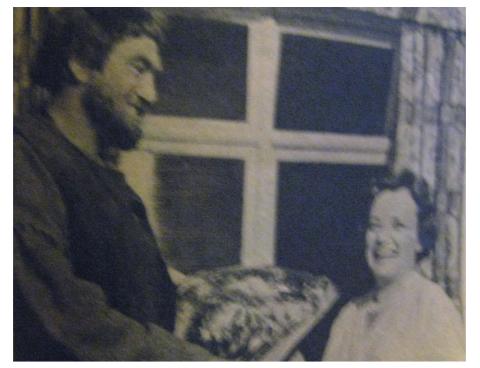
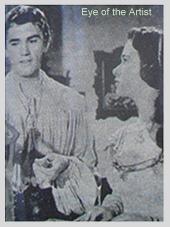
Picture - You must recognise Archie Duncan (aka Little John) but who is the iconic lady with him? Answer

To Main TV Menu

.

.

.

.

.

.

.

.

.

.

.

ROBIN HOOD starring Richard Greene
On December 10th 1958 at the High Pine Club, Mr and Mrs Fisher of Sapphire Films and Richard Greene threw a farewell buffet plus an orchestra "for dancing." Among those attending were Sidney Cole, producer, and his assistants; technicians Ken Hodges (lighting), Noel Rowlands (camera), Pip Pearson (sound); directors included Compton Bennett, Gordon Parry, Terry Bishop, Robert Day, Peter Seabourne and Anthony Squire, along with assistant Frank Holland. Lots of the actors attended including both Sheriffs, Alan Wheatley and John Arnatt, plus Marian, alias Patricia Driscoll with husband Duncan Lamont. Also there was Paul Eddington ("given a big chance in the last serial"), Alexander Gauge, Archie Duncan and stunt man Rupert Evans. The report adds it was "a happy occasion."
The series provided a rare phenomenon, success for a British TV series in America, the Eldorado of all British production companies. In early April 1957, the series came a respectable 17th in the US National TV Nielsen Ratings with a score of 34.9, indicating over 11 million homes watched the programme (by comparison Sir Lancelot came only 86th).

My mini reviews of selected stories:
1 The Coming of Robin Hood - This is a brilliant opening story that sets the tone for the series. The return of Robin, hero of the Crusades, but now homeless thanks to the edict of Prince John, and his local agent, a certain Sheriff
2 The Moneylender - A debt collector (Leo McKern) lends at 100% interest. Robin returns the excess interest to its payees, much to their surprise. But this story is principally about how Robin becomes leader of the Sherwood Forest outlaws.
3 Dead or Alive - A "7 foot oaf" is offered his freedom if he captures an outlaw, but Robin proves too wily for Little John
9 Checkmate - Naughty Count de Waldern (Leslie Phillips) thinks he's teaching Lady Marian how to play chess, but what he really wants is to play Love. On the other hand, she's really there to string him along whilst Robin rescues the Count's prisoners from his "impregnable" castle
20 Errand of Mercy- Many of the poor people are down with St Anthony's Fire, so Robin creeps into Nottingham with some herbs for Anselm the Apothecary (Hal Osmond). The sherrif gets wind of Robin's mission and surrounds the area- "what a pleasure it'll be to hang him!" However Robin eludes capture when the sherrif's soldiers, "cowardly dogs," refuse to go near the plague victims. But with Robin injured, it looks like curtains. Indeed, out of the gates he is carried, in the Death Cart.... but then a miraculous recovery!
47 Isabella - Princess Avice (Helen Cherry). wife of Prince John, requests Robin come to the Tower of London. For John has "a special arrangement with heaven" to allow him to marry a French princess (Zena Walker). Robin is asked to warn off this "unsuspecting child," though what he actually finds is a "she-wolf" who brings John a fine wedding gift, Robin himself "to be burned at the stake." Avice gets him out of jail and the wedding is stopped single handedly by our hero
72 The Mystery of Ireland's Eye- Robin and Tuck have a week off from Sherwood as they help Marian find her uncle who's gone missing on an Irish isle terrorised by Rolf (as this is Ireland. this must be Eddie Byrne)
76 Path of True Love - Lionel Jeffries playing a baddie! It seems improbable, but he's Sir Charles, usurper of Robin's family home Locksley. He plays it as a dithering incompetent. But underneath he's sly, turfing the tenants off 'his' land. Yet, if they could clean Locksley by Lady Day, in law they'll be entitled to keep their tenancies in perpetuity. Robin helps them get into his old castle to give it a spring clean whilst Lady Marian distracts Sir Charles. No Merry Men in this tale.. had the Sherriff finally captured them?
79 The Salt King - Bad Lord Guthrie is upping the price of salt with connivance from the sheriff. Robin buys fresh supplies from the seaside which Tuck then gives away in Nottingham. However the sheriff impounds Tuck's supply which Robin has to nick back. Dressed as a Salt Diviner, he incredibly finds salt on Lady Marian's land- actually not so surprising as he'd put there in the first place
80 A Tuck in Time
81 Pepper - Rescuing an impressionable princess blinded by love for King John, Robin comes face to face with John inside The Tower of London
82 The Charter- "Incredible," but King Henry I's lost charter curbing the power of tyrant kings is wanted by the Sheriff - to destroy, of course! Robin plucks it from right under the Sheriff's nose
91 Christmas Goose- Sir Leon (Jack Watling) presides at the trial of a boy's goose. Improbable, but a nice story with the prosecuting baliff (Paul Eddington) pitted against Friar Tuck. When the goose is sentenced to execution, it's up to Robin to rescue it. In a neat plan, he gets at Sir Leon's Achilles heel, his only daughter (Jane Asher), and it's a happy Christmas Day ending, exit laughing....
94 The Profiteer
103 The Ghost that Failed -A ghost with "moaning and the sound of iron chains" is frightening peasants, But Little J and F Tuck "keep a calm mind" and prove it's only Rupert Davies. Little J dresses as a ghost to teach him a lesson but rain rather spoils the illusion
112 The Fire
122 The Devil you don't know- A poignant moment as the Sheriff bows out, giving his new deputy Ralph a last lesson in how not to catch Robin Hood. Alan-a-Dale has been taken prisoner, and Ralph plans to use him as bait to trap Robin. Indeed Robin is lured into the inner sanctum of the castle but Ralph's unscrupulous treatment of Lady Marian brings out the gentleman in the retiring Sheriff, even at the cost of losing his prized outlaw
To Historical

.

.

.

.

.

THE BUCCANEERS starring Robert Shaw

1 Blackbeard
2 The Raider
3 Captain Dan Tempest
4 Dan Tempest's War with Spain
5 The Wasp
6 Whale Gold
7 The Slave Ship
8 Gunpowder Plot
9 The Ladies
10 The Surgeon Of Sangre Rojo
11 Before The Mast
12 Dan Tempest and the Amazons
13 Articles Of War
14 The Hand of the Hawk
15 Marooned
16 Gentleman Jack and the Lady
17 Mr. Beamish And The Hangman's Noose
18 Dead Man's Rock
19 Blood Will Tell
20 Dangerous Cargo
21 The Return Of Calico Jack
22 Ghost Ship
23 Conquistador
24 Mother Doughty's Crew
25 Conquest Of New Providence
26 Hurricane
27 Cutlass Wedding
28 Aztec Treasure
29 Prize Of Andalusia
30 Dan Tempest Holds An Auction
31 The Spy Aboard
32 Flip And Jenny
33 Indian Fighters
34 Mistress Higgins' Treasure
35 To The Rescue
36 The Decoy
37 Instrument Of War
38 Pirate Honour
39 Printer's Devil
A series of 39 stories made at Walton and Twickenham Studios cashing in on the success of the Robin Hood series.
No one has adequately explained why Alec Clunes disappears after the first stories. Clunes certainly seems to have been the intended star, for prints exist of the opening titles which announce him as the star. Publicity in Spring 1956 stated he was the "main character," a reformed pirate now a governor, and that "every episode will show one more pirate being 'put down.'"
But, having said that, it's fair to say Robert Shaw makes a fine swashbuckler, everyone's idea of a jolly pirate. For the outdoor scenes, the ship from the film Moby Dick was used, moored at Falmouth, and several scenes were shot on the river there. But although the indoor sets were well constructed, they look terribly stagey, providing awkward transitions from the filmed material to 'live' shots, and somehow the wide open spaces are never quite conveyed in the claustrophobic studios.
In fact Robert Shaw admitted, "I have never been outside the studio," as his double shot all the exterior scenes in Cornwall. He was paid £10,000 for the series, under a seven year contract, pay rising annually. Shaw explained, "I started on what is regarded as a comparatively low rate, because I was absolutely no-one."

To Historical Menu

.

.

.

.

.

.

.

.

.

.

.

IVANHOE (1957)
Thankfully most of the 39 stories have survived, and have been sold on the internet. They are:


1 Freeing The Serfs
2 The Gentle Giant
3 Slave Traders
4 The German Knight
5 Rinaldo
6 The Whipping Boy
7 The Witness
9 Wedding Cake
10 Lyman The Pieman
11 Face To Face
12 Black Boar
13 Freelance
14 The Masked Bandits
15 The Weavers
16 The Masons
17 Arms And The Woman
18 The Circus
19 The Escape
20 Murder At The Inn
21 Prisoner in the Tower
22 The Cattle Killers
23 By Hook Or By Crook
24 Treasure From Cathay
25 Brothers In Arms
26 The Double-Edged Sword
27 The Kidnapping
28 Widow Of Woodcote
29 The Princess
30 The Gentle Jester
31 Counterfeit
32 Search For Gold
33 The Devil's Dungeon
34 Three Days to Worcester
35 The Night Raiders
36 The Raven
38 The Swindler


You can see why Hollywood wanted Roger Moore. Spot embryonic elements of his most famous creation, The Saint, in Ivanhoe! "We've tried to make it authentic throughout," said Roger Moore in an interview. "Our master-at-arms and swordsman, Peter Diamond, has some 40-50 swords, 12 crossbows, and 50-60 lances. We have bought five horses and have had the use of 30 more." In one fight Moore was knocked unconscious with the head with a battleaxe, and at first his realistic acting was highly praised, until the truth dawned! "I wish he'd have a double for dangerous scenes," argued producer Bernard Coote, "but he refuses and does everything himself."

The executive producer was Peter Rogers. The series made by Sydney Box Productions at Beaconsfield Studios and at AB Studios Elstree. A pilot was made in colour, according to Roger Moore's autobiography, but although the title sequences look as though they were once in colour, the main series was b/w.

To Historical Menu

.

.

.

.

.

.

.

WILLIAM TELL

1 THE EMPEROR'S HAT
2 THE ASSASSINS
3 THE HOSTAGES
4 LANDSLIDE
5 THE BOY SLAVES
6 THE BARONESS
7 THE SECRET DEATH
8 VOICE IN THE NIGHT
9 THE GAUNTLET OF ST. GERHARDT
10 THE CUCKOO
11 THE ELIXIR
12 THE MAGIC POWDER
13 THE PRISONER
14 THE RAID
15 THE LOST LETTER
16 GESSLER'S DAUGHTER
17 MANHUNT
18 THE BANDIT
19 UNDERCOVER
20 THE BEAR
21 THE SUSPECT
22 THE GOLDEN WHEEL
23 THE BRIDE
24 THE AVENGER
25 THE YOUNG WIDOW
26 THE SHREW
27 THE TRAP
28 THE KILLER
29 THE MOUNTAIN PEOPLE
30 THE SURGEON
31 THE ENSIGN
32 THE UNWELCOME STRANGER
33 THE BLACK BROTHERS
34 THE GENERAL'S DAUGHTER
35 SECRET WEAPON
36 THE TRAITOR
37 CASTLE OF FEAR
38 THE SPIDER
39 THE MASTER SPY
The series started on British tv around August 1958 though production of the stories only finally finished in late January 1959, the final episode made being The Master Spy. The mountain scenes were filmed in Snowdonia. The programme did exceptionally well in America and after three weeks in New York was top of the children's tv ratings, so naturally a second series was planned though sadly it was never made. Wrote Margaret Cowan in March 1959- "it will be a safe bet to say that they will now do a second series." In fact, all that happened was the props got used in a feature length film.
Sir Robert Fraser, ITA Chairman, sent the executive producer Ralph Smart a "congratulatory letter." Pity the Americans didn't do likewise. Smart stated in a Jan 1959 interview: "when we used to offer parts to the bigger names, we always got refusals. Now that they see the successes of these scripts, and if the parts are good, they accept."
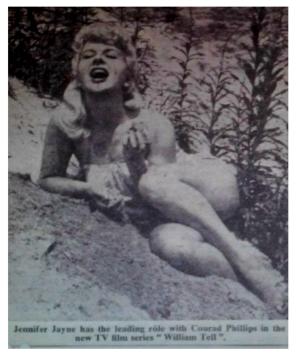
In an early episode Conrad Phillips crocked his leg on location. Another accident occured when his right shoulder was injured in a swordfight. And in one scene "he almost got hanged" and received a "slight scar" round his neck to prove it. All genuine, as he had medical certificates to prove. Jennifer Jayne described her role as William Tell's wife as "the most action packed of her career." More worryingly, Ralph Smart told TV Times (17 Aug 58 edition) that she had nearly broken her neck "a few times." Apparently in the first few episodes she wore a long peasant costume which would cause her to trip up. The problem was solved when she was given "more boyish costumes."
The whole series was repeated on Bravo TV in the 1990's and is available on the Network dvd.
To Historical

.

.

.

.

.

.

.

.

1 The Emperor's Hat
Willie the dog, and young Walter Tell, espy strangers marching up the valley. "They're soldiers," his very observant mother notes. Father William is in the fields when his son warns him, Tell Sr sets a grand example of defiance by telling the Austrian soldiers to their face that he is not going to kow-tow to their Emperor Rudolf. No taxes to them will Will pay, and the locals take up the example and chase off the enemy. William walks to a neighbouring village to inform his father, Judge Furst, en route pushing an Austrian into the river for good measure. But at his dad's village he finds capitulation. The hat of the emperor is the symbol of Austrian rule. On a pole it is placed in the town centre, and anyone passing it must kneel. Tell solves that by getting a picture of St Bernard to be placed nearby and to that the Swiss will bow, and even the Austrian soldiers grobvel before it.
Landburger Gessler is not amused. As he gobbles a juicy apple he proclaims, "I have power to see my judgement is obeyed." He tries to get Judge Furst to legally condemn his own son, but the old man will not. So Gessler hits upon a novel and infamous plan. Young Walter has fallen into his clutches, and he asks, nay demands, a demonstration of William Tell's legendary archery kills. An apple is placed like a hat, where else but on Walter's head. One hundred paces away, WT has to draw his crossbow, as Mrs T watches on anxiously. "I'm not afraid," cries Walter, if a little feebly. Tense moments. Then the apple is split in two.
"A great shot," Gessler has to concede. He had promised WT his freedom if he succeeded. But to prove his scurrility, he instead places WT under arrest. But no bars hold WT and with Mrs T and Walter he makes his escape, waving a cheery farewell to the frustrated Gessler.
In a final scene, the Switzerland states agree to unite as friends against their common enemy
To
William Tell Menu

.

.

.

.

.

.

.

.

The Assassins

In a mountain cave, Hedda is cooking, or at least she is trying to. However WT and Walter have dammed up a stream and the water has come flooding into their cave. Fritz and Gretl, friends, offer to make the cave "more comfortable," and the whole village turns out to make the place as much like home as it can be.
His Highness Prince Karl of Hapsburg, 'The Butcher,' is to stay with Gessler in Altdorf. But Gessler has received sealed orders from the Emperor himself to kill the Prince. Two Swiss, converted to fight for the Austrian army, are to do the deed, they are Bolf (Alfred Burke) and Maddeaux (Edwin Richfield).
It is dawn when they stab the sleeping royal, and are immediately arrested for high treason. Gessler secretly offers them their freedom if they promise to track down and kill WT. Cunningly, Gessler has anticpated that WT is bound to attempt a rescue of such Swiss heroes.
"What are we waiting for?" cries WT when he is informed. The prisoners are being transported to Austria. Via a deep ravine, he snatches Bolf and Maddeaux away from their Austrian guards. This is followed by a celebratory meal as the pair join Robin Hood's, sorry WT's, band of outlaws.
After the festivity, they bed down for the night, "we'll do it tonight, eh?"
All is quiet when they rise and enter WT's newly swept cave. The family sleep. Yet WT is not fooled. They cannot catch him unawares. They feign a story. "What are they up to?" stirs Hedda, as WT keeps his eye on the thwarted couple. The rest of the night passes peacefully, then in the morn, WT takes the pair hunting, "there should be plenty of sport."
Maddeaux fires his crossbow at WT, but ever on the alert, WT gets in first and that just leaves Bolf. They struggle until WT is knocked down by a small boulder. Luckily Walter is on hand to prevent his dad being finished off, though in fact it is WT's boulder that delivers the fatal blow

To William Tell Menu

.

.

.

.

.

.

.

.

3 The Hostages
William Tell and his companion Fritz relieve an Australian patrol of its weapons. Though only the two of them, the dozen or so enemy have to cross a lake, where WT surprises them giving them all a ducking.
"The man's becoming a nightmare," cries the infuriated Gessler. He tears off the responsible officer Hofmanstahl (old hand at this sort of thing Peter Hammond), who promises to capture WT when he rows back across the lake. Thus there is an Austria v Switzerland boat race (presumably Lake Bala), yet though the half dozen enemy row faster, they prove no match for WT's archery skills.
For a second time, Hofmanstahl faces the wrath of Gessler. As a reprisal, Gessler's men march on WT's home village. "It's the Austrians!"
With the village surrounded, all WT can do is hide under some straw. This is a temporary refuge until young Walter Tell lures an enemy soldier into a barn, wjhere WT knocks him out and dons his uniform. Taking Hedda Tell and Walter as 'prisoners' he makes his escape to the hills.
Enraged at losing his prize, the evil Gessler announces he will punish the villagers by arresting six of their men. They will die unless WT surrenders. The chopping blocks are made ready. Blindfolds placed on the six men.
But Hedda has warned WT who swims downriver, and with his crossbow he fires. An almighty scuffle, "there he is, get him you fools!" Amid the uproar, WT, in the style of good old Errol Flynn, eludes all and sundry and points his bow into Gessler's back. Gessler is forced to cancel the executions and call off the search for WT. A truce, he annoucnes to the bewilderment of poor Hofmanstahl. But the officer understands Gessler's gestures and springs on to WT, who however has long gone, leaving only the bow in Gessler's behind. "You fool"
To
William Tell Menu

.

.

.

.

.

.

.

.

Landslide (No Walter Tell)

A city dignitary from Altdorf has come to WT's mountain home on a delicate mission. "Too much hardship" has resolved local citizens to order WT to stop robbing Gessler's tax collectors. But WT claims he hasn't stolen such money of late, even in a good cause. Witnesses however claim to have actually seen him commit the robbery. "I'm going back to Altdorf," WT announces, "I seem to be making a lot of money. I want to find out why I haven't got any of it."
Even Aunt Maria in the village is against WT, for another witness identifies WT as the robber. An ugly crowd are gathering.
Taxes are being collected today in WT's home village of Bergelin. Gessler sits impassively as his lackey (Frank Thornton) takes what is due from the Swiss peasants. Many claim poverty, including Albert Steptoe, or rather Wilfred Brambell as Josef. But all have to pay up or else.
Gessler's train carrying the taxes is robbed by William Tell! Or at least someone who looks like WT. It so happens Hedda Tell is on hand and sees her husband's double- she has to be taken prisoner.
Now Gessler returns to Bergelin to collect the taxes anew. He informs the locals that it was WT who had robbed him. Catch the imposter, that's what WT must do.
At Devil's Gap, the Swiss travel, to start a landslide to prevent Gessler reaching the next village scheduled for taxing. WT hearing Hedda is now in Gessler's hands, asks Josef for a horse so he can try and prevent any tragedy. However Josef looks now less like Albert Steptoe, more Peter Lorre really, as he locks our hero in his barn and sends for the Landburger to claim his reward.
WT has broken out of the barn having set fire to it. Two Austrian soldiers don't detain him long. As he reaches Devil's Gap, the rocks are already tumbling. Amidst the dust rubble and confusion he finds Hedda held by his double. It's not too easy to tell who wins the fight as both WTs are dressed the same, but I hadn't noticed before that the double actually has a scar on his face, so we can breathe again when one of them dies. WT is thankfully reunited with his wife
To
William Tell Menu

.

.

.

.

.

.

.

The Boy Slaves
(No Hedda Tell)

Boys that the Austrians have taken into forced labour are to be returned to their families as a goodwill gesture. Representing the Emperor, Count Heinemann is trying thus to appease the peasants, though Gessler is in no way enthusiastic about the scheme. He's even less keen when a local lad knocks off his distinguished hat, "seize him" shrieks the infuriated Landburger. Luckily WT is on hand to spirit away the lad who is called Carl Schmidt (Frazer Hines). After hiding him at the Gruber's, who are expecting their son Pierre shortly to be reunited with them, WT billets Carl with the kindly Aunt Maria (Marjorie Rhodes) who is also expecting her son Jean to be home soon from the labour camp. She gives the unwilling Carl a bath, and, more welcome, shelter.
"Comb the forests," orders the frustrated Gessler who must have his revenge. So angry is he that he rescinds the return of the boy slaves, issuing a proclamation to this effect. "Barbaric," declares WT, while the Swiss families despair. Carl decides he must give himself up.
"Talk, or you'll die," Gessler shouts at the lad, forgetting everything else in his fury. The more mild mannered Count objects to Gessler's highhandedness, but it seems firmness is rewarded when WT delivers a note offering to give himself up if Carl and the other boys are released. "No tricks"... as if Gessler would!
All are happy next day when the lads do come home, all perhaps except WT whose public execution is announced for noon on the morrow. Gessler is exultant.
The lads devise a plan to rescue their saviour. Carl approaches the Count about an amnesty. As a man of honour he agrees to explore the possibility, but he's been tricked as the lads kidnap him. "If Tell dies, so do you."
Thus as WT kneels on the execution block, with Gessler happily watching on, a signed message from the Count is delivered. "Release the prisoner!"
Carl is now staying with Walter Tell as his reward

To William Tell Menu

.

.

.

.

.

.

.

The Baroness
A story without Walter Tell

Hedda is cooking, while WT relaxes surrounded by admiring looks from the village maidens. "Beautiful" Lady Marilyn (Delphi Lawrence) is brought to him with a tale of woe. The Austrians are forcing her to give up her estate as retribution for shielding a patriot.. WT promptly rides to her rescue.
Her home, more a castle actually, is welcoming, no sign of any crisis, with WT wined and dined royally, so it's as well Hedda has her suspicions, maybe jealous suspicions, and has followed her husband, for Marilyn has tipped off Gessler! WT is "entertained" with "wine, perfume," and "for a man who lives in a cave that ought to be quite enough." Hedda has been smuggled inside the castle and poses as a minstrel. It's a truly dreadful song she sings, warning her husband who however is too engrossed to even notice her.
The triumphant Gessler strides in. After a close fight WT is triumphant, but then he collapses- it was the drugged wine with which Marilyn had plied him.
"The mouse is mine," Gessler gloats to General (later Colonel) Bullinger. Gessler's evil scheme is to put WT on trial in Altdorf, the verdict a foregone conclusion.
WT is locked away, but Hedda sings again before WT's two guards, but it may not be her singing but the remainder of that drugged wine that polishes off the guards. Groggy, a freed WT orders Hedda to get reinforcements, she improbably escaping via a tiny barred window. The alarm raised, Gessler waddles after her, but Bullinger is more shrewd and concludes WT is still hidden somewhere inside the castle, "he must be here." Finally the escapee is cornered, "prepare for a hanging," Bullinger orders, "immediately," he adds.
The noose is tightened around WT's strong neck. Yet the peasants are also staging a hanging- Gessler's! However an exchange is offered and as the two prisoners pass each other there are a few well chosen words. So WT is safe, but he gets a bit of a ticking off from Hedda

To William Tell Menu

.

.

.

.

.

.

.

Secret Death

"You clumsy oaf!" Gessler is ranting again, but Captain Hofmanstahl brings him good news. He has exposed an armourer named Schmidt, who has been supplying arms to his compatriots. The penalty is death, but instead Gessler orders the puzzled Hofmanstahl to only beat the man. But he is to be watched carefully once he is freed.
Hedda has collected crossbows from her father Judge Furst. But she accidentally drops the basket with her prize and the eager Gessler brings her before the judge. The penalty is death smirks Gessler. But he is thwarted when the judge rejects the charge of treason, since she is only helping her own people. Though Gessler has to accept the ruling, once Hedda is out of the court, she is quietly rearrested. "It grieves me," the Austrian informs the judge, though he doesn't look that grieved, because the judge will never see his daughter again, not unless WT gives himself up in exchange for her.
Maximillian Schaffner (Sid James no less) is a magician who had been sentenced to the pillory by Judge Furst for selling fake potions. But now he is released, WT enlists his aid. Schaffner has a magic powder, the genuine article, that can put you in a coma. The important thing is to take the antidote within four hours, and this revives the apparently dead person.
Gessler is making ready to torture Hedda, but he's missed the chance for he finds her dead. But he must have a sixth sense, for he refuses to allow her father custody of the body. So WT has to borrow an Austrian uniform, and with the assistance of Schmidt breaks into the vault where Hedda lies. This is quite an easy task, for the Austrian soldiers don't expect one of their own to attack them.
Inside WT revives his wife, but the blustering Gessler is evidently not so daft as he looks, for he is on the watch. In triumph he arrests WT, leaving the apparently motionless Hedda where she is.
Hedda is now at liberty and she roams round, her ghostly form scaring the Austrians. Easily she releases her husband, and with a spot of realistic groaning the couple carefully make their bid for freedom, "we were lucky there!" Sadly we never see Gessler's reaction to this latest setback

To William Tell Menu

.

.

.

.

.

.

.

.

.

Voice in the Night (1958)
Gessler is guzzling snails as he offers "surly Swiss" Jules Gunther (Ronald Leigh-Hunt) an unfair price for his "large attractive house," the finest in the district. Two hundred crowns is a pittance and when Jules turns the offer down, Gessler orders Frederick to force a Swiss prisoner to escape and seek refuge in Jules' home.
In an attic, Frederick discovers the escapee and Jules is placed under arrest. However Judge Furst refuses to sign Gessler's "trumped up" charge.
WT, Hedda and Walter have their own secret way of entering Altdorf, via a secret passage that leads to the well by the judge's house. They are in time to hear Gessler sack Judge Furst and replace him with his former clerk Schwarz. "You wretched little traitor," breathes Furst as he is lead away to the dungeon to join Jules Gunther.
Schwarz is now lording it over his compatriots but WT is here to teach him a lesson. In a plot worthy of a minor Mission Impossible, 'His Honour' Schwarz is locked in a locked replica of his new bedroom. When he awakes, a voice of doom warns him of his fate (actually it's WT), unless, that is, he resigns his post.
In the morning, he is back in his own bedroom, back to normal, except for his hangover. The present terror of Gessler is more immediate and the judge prepares to sign the death warrant prepared by Gessler. However WT fires a warning arrow and the verdict is suddenly altered to Not Guilty. WT barely escapes the Austrians down the well. "He must be here!" rants enraged Gessler. The traitorous judge is arrested, but Gessler has to grovel to Judge Furst and release him, though strangely we never hear of Jules' fate

To William Tell Menu

.

.

.

.

.

.

.

.

The Gauntlet of St Gerhardt
Austrian gold is stolen by Swiss who carry with them a holy relic, a gauntlet that apparently gives each "the strength of ten." When not carried by the soldiers, it is kept safe by a "meddlesome" abbot (Ian Wallace). Gessler fairly sees that that gauntlet must be captured. In charge of the patrol commissioned to steal it is Major Augustin, under him the volatile Werner (Derren Nesbitt). Quickly the abbot is seized, but WT is too late on the spot, "we'll get it back." His allies are Hedda and Walter his son.
These two kindly offer to take care of the Austrians' horses, while they take a rest, but taking care means galloping off with the animals. So the six Austrians have to walk with their prize, which is carried by the abbot. So feeble are these Austrians one is soon too tired to walk on.
That night the five rest in a poor hut, a meal is prepared which WT quietly removes as the abbot pronounces a very long grace. On empty stomachs they retire, but WT is now firing burning arrows and the hut has to be hastily vacated. Brunner the soldier on guard is taken prisoner. The evil Werner is all for pushing the abbot into the blazing hut, but the major will not permit such an atrocity.
Next day more sabotage as Hedda nicks Werner's boots. Frustrated beyond endurance he pushes his leader down the mountain. "He fell," he tells the little who remain of the Austrian patrol. In fact there are now only two of them. Trooper Strauss (Edward Judd) refuses to kill the abbot and there is a fight. Then there was one, Werner. The abbot prepares to meet his fate. But WT is ready to make his move, and thus the gauntlet is back in Swiss hands.
Werner has to go back to Gessler to explain the slightly bad news. Gessler is not amused. Werner is in disgrace
William Tell Menu

.

.

.

.

.

.

.

.

10The Cuckoo

Gessler's getting all worked up again, because his tax collectors haven't gathered enough to send to swell the Austrian coffers. And the Emperor is blaming Gessler, so naturally enough, he blames his subordinates! So worried is the poor Landburger, that he can't sleep at night, and when he finally drifts off to slumber, a cuckoo early in the morn awakens him.
Ferdinand (Jack Watling) is entrusted with escorting what gold has been collected to go on its journey to Austria. A pigeon informs WT, and he prepares a trap. On the long trip, the Austrian train rests at a mountain hut overnight. As the guards snore, WT emerges from his hiding place to snatch the treasure which Hedda and Walter Tell carry off by donkey.
The sleepless Gessler has been awoken yet again by that wretched cuckoo. He orders Hofmanstahl to rouse all the sleeping soldiers to dispose of the errant bird. A sledgehammer to crack a nut, yet that tiny nut eludes the whole useless army. When Gessler is told of the theft of the gold, it really finishes off his day.
Ferdinand is vainly searching for it. WT has temporarily hidden it at a clockmaker's named Conrad (George Benson) and it's unfortunate that Ferdinand hits on the place. The old clockmaker distracts Ferdinand in his search, showing him his latest idea, a clock that tells the time (surely not a new idea!). "It's the only timepiece in the world," declares Conrad. But it has novely value in that a cuckoo announces the hour on the hour, and the unhappy Ferdinand sees in this an opportunity to placate Gessler's wrath with a handsome unique gift. Ferdinand takes the prototype to give to his leader, though WT for reasons that I couldn't quite fathom, substitutes this later for another clock.
Oh dear, the exhausted Gessler has at last managed 40 winks. Not amused at being awoken, he is at least amused by Ferdinand's offering, "remarkable." Yes, he is most impressed with this clock, but just then the hour is announced by the cuckoo.... and the time is twelve o'clock!

Note- in the filmed sequences, Hedda's hair seems much more straggly and a lot darker, while in the studio scenes her hair is nicely groomed blonde. Then, in one brief film clip on a hill side, it is clearly a stand in for WT that we see

To William Tell Menu

.

.

.

.

.

.

.

The Elixir
A story without Hedda Tell
Walter is having to go to school, and WT makes sure he gets there. Father Jules is the teacher, but his lesson is interrupted by Austrian soldiers bringing Gessler's proclamation that the school has to be closed. After the pupils are sent home, the soldiers start to vandalise the school, but Jules, with WT's help, teach these bullies a lesson.
As he guzzles soup, Gessler is told of the incident, and he is not at all pleased. He decides to punish the abbot (Ian Wallace) who is training Swiss teachers. Carried by half a dozen perspiring soldiers, Gessler is carried to the monastery, to demand the secret recipe of the elixir the monks make there. He also wants to know why the abbot has not paid his taxes.
It all goes to charity, patiently explains the abbot. Gessler offers a deal, he will waive all taxes in return for the formula for the elixir. Meeting refusal, he imprisons the monks.
Disguised as a dead monk, WT is able to elude Austrian soldiers now guarding the place, and organise a resistance. The abbot however cannot agree to any violence. So WT's plan is to awake the snoring Gessler, forcing him to sign a charter promising exemption of taxes for the monastery. "I do this freely," he is forced to pronounce. He even has to agree to a state subsidy for schools. And all the monks have to be released. Though, with a crossbow trained on him, Gessler seems none too happy, the abbot is satisfied enough. A quick trick however and Gessler is free and captures WT. For a second. But WT fells him and gets away disguised as a monk, taking with him Gessler an ignominious hostage.
Puzzle, find Gessler. The Austrians search in vain. They determine to hang all the monks as a reprisal when in totters a bedraggled Gessler, defeated and depressed

To William Tell Menu

.

.

.

.

13 The Magic Powder
No Walter Tell
Scientist Dr Klein (Henry Oscar) refuses to allow WT the use of his strategically placed castle, "I will not be mixed up in your warlike goings-on." Perhaps the real reason is that he has another guest, Landburger Gessler, and he is showing off his latest discovery to the Austrian, an exploding powder, surely that had been around years earlier. Klein refuses to impart the formula to Gessler, who can see the potential for such a substance, but Klein will only reveal it to his colleague a professor in Milan.
As he has never actually met this academic, Hoffmannstahl is persuaded by Gessler to pose as the professor. The conversation is rather one sided as Klein reveals his ingredients to make up the powder, but then Hoffmannstahl rather blunders and the nature of the fungus needed to complete the formula is never spoken as Klein sees he has been tricked.
In the torture chamber, Klein is held until he should tell all. WT plans a rescue and as Hedda arranges a diversion by the castle wall, WT chisels out a hole into which some of Klein's powder is inserted to blow a much bigger gap. However Gessler is soon there, "it's William Tell!" cries the eager Landburger, and there's a swordfight. Hedda helps Klein get away and WT then vanishes too.
The frustrated Gessler decides to root through Klein's home to discover what the formula for the powder is, but WT has anticipated this and there's a second fight. A disillusioned scientist sees that he must destroy all the powder and all documentation, and his rather extreme solution is to blow everything to smithereens with it. A gigantic explosion. "he died to keep the secret," cries WT. By contrast Gessler's complaint is, "to think what we could have done with it"

To William Tell Menu

.

.

.

.

The Prisoner
A new enemy for WT in the shape of General Bullinger (Bruce Seton), who is using forced Swiss labour to build a military road.
With Hedda, WT is searching for Jules, who has an important message. He has disappeared, the likelihood behind he is held prisoner in Bullinger's chateau.
WT has a blacksmith make him a trick ball and chain, so WT can swap places with a member of the chain gang constructing the road. Every night, these workers are taken to Bullinger's castle, and thus WT becomes Number Six, The Prisoner, heard that somewhere else?!
Now WT is inside the castle, but he is locked up in a hovel of a prison. He promises his fellow captives, "if you help me, I'll get you all out of here."
'Tis dark when WT escapes, to prowl the castle. "What are you doing here?" the incredulous Jules asks WT, who soon learns the message is about a young Austrian prince, Frederick, whom Bullinger had been ordered to kill, but who is now being kept prisoner in a mountain chalet. The general plans to make him a puppet ruler.
Next day as the road is dug WT gives one of the warders what he deserves, slipping out of his trick ball and chain. The other prisoners soon join in the rebellion and the Austrians are outnumbered.
WT soon has the prince, who however turns out to be a mere lad. Hedda realises "we can't bargain with this child," and being the humanitarian he is, WT has to agree. But luckily here comes Uncle Sebastian (Bullinger) to the chalet to collect young 'Ricky.'
Thus the "peasant dog" is in a position to blackmail Bullinger. An amnesty for the prisoners. "An impossible demand," protests the general, but what choice has he?
Concludes WT happily to Bullinger, "it's about time you had a ball and chain around your leg"

To William Tell Menu

.

.

.

.

The Raid
WT and Walter are stopped by Austrians, they try to run away, pursued by a dozen of the enemy. Across a stream, up a mountain they run, after a while poor Walter needs to be carried. They find a hiding place in a cave, but after a much needed rest, a Swiss man attacks them, mistaking WT for an Austrian spy. Walter happily watches on while his dad is naturally victorious over Hans. "Take me to your captain," WT orders him.
Can WT prove he really is who he says he is? With the aid of his crossbow, WT amazingly shoots an apple in flight.
Now friends, WT learns that this band of Swiss have few wepaons, so WT proposes they raid the local Austrian armoury. WT and Hans help themselves to a couple of Austrian soldier uniforms and boldly march into the fortress. There's a chance to be "acquainted" with Gessler, for he is dining royally here. Over the feast, the Landburger addresses the troops on the subject of the "arrogant peasants," which makes Hans so furious, WT has to drag him away to explore the castle.
It's bad fortune that Gessler catches them in the armoury, but our heroes escape by jumping into the moat.
The raid on the castle is finely planned. Even Walter will come in useful, for he climbs a pole up to the battlements, enabling a bridgehead for all the Swiss to climb. The roof of the building at the top of the fortress is reached, tiles removed, and once inside the building, the ceiling is cut away. Gessler, feeling a little unwell after his gastronomic exertions, is sleeping below, so he has to be bound and gagged, a picture of helpless stupidity, only able to watch powerless as the wall to the armoury is broken down. Swords and rifles are appropriated. As you might expect, the Swiss are then chased by the enemy, who somehow never quite catch up. Amid laughter the triumphant Swiss depart with their booty
To
William Tell Menu

.

.

.

.

The Lost Letter (No Walter or Hedda Tell)
Judge Furst (who's not been seen since story #8) has received details of the locations of Swiss arms dumps. The wise Franz (Alex Scott) surmises, "suppose the letter were to fall into Gessler's hands." True, the information is in code, but Franz is volunteered to bring the vital letter to WT immediately.
But Furst's helper Muller has sneaked to Gessler, and Franz winds up in enemy hands. Luckily he gets away, and hides in a cobbler's shop where he conceals the missive in a boot that is in need of repair.
Franz is recaptured and, refusing to divulge where he has put the letter, is sent away to be tortured. WT has climbed into the castle, and fires a crossbow at a chandelier which falls knocking out several Austrians. Defying the rest, WT rescues Franz and they return to the cobbler (Max Bacon) to collect the document.
Where is the boot? Oh no, it was Gessler's boot, and it has now been repaired and returned to its owner. So back they go to Gessler, the cobbler reluctantly cobbling up some story about needing to repair the boot again. But Gessler is satisfied enough with the job and insists on keeping his boot.
So as Gessler retires for the night, a disguised WT enters Gessler's bedchamber, but no boots... they have been taken down below for cleaning. Here WT borrows the boots and rips open the heel, but the letter is not there! He must have the wrong pair.
It has taken Gessler a long while to work out the letter must have been hidden at the cobbler's, and now he's searching the shop. Finally he grasps that the letter must be in his own boot. He removes his boot, but Vera, the cobbler's assistant bursts in with vital news. She can show Gessler where WT is. While Gessler pursues his goose chase, WT grabs the letter from the boot. Thus when Gessler comes to examine his boot, there is only a blank sheet of paper.
As a reprisal Frederick, Gessler's henchman (Derren Nesbitt) vandalises the cobbler's shop and this awakes a hidden WT into action. Frederick is stopped, the letter is safe, and the rather retiring cobbler is now a firm Swiss patriot

William Tell Menu

.

.

.

.

.

.

.

Gessler's Daughter (No Walter Tell)
The story that sees Gessler and William Tell, for one moment only, joining forces!

Fraulein Anna (Perlita Neilson) can't stand her father, and who can blame her? For he is none other than that Austrian Gessler, who has invited her to come to see him in Switzerland.
Her journey is arduous, but she is well guarded, though not well enough, for she is captured by a gang of Swiss peasants lead by Jakob Muller, who speaks in a kind of Irish brogue, "it's too good to be true." This embittered Swiss wants revenge for his daughter who had been killed by Gessler's soldiers. So he and his wife force her to work for them, as well as demanding 10,000 ducats for her safe return.
Gessler has to agree, and the money is handed over, but the bargain isn't kept and Anna is not released. Gessler is stumped, conceding there is "only one man who can help me now." Yes WT, an improbable alliance, but a secret meeting is arranged at a deserted hut, "alone and unarmed." Neither party naturally trusts the other, so each have protection at a discreet distance. (Note, Gessler's double in the film sequence isn't quite like him in one long shot.)
At an uneasy tryst, realising even Gessler "has some human feelings," WT agrees to assist in finding Anna, though the deal is nearly broken before it is sealed by Gessler's soldiers who show their hand. However, Gessler is blindfolded and taken to WT's secret cave, WT seeing that just for once Gessler is on the level.
WT questions the local Swiss, including Jakob, who denies ever seeing the girl. But he comes across Jakob's girl pulling water from the well, and sees she is no servant. Jakob fights WT to stop him taking her away, but he is no match for WT and Anna is taken safely away to the cave, for a happy reunion.
All that remains is to escort them back to the rendezvous hut, where WT is surrounded by the enemy. Gessler sees his chance, "we don't have to honour agreements made with rebels," he now decides. However Anna rightly gives her father a dressing down, refusing to travel onwards with him. That night, as WT lays tied up, she sets him free, he vanishes gratefully.
Next morn, Gessler has to make the best of the situation and now claims he had decided to keep his side of the bargain, and release WT, so Anna does return with her father to Altdorf
William Tell Menu

.

.

.

.

.

.

The Manhunt
(in this story there's no Walter or Hedda Tell, nor Gessler )
All on his ownsome, WT walks into a village, which has changed since WT last saw it. Only two men are left here, Heinrich and his son Peter. The reason is soon apparent, for mad Prince Maximillian, the Emperor's brother (Christopher Lee) has taken over the lands to use them for his passion, hunting.
Taking a punt out on the lake, WT, seemingly by design, spoils the prince's pursuit of a deer. "There is an intruder on my island." WT leaves the prince a message which in effect tells him to get lost.
Surely the mad Max won't take that lying down. But he seems to. While WT rests, Heinrich and Peter go a-hunting themselves for some food for their guest. WT awakes refreshed, and makes his way to the island too. Rather carelessly, he falls into a bear trap where already lie Heinrich and his son. Maximillian's sadistic plan is to release his prisoners and to hunt them with his baying hounds, "a thrilling day's sport!"
One minute start he generously allows them, then "the most exciting hunt of my life." Yes he rather seems to enjoy it, but in this battle of wits you know it's bound to end in a one to one fight between Lee and WT. And after a few Austrians have been polished off, and Heinrich and Peter "go to earth" in a cave, and the wily prince then smokes them out with fire, all is set up for the fight. But WT simply shoots the prince and rescues his friends and that anticipated fight disappointingly never materialises
To the
William Tell Menu

.

.

.

.

.

.

The Bandit (No Hedda or Walter Tell)

Gessler is busy negotiating a bargain price for some jewellery. He takes it as a personal bribe, sorry gift, for the Emperor. But on his way to Austria a bandit named Rinaldo relieves him of the jewels.
Ideal funds for the Resistance, so WT sends Fritz to collect them. When he hasn't returned after two weeks, WT sets off to find out why.
A serving girl at the Cross Keys shows WT a keepsake she'd discovered on a mountain road. It happens to belong to Fritz. She shows WT where she had discovered it, and in a nearby cave, there's Fritz's corpse.
Incognito, WT goes to Rinaldo's hideout. Flattery gets him everywhere, "they speak of you all over Sweitzerland," that's what WT says to Rinaldo. And having proved his bowmanship, WT is offered a place in the band. But Carl, Rinaldo's right hand man, exposes WT, forcing him to reveal his true identity. Where are the jewels? According to Rinaldo, Fritz had set off with them. He never arrived retorts WT, one of your gang must have followed him and robbed him. Such an insult the leader cannot accept, so it's the Fight of the Single Knife, a duel to the death. Once WT has won, Rinaldo has to accept that one of his group is a traitor. A search of the camp yields the jewels, in the quiver of Marco.
So WT departs with the treasure. However he is followed, and attacked. Of course he emerges the victor and his assailant proves to be a surprise. So now the traitor is exposed and disposed of

William Tell Menu

.

.

.

.

.

.

Undercover (No Hedda or Walter Tell or Gessler)

Austrians shoot a hooded black figure on horseback. He mutters a dying message that Jacques has been killed, and something about The Raven. Now Jacques had been a Swiss spy in the Austrian Emperor's castle and this Raven had supplied WT with valuable intelligence, so, posing as a poulterer, WT rides to Innsbruck to find a replacement for Jacques.
Herr Johann, the keeper of the inn where he stays, sets Ernst on WT and ties him up in a cellar, then informing General Michaelis (Ian Colin). But when he is convinced of WT's bona fides, it becomes clear that Michaelis himself is the high up Austrian spy, the Raven.
The Emperor (Derek Bond) has a right hand man in General Rheinhardt (John Longden), and they are planning a secret new route for all Gessler's gold to be transported to Austria. As Michaelis is also privy to this information, the next shipment of gold is easily diverted into Swiss hands.
But Johann has a daughter, Magda (Jill Browne), who is in love secretly with Austrian Sebastian, and he's the one charged by the Emperor of proving the suspected Michaelis' duplicity. Michaelis is followed and in a double coup, he is caught alongside WT! Resistance leads to the mortal wounding of Michaelis, but WT eludes capture by hiding in a beer barrel.
"If Rheinhardt brings Michaelis down, he must die or Switzerland will run with blood," WT had prophesied. So with the sword WT finishes off Rheinhardt, before making good his escape. Michaelis had handed WT the name of another high up Swiss sympathiser, General Fisher, so happily the spy ring is able to continue

William Tell Menu

.

.

.

.

.

.

The Suspect (No Hedda or Walter Tell)
Fighters before Farmers, that's Switzerland's current buzzword. Villagers are keen to find the traitor who has caused arms and food bound for WT to be intercepted by the Austrian enemy. Dagma (Marianne Benet) keeps disappearing into the mountains, and refuses to explain. Leader of the locals Waldmann decides she is guilty, but up steps good WT to intervene. "No need for proof," declares Waldmann, but WT castigates his countrymen for acting more like Austrians, the ultimate insult. A brawl, WT wins naturally, and the girl is freed.
Dagma refuses to tell even WT himself where she goes to. She is overwhelmed with caring for her ailing mother and Gaston her depressed dad. But periodically she disappears into the mountains, her mother hopes it might be romance.
So to prove she is no spy, WT sets a simple trap. He tells Dagma that the next shipment of arms is to pass this night. When the arms are in fact ambushed, that seems proof enough she must be the traitor. Restless villagers come banging on her door, and she is locked up.
WT promises Gaston he will try and find the truth, but he will have to hurry. At her trial next day, a kangaroo court presided over by Waldmann, the verdict is pronounced. She is to be taken to Devil's Drop to let Providence decide the issue. She is to be placed in a barrel full of stones and pushed over the edge. Indeed a miracle is needed to survive that ordeal!
But WT knows the facts by now. It was Gaston who sold the information to the Austrians, to pay for the medicines his wife desperately needed. Will WT be too late to save Dagma? Her admirer Ludwig is pleading for her, and even her mother has arisen from her sickbed to argue her cause, but it is WT's evidence that prevents the injustice. Gaston confesses to the crime. "He betrayed us for this?" cries Waldmann, as it transpires he never received money, only rare herbs to treat his wife. WT pleads for mercy. Apparently Dagma's trips to the hills had been in a vain search for these herbs

To the
William Tell Menu

.

.

.

.

.

.

.

.

THE COUNT OF MONTE CRISTO starring George Dolenz

These first in the series
were all made in HOLLYWOOD:

1 THE THREE NAPOLEONS
2 THE PEN AND THE SWORD
3 THE DE BERRY AFFAIR
4 THE SARDINIA AFFAIR
5 THE BLACK DEATH
6 FIRST TRAIN TO PARIS
7 VICTOR HUGO
8 RETURN TO CHATEAU D'IF
9 THE GOLDEN BLADE
10 THE DUEL
11 ANDORRA
12 AFFAIR OF HONOR

. . BRITISH MADE:

13 THE MAZZINI AFFAIR
14 A TOY FOR THE INFANTA
15 MARSEILLES with Conrad Philips
16 THE LUXEMBOURG AFFAIR with Lloyd Lamble
17 THE TEXAS AFFAIR
18 THE CARBONARI with William Franklyn
19 THE DEVIL'S EMISSARY
20 BORDEAUX with Betty McDowell
21 FLIGHT TO CALAIS with Hugh Williams
22 NAPLES with Maurice Kaufmann
23 ALBANIA with Ralph Michael
24 ACT OF TERROR
25 THE EXPERIMENT

26 MECKLENBURG
27 THE PORTUGUESE AFFAIR
28 LICHTENBURG with Allan Cuthbertson
29 BURGUNDY with Walter Gotell
30 MAJORCA with Ian Bannen
31 SICILY with Alexander Gauge
32 A MATTER OF JUSTICE
33 POINT COUNTER POINT with John Loder
34 THE TALLEYRAND AFFAIR
35 THE ISLAND
36 ATHENS with Elwyn Brook-Jones
37 THE BAREFOOT EMPRESS
38 MONACO with Patricia Laffan
39 THE GRECIAN GIFT with Douglas Wilmer

This was the first of several series to have episodes made in both America and England.
Nick Cravat played the mute Jacopo. Other semi-regulars included Henry Cordon as Carlo (US stories 5 to 12) and Robert Cawdron as Rico (UK stories).

I have placed the American made stories in the most likely sequence. No.1 was a pilot, this and stories 2 and 3 included the Count's servant Mario who disappears after this. Stories 4 and 6 to 12 all have Carlo, who is introduced in the first of these, and is clearly shown to leave the series in story 12.

To Historical Menu

.

.

.

.

.

1 The Affair of the Three Napoleons - (US pilot episode)

"In the year 1834, rumblings of rebellion threatened the throne of France. It was a time of intrigue, conspiracy and secret rendezvous."

Our first sight of the Count is at his desk leisurely sipping wine.
He has a visitor, Mlle Renee Morell (Faith Domergue) who makes an appeal to the man "battling injustice wherever he might find it" (Sounds rather like The Four Just Men introduction!).
Her father Albert has been done in while trying to find out the identities of the plotters against King Louis Philippe. The only clue, a snuff box with 3 gold coins.
But though she is positive that her father once knew MC while both were imprisoned in the Chateau d'If, surprisingly MC is cold and unhelpful, sending her away. It's because he is worried his own identity might become known.
Yet as a defender of the downtrodden, he does investigate the crime, first questioning a man in Vichy whose life MC had once saved. He learns that these three gold coins are the way that supporters of Napoleon identify each other. Morrell had infiltrated the group but had paid the price.
A baron, on his way to meet the leaders of the plot, is intercepted by MC, who then impersonates this baron. He presents his credentials, the gold coins to the leader, Paul, at a ball this man is holding. He introduces his fiancee, none other than Renee. She's puzzled at MC's presence here. Privately MC tries to make amends for his former rudeness, but telling her that her fiance is the leading plotter against the king isn't the best way of doing that. "I intend to tell Paul," she says to MC, but she is finally persuaded to give MC a little time to prove his accusation.
However the baron whom MC is impersonating gets out of his bonds and persuades Paul of his own bona fides. MC has to come into the open, and snatching the documents Paul holds with the names of all his co-conspirators, he makes his escape. Though Mario is wounded in the fight, Jacopo is entrusted with taking these documents to the king. As Mario watches on from his sickbed, MC has a showdown with Paul and the enemy of the king is then arrested.
Renee can see now that she's been "a fool," and thanks MC

To Monte Cristo Menu

.

.

.

.

.

.

.

.

.

2 The Pen and The Sword

The scenery looks like the wild west, but apparently we are in France, where Veritas, a mysterious masked figure, is delivering leaflets denouncing army general Jean Beauclair. "He certainly has a facility for stirring up excitement." In fact the allegations cause the general to shoot himself.
The next target for Veritas is Justice Minister Bonjean, who deserves all he gets, for he has squandered the people's taxes in gambling. The worried minister, as worried as any modern day politician, declares, "we must find Veritas."
12 Rue de Charbonne is where the pamphlets are printed, so soldiers break in there to arrest Dubois, a bookseller, though his daughter Charmaine manages to get away in time, straight into the safe arms of Monte Cristo. But she at first sees him as yet another aristo and doesn't trust him. But he gains her confidence by promising to rescue Dubois, if he can find where he is being held prisoner.
Bonjean himself will give the information! He's gambling as usual, and Monte Cristo takes him on, a million francs is the stake. Bonjean is soon down, "I lost everything."
But Bonjean's army officer Debrec has persuaded Charmaine to reveal the identity of Veritas, it's the Count. "I order his immediate arrest," cries Bonjean in triumph.
But face to face with Monte Cristo he is not so brave. The pamphlet denouncing him seizes him with anger and he rips it up.
Take me to Dubois, demands Monte Cristo, and admit you have stolen two million francs of the people's money, in return the leaflet will be suppressed. After a swordfight Monte Cristo is locked in prison, but at least he's found Dubois, for he is sharing a cell with him. He proves the pen is mightier than the sword, well sort of, after another swordfight, when the pen is handed to the defeated Bonjean, to sign his ignominious confession

To Monte Cristo Menu

.

.

.

.

.

.

.

.

.

3 The De Berry Affair
It's the year 1835. The Count of Monte Cristo is out shooting with the French Minister of the Interior when someone takes a pot shot at King Louis Phillipe. Missed. While the king regains his wind, The Count gives chase, "Edward it seems you are always on hand when I need you."
Behind the failed plot is the Duchess Deberry, niece of the king, who wants the king deposed, though not killed. She is arrested by Thiers, though in fact it is he who is behind the whole plot too. There's only "one man in France" (the king's corny own words) who can save her, yes, The Count. With his two friends Jacopo and Mario, he rides to the fortress where is held the duchess. On the morrow she is to be executed, so there's no time to lose.
Donning masks, eliminating the sentry, they have quickly effected the rescue of the duchess. Out the way they have entered, though soldiers gives chase. Looking more like The Lone Ranger on his white steed, the Count draws off his pursuers, even though wounded in the arm by a gunshot. Thus the duchess escapes, and reunited with Edmund they ride on. More like a gangster film, they nearly run into a roadblock, organised by Sevier, Thiers' right hand man. As they ponder their next move, the duchess explains why she had rather unwisely headed this attempted coup. "I've still much to learn of government and politics," she admits, she's not the only one. But she agrees to ride to Paris to testify against the plotters. Edmund, Jacopo and Mario take on the guards at the roadblock, disarming them incredibly easily. With a sword to his throat, Sevier has no choice but to give them safe passage to the Count's chateau, but there waiting for them is Thiers who has "no alternative," he claims, but to eliminate them. But Edmund has trumped his ace, for the king has been listening to what has amounted to a confession, "the fortunes of war," and it's Thiers who is taken away captive.
A toast to the king, and the duchess is permitted to go into exile in Italy . . To
Monte Cristo Menu

.

.

.

.

.

.

6 First Train to Paris

1834. Roland has an urgent message for Monte Cristo- the new railway engine is to be blown up. He can say no more, mainly because he's shot dead. But his dying action is to shove a scrap of paper into The Count's hand, on it the time of the explosion, 5am on the engine's trial run. "Someone is planning to blow up the train," declares Edmund, in a masterpiece of the obvious.
He and Carlo gallop at breakneck speed through what looks more like California than France, en route enjoying a little swordfight. Too late they arrive at the scene of the crash, "a terrible tragedy," not that we ever see even the sight of any train. Premier Jean Gerard is a broken man, for he had promoted the new railway. Leader of the opposition, journalist the Duke of Cordot (John Hoyt) refuses to act in the national interest, seeing his own political chance.
Yet Edmund appears strangely confident that a crisis can be averted and promises Gerard to find out who is behind this sabotage, though anyone with any brains at all could guess. At the Paris Stock Exchange, looking remarkably like a studio set, there's panic as railway shares start to plummet. 'Tis what Gerard has feared. One man however is buying! That's Edmund, partly to keep up public confidence in the new railway but also to flush out the villain. As people continue to sell, Edmund continues to buy. "He can't possibly succeed," Cordot smirks.
Trading has now ceased for the day. Edmund's "sheer insanity" leads him to Cordot in this way...
Police detective Duval arrests Edmund for Roland's murder, who told you about him? Edmund responds. It must be the man behind the plot. That's Cordot. Edmund refuses to be arrested and ties up Duval and his men. With Jacopo and Carlo, The Count rides to gather proof against Cordot. He persuades Gerard to tell Cordot that he already has proof of Cordot's duplicity, that ruse gets Cordot to contact the men he'd contracted to kill Roland and with a neat little trick Edmund has Cordot where he wants him.
Now railway shares are thankfully booming and the premier is back at the helm

To Monte Cristo Menu

.

.

.

.

.

.

.

10 The Duel

1835. Odette is bidding farewell to her fiance Pierre who is leaving Paris on the Toulon stage, sorry coach. No sooner has this departed than one Charles Rolla steps up to her, makes advances and her father is forced to defend her honour by challenging Rolla to a duel.
But she knows a man who can help, Monte Cristo. As the duellists square up, Edmind arrives on the scene. Yet just too late to prevent a tragedy. "Why did you murder my father?" cries Odette.
From the police, The Count learns that Rolla is a serial duellist, this year he has already killed four men in duels.
At the Paris Opera House, Rolla tries to spark yet another duel, with The Count himself, whose inquisitiveness needs silencing. But Edmund will not rise to the bait and Rolla resorts to a final insult, "coward!" Even that fails to rouse the pacific count.
Jacopo follows Rolla, Carlo finds out more about the dead opponents, while Edmund enjoys the rest of the opera. Then he quizzes Odette about what she knows of Charles Rolla. It seems that his father Vincent will inherit a dukedom if one more person happens to die, and the man standing in the way of such an inheritance is none other than Pierre Monet, Odette's intended. There's some rather muddled connection between all the dead in The Victoire, a ship that sank at the Battle of Trafalgar. The Commander of that ship was Vincent.
Edmund makes haste to Toulon where Rolla is already demanding satisfaction of Pierre, "tomorrow at dawn."
However it is Monte Cristo who announces himself at this duel, and he challenges Rolla. Pistols. Distance to be two paces decides Edmund. "Ridiculous," scoffs Rolla, who, exposed, collapses on grovelling knees.
The Count apologises to Pierre for usurping his place at the dawn meeting, and there's some consolation for Pierre with a kiss from Odette

To Monte Cristo Menu

.

.

.

.

.

.

.

.

.

.

.

11 Andorra

1837. In his palace, Charles the widowed Duke of Andorra is shot dead by his brother Victor's accomplice Louis. Gerard, the heir and his sister eleven year old Renee are hastily taken from their castle home by the faithful Porello, who is murdered for his trouble.
But before his death, Charles had asked The Count of Monte Cristo for help, and our hero soon sees through the conniving Victor and his apology of a story that the two children had died of a sudden illness.
MC finds where the children are hiding, and takes them over the border and into Spain right under the eyes of the watchful Louis. They have joined a company of gypsy mummers.
The two children as well as Edmund dress as gypsies, and borrow a gypsy caravan to return back to Andorra. But Victor has learnt of their plan and before they can leave Spain, there's the traditional swordfight, "stop the gypsies." Carlo keeps the children safe while MC gives Victor what he throoughly deserves, and the children enjoy the sight of Victor being taken away by the Spanish police, "you're safe now, children"

To Monte Cristo Menu

.

.

.

.

.

.

Affair of Honour
This must be the last of the American made stories, as at the end Carlo bids adieu saying, "my family in Italy needs me." Or in other words, the producer doesn't want me.

It's another duel, this between a merciless baron who is an expert swordsman and Antoine. Up rides MC accompanying Maria here to support the underdog, she is really the cause of their dispute. But the baron suddenly collapses, it would appear that there was a deadly poison on the tip of Antoine's sword. He's wanted for murder, though MC, certain of his innocence, helps him elude arrest.
Marie asks Raoul Count de Bray her uncle, who is her guardian and keeper of her fortune until she is of age, if he'll help her escape the country with Antoine. But de Bray has signed a confession claiming he's the killer of the baron, who was his business rival and who was forcing him into financial ruin. MC however believes he is only trying to protect his ward.
To solve the case, MC consults Professor von Humbolt, an expert in poisons, but he's not at home, says his assistant Suzanne. Now MC is under arrest for obstructing the police, and Antoine's hiding place has been found out. But Jacopo and Carlo rescue MC who breaks into the police station to borrow the duelling sword used in the duel.This he takes to von Humbolt, who identifies the poison as curare, yet in the whole of Europe he is the only person who has such a rare poison and this he keeps under lock and key. You guessed it, the key's disappeared! Suzanne must have taken the curare and given it to the killer. MC tracks the poisoner down and duels with him, despite facing a sword tipped with curare, "just one scratch..." It was bound to end one way. "There's no need to arrest him," MC informs the police. Antoine and Maria express their thanks
To
Monte Cristo Menu

.

.

.

.

The Mazzini Affair
Guiseppe Mazzini (Michael Aldridge), "revered by every liberty loving soul in Italy," is hunted down by Austrian forces when Italy is overrun in 1832.
Baron Reiker orders him to be hanged, but Rico d'Amico, who runs an olive oil and wine business, sends for MC, who promises to rescue Mazzini, for the sake of his fiancee Carla (Maureen Connell). As "the place is thick with guards," MC poses as the priest administering the last rites.
8.10am, the priest announces himself at the condemned man's cell. He gets Mazzini to dress in priest's robes while MC takes his place. The execution is only postponed however, MC's is to take place next morn!
Manoeuvre 17 is the rescue plan. A composed MC is defying the Baron's taunts, "before you die, we require you to talk." Where is Mazzini hiding out? But answer comes there none, for MC leaps out of a window, a strategically placed haycart breaking his fall.
Baron Reiker gives pursuit, and surrounds the shop where Mazzini is hidden. There is a fight in which of course MC is the victor, but the Baron's gun is finally more powerful. "You put up a good fight, Count," Reiker concedes.
However there's a stroke of good fortune, for the Baron's right hand man Frederick proves to be on the Italian side, and hands MC his sword, and MC promptly defeats Reiker in a fair duel.
Mazzini and Carla are shipped away from Italy to safety in France by MC
To
Monte Cristo Menu

.

.

.

.

.

.

The Texas Affair
France 1836. A stage is held up, just like in the Wild West. It so happens MC is on hand and escorts the passengers to safety at his chateau.
Henri Mate (Henry Oscar), personal aide to the Prime Minister, calms down the two who had been attacked, old American soldier John Crane (Macdonald Parke) and Martha his granddaughter (Betta St John). Crane had sailed to France to seek support for his native Texas' cause in its struggle for independence from Mexico. We get a bit of a history lesson about The Alamo, "they fought and they died because they loved freedom." This moves MC who promises to speak personally to the French Prime Minister.
Yet on his way there he is attacked by a gang lead by a man with a hooked hand. MC is tied up and whipped, but is then fortunately rescued by Rico and Jacopo.
So now MC resumes his trip to Paris, only to be rebuffed by the PM himself, "no business of France." But MC has a heart to heart with him, pledging to introduce John Crane to present his case at the forthcoming Council of Alliance. MC even acts the modern day banker, threatening to disrupt his own country's finances if he does not get his way.
When he fetches Crane, MC learns Crane has been kidnapped. Jacopo however knows where the villains have hidden him, at the Three Bells, and here they catch up with the baddie with the hooked hand. He's with the high up official who is in the pay of Mexico and who has organised this kidnap.
"Now we will know the truth" as Crane is rescued, and before the Council, Mexico's duplicity is exposed

Monte Cristo Menu

.

.

.

.

.

.

.


19 The Devil's Emissary (filmed in Britain) -

"Soon I shall have my revenge!" declares Sgr Diabolo (John Sherman).
With his henchman they terrorise a remote French valley. A failure to obey him, will mean it's the worse for Marie (Jan Holden), whom he holds prisoner under the spell of his mesmerism. Posing as Sgr Lucifer, our hero,
The Count, deliberately walks into a trap in order to trick Diabolo into a confession of his wickedness

Monte Cristo Menu

.

.

.

.

.

.

.

.

.

.

.

.

.

Act of Terror

1836. In Le Havre, masked men seize Victor who has signed on as crew member on one of MC's ships. The gang are terrorising the waterfront, just like in the film made about the same era.
MC has returned to his chateau for an urgent meeting with Jacques Bergere and Pierre Duval of the Le Havre Society of Shipowners. They bring Janine, Victor's sister, who relates the terrible tale. All ships are unable to move out of Le Havre, except those of Jean Marat.
100 francs a day plus a bonus is what MC offers sailors who are willing to sign on his ship The Pelican. At that wage there are plenty of takers, but the first volunteers are laid upon by thugs and MC, who is following them, is also captured. He is taken to the hunchback leader of the terrorists who wears a mask like the rest of his mob. MC is released, in order to take a message to the shipowners, it's the old protection racket.
At a very heated meeting, MC does relay this message, and accuses Marat of being behind the terrorism, a charge that is vehemently denied. In fact the tables are turned on MC, when it is announced that MC's own ships are now permitted to sail, as he has stumped up the protection money of 50,000 francs. This information is sent on an unsigned note, and isn't quite true, but it causes the meeting to break up in disarray, a duel the inevitable end when Duval faces up to the beleaguered MC.
Later Marat admits privately to MC that his ships were being allowed to sail because he had paid up. But to whom? Marat is inevitably killed before he can answer.
MC has one chance, to pose as a sailor seeking a job. He is taken to join the other conscripts like Victor, but Rico and Jacopo follow him. When he is brought before the gang leader, he is of course recognised. But MC has found out what he wants to know, the identity of the big boss. An almighty punch up concludes the action, despite his wounded arm MC triumphs. Victor is reunited with his sister.
Thus the racket is busted. The story seems more American than French, hardly a true story of press gangs, maybe the gang leader is supposed to be a cross between Charles Laughton and Marlon Brando, but he turns out more like one of the Three Stooges

Monte Cristo Menu

.

.

.

.

.

.

The Experiment
Paris 1835. Scientist Pierre (Conrad Phillips) is arrested and locked in the Bastille. Maurice Rasson and Honore, Countess of Dijon (Harriette Johns), grab the chance of 'borrowing' Pierre's treatise on oxygen, seeing the opportunity of making themselves a fortune.
Suzanne, Pierre's wife, appeals to MC, who promises to look in to the matter. Pierre has been accused of being a traitor, his trial to take place behind closed doors. MC canattend as an observer.
Maurice, representing the Academy of Science, tells the court that Pierre has invented this deadly vapour. A demonstration with mice who are exposed to this gas ends in their death. "All lies," screams Pierre, but the evidence seems incontrovertible and he is sentenced to the guillotine.
Suzanne helps MC reconstruct the experiment later, though she cannot recall every detail of it, and in the end they have to give up. The only thing to do is get the real formula back from Maurice who panics when he sees MC has stolen it. Honore however is the stronger partner, "Cristo must not live through tonight," she declares. Her scheme is to use their gas to kill MC who is now of course quite convinced of Pierre's innocence.
Not yet quite gassed, MC gets Rico to grab Honore, and Jacopo Maurice, to haul the pair before the trial judge.
Before the court, MC makes an offer, they and he will take a sniff of Pierre's 'gas,' which MC knows is the real thing, but Honore and Maurice believe is their poisoned substitute. That forces an admission of their trickery, after which MC sniffs it happily, proving it is harmless. "Oh you fool," cries Honore bitterly. Thus Pierre is freed
Monte Cristo Menu

.

.

.

.

.

.

Mecklenburg

Quite a pleasing story, set in 1835.
Ferdinand, Duke of Orleans, plights his troth with Princess Helene of Mecklenburg, promising to elope with her on Friday night. But evil Baron Reimer (Raymond Huntley), for political reasons, is arranging her marriage of convenience with the Crown Prince of Prussia. Why the couple don't elope on the spot is not so clear. But perhaps just as well, for as he scales down from her balcony, Ferdinand plops into the arms of Reimer's cronies.
MC wants to know why the French nobleman has not returned to his homeland. He asks the Baron. I should add that MC is in disguise, posing as a Prussian aide to the Crown Prince, and thankfully the Baron is quite deceived, even to the extent of agreeing that MC should be given the honour of shooting the imprisoned Ferdinand. Reimer also presents MC to Helene, who is persuaded to sign her marriage contract with the Crown Prince, in return for Ferdinand's alleged release. Wily old MC manages to get the contract, "I will hold this for my Crown Prince," he declares.
Ferdinand's execution is set for 10pm that very night. Privately, MC is able to tell Helene of the whole devious plot and she happily plays along, a necessary task, for unexpectedly the Crown Prince is coming very soon. He mustn't meet MC or the game will be up!
10pm, and instead of an execution, MC starts an almighty skirmish which sees Ferdinand freed and carried to safety.
But there's rather bad news for Helene. The Crown Prince has arrived, a charming fellow if truth be told, and Baron Reimer has prepared an immediate wedding ceremony. However in steps MC with Ferdinand, and the wedding is suddenly off. The Crown Prince is obliged to leave ignominiously and the Baron charged with high treason. That he cannot stomach, so has a swordfight with MC which concludes with the convenient toppling over the balcony of the Baron.
So now Helene is queen and free to marry Ferdinand, hurrah!

To Monte Cristo Menu

.

.

.

.

.

The Portuguese Affair
At the Three Swans Inn in Portugal, Lt Denis Dodge (Richard Bebb) of the British Navy is having a quick drink, en route to his marriage, when there's a police raid. Dodge is ordered to dodge, as the police are after a thief, Cuero (Bill Nagy). The crook is soon captured, but where is the secret document he has stolen?
Denis Dodge arrives for his wedding, to the lovely Theresa, who is being given away by MC, but he is arrested for Cuero's murder.
He is carted off to prison, but MC is the man to sort out this injustice! The Minister of Justice is appealed to, but he is strangely indifferent, indeed there is no official record of such a crime or prisoner. This is beginning to look more like a spy story, especially with Cuero's American accent, but Branza, the Minister's assistant (Patrick Troughton) explains Cuero was a secret agent, bringing a document that would implicate Don Pedro in a plot to make himself dictator in Portugal. Poor Lt Dodge is being tortured to make him reveal where this document has been hidden, even though we know he knows nothing.
Rico and Jacopo find a disused mine where this torture is taking place. However Rico is shot in the head as Jacopo rides to fetch his master. However he isn't quite dead of course.
MC is questioning the landlord at The Three Swans and that elicits the news that a cobbler has got Cuero's boots. MC retrieves them and there is the document in the lining, then he creeps into the mine with Jacopo to rescue Denis. The rocky scenery looks awfully flimsy in the subsequent punch-up, finally it caves in, as it is meant to, after Denis has been rescued.
Now MC can expose the traitor named in the secret paper. We finish with a happy marriage ceremony amid the usual jolly laughter
To
Monte Cristo Menu

.

.

.

.

.

.

.

.

A Matter of Justice
A court martial at Army HQ in Paris. Lt Albert Lenz is found guilty of treason and sent to Midi Prison, prior to exile on Devil's Island. Naturally his mother is distraught and appeals to Maurice Ronda a newspaper editor who agrees to interview the judge, General Le Claire. "There has been no injustice," he insists," the case is closed. On the grounds of national security, noone is permitted to read the secret case file.
MC is unimpressed and poses as a guard, with two prisoners, Rico and Jacopo, to gain entrance to the jail. Lenz however refuses to escape with them, for that, he explains, would be an admission of his guilt. He says he had been convicted as a spy, a letter forged in his name was the decisive evidence, this had been discovered by the head of Army Intelligence Colonel Michelle. His prosecutor du Valle (John Phillips) had easily got Lenz convicted.
After a fight with prison guards, MC confronts Michelle. He's played by Alan Wheatley, so we know he's bound to be a baddie! "The case is closed" he echoes. But Jacopo 'borrows' the file and MC persuades Ronda to publish the true story in tomorrow's paper. However MC is now under arrest for breaking in to Midi Prison, though media pressure, as it's called these days, doesn't keep him there.
MC returns the stolen file to Le Claire, the king's agreed to a new trial, he adds.
At this trial MC acts for Lenz. He questions Major Du Valle and then calls Colonel Michelle. Events are interrupted by a gunshot. Michelle has shot himself, and the case has to be adjourned.
MC has a serious talk with Du Valle. A game of chemin de fer. "I'll play fair," claims MC, but will his opponent? As du Valle loses he writes his IOU. This MC carefully retains.
The case resumes and MC proves that du Valle is the real spy. "May I have the honour of congratulating you," snarls du Valle to MC. Lenz is exonerated and gets a hug from mummy
To
Monte Cristo Menu

.

.

.

.

.

.

.

.

The Talleyrand Affair
Set at Christmastide, the background to this story is the proposed dividing of Netherlands to create the new country of Belgium. Lord Palmerston of England (Finlay Currie) supports such a move, but Holland are against it. Any such declaration will be in jeopardy if the envoy from France is delayed.
He is MC, rough seas have hindered his progress, but now he is strangely resting at The Wayside Inn for a meal. Thieves attempt to steal the document he is bearing, unsuccessfully, and that seems to awaken the Count into proceeding to London without ado.
Talleyrand is handed the French papers which agree to the partition of Netherlands. But he is being blackmailed by "the most beautiful woman in Europe," The Duchess of Maastricht (Patricia Laffan) who represents the opposing Dutch government. She has proof that Talleyrand's son Paul has accept a huge bribe. Unless Talleyrand opposes the scheme, his son's duplicity will be exposed.
Posing as a butler, MC serves at the duchess' table, and overhears where Paul is being held a prisoner, Wroxham Manor. With a little help from his friends, MC eludes the duchess and then penetrates into the Manor. Paul is located, and he apologises for being tricked by the duchess into gambling debts, but she is now on the scene and has captured them both. Leaving them tied up, she marches off to the signing of the treaty to sabotage it. But Rico and Jacopo free the pair and after a fight in which Paul is knifed, our heroes make good their escape.
In the nick of time, Paul reaches Lord Palmerston, and his wounded appearance help convince that the Duchess is lying and the traitor in their midst is exposed.
All this happened on Christmas Day, that could never be nowadays as everyone is on holiday for days on end, and maybe this could never have happened, if it ever did
To
Monte Cristo Menu

.

.

.

.

.

.

.

.

The Island
The Island of the title is The Isle of Monte Cristo, to where MC had flown after his legendary escape from Chateau d'If. The story is, he'd found his treasure on this isle, some say it's still there. To learn the truth, Rico, idly sipping a tankard at a wtaerside tavern is drugged.
MC is conversing with his old opponent, "in spite of our previous differences," The Duchess of Maastricht, first seen in The Talleyrand Affair. Jacopo brings news that Rico is missing, and The Ferrett, an informer, states he's in the hands of a gang of Corsicans. MC makes inquiries at a fishing village, the landlord of The Red Turtle promises him a reunion with his friends. Friends, because Jacopo is now in their hands also.
In a clifftop chateau, MC encounters once more The Duchess, who has some madcap scheme to overthrow the weak French government with the support of Corsican mercenaries. She invites MC to join the group who are to make Napoleon's grand nephew a figurehead on the throne. She needs MC's fortune, will he support her? That could never be, so Rico and Jacopo will receive more beatings. "Lead us to your treasure," she demands, and she is lead, to a cave on the island that I suppose could be called a wild and lonely place, wind whistling through the tunnels. Napoleon overhears The Duchess' plans to make him but a puppet leader, and her other friends are not too loyal either, so falling out among themselves, there's a bit of a fight and the revolution is over. For a second time, The Duchess has been thwarted. Her hopeful nature vainly waits for success third time lucky when she'll next meet MC
To
Monte Cristo Menu

.

.

.

.

.

.

.

.

The Barefoot Empress
Incognito, the Austrian Inperial Empress Anna (Jane Griffiths) is travelling through eastern France. French revolutionaries are planning to topple the king, and in the Church of the Three Angels, they hatch their plan to assassinate Anna while she's resting the night at the monastery of St Just.
MC has been ordered to protect the empress. He discovers the priest at the Three Angels church, dead. Following the assassins' tracks, MC knows he is riding into a trap, but it is the only way to find out who the assassins are. The trail leads to Col Latoure and Baron Buray who immediately capture MC. 'Tis for a brief moment however, for Rico and Jacopo spring to MC's rescue.
He rides off to protect the Empress, who is at the monastery, happily dreaming she's following in the steps of Joan of Arc. Though maybe she doesn't anticpate martyrdom, but even after monks have attempted, unsuccssfully, to kill her, she still gallantly refuses to accept MC's offer of assistance. He helps anyway, carrying her off to a mill. "Escape won't be easy."
Against her better judgement, the empress dons a peasant costume and while Rico and Jacopo divert the colonel and the baron, MC and her majesty ride away in a horse and cart. But they have to continue on foot, and soon the empress is bathing her weary feet by a river, considerably cheered at last by sustenance and giggling over herself as The Barefoot Empress. It's a happy scene, attractively photographed, though she is less pleased when MC refuses to accede to her royal command to make for Belfort, and comfort. The moment is interrupted when they are discovered, and it's a swordfight, MC v the colonel and the baron, "run your majesty."
Now it is dark. They reach their rendezvous, a barn where Rico and Jacopo have brought the empress' lady in waiting. Betrayal! The barn is sourrounded, and the prisoners of the barn are forced to come out or the barn will be burned down. There's a giant fight, somehow MC and Co do not seem to be outnumbered! The King's cavalry march in, far too late to be of any assistance, for our heroes are victorious. The Empress is now able to proceed in safety to her destination in Versailles
To
Monte Cristo Menu

.

.

.

.

.

.

.

LONG JOHN SILVER with Robert Newton
This 1955 Australian made series, in colour, gave Robert Newton the opportunity to continue his celebrated role as RL Stevenson's hero. Whilst many of the stories are predictably mundane, a few have genuine quality.
I specially like #3 The Orphan's Christmas which is a good old fashioned seasonal tale.
#4 Execution Dock is a semi-masterpiece all on its own.
#7 The Tale of a Tooth has Newton at his comic best suffering toothache.
Some of the series was shown this decade numerous times on the satellite channel 'Life'.

2 Pieces Of Eight
3 The Orphan's Christmas
4 Execution Dock
5 The Eviction
6 The Pink Pearl
7 The Tale of a Tooth
8 Ship O’ The Dead
9 Sword of Vengeance
10 Turnabout
11 Miss Purity's Birthday
12 Dead Reckoning
13 Devil's Stew
19 Dragon Slayer

Click episode title for my review

Historical Menu

.

.

.

.

.

.

.

.

2 Pieces of Eight
Script: Martin Rackin. Director: Lee Sholem.

Government taxes are levied on every ship in harbour, but how can Long John pay? His only resource, Purity, turns him down, unless that is, he consents to marriage. No, he cries.
A solution comes with Salamander the Greek, a slimy traitor in league with the Spaniards. He has been captured by LJ's men, and in return for his life, offers to take LJ to where the Spanish fleet is lying, off the east coast of Panama. They are loading their ships with gold.
His plan appeals to the greedy side of LJ, though some think it's a trap. So with Jim and his crew, LJ hides their longboat for a quick getaway, "we'll need all our strength to strike."
"But it seems "a sight too easy" to relieve the train bearing the gold down to the Spanish ships. "Keep your eyes peeled," warns wily old LJ. His men carry the stolen gold back to the longboat but find it has been vandalised. How to get back now to their ship? There is only one way, a long trek across land under the burning sun. However Salamander claims to know a short cut.
The arduous trip soon proves dispiriting, one man is bitten by a snake, "he's dead." Thirst threatens, "but not that water," warns LJ, "he be drinkin' his own death, lad." Hunger too afflicts those remaining, though LJ believes "they've blubber enough from years of soft livin."
Another crew member dies. Dinner that night be leather, chewy if nothing else. Apparently there is no natural food growing in the area. As they all sleep a weary sleep that night, Salamander sneaks away to mark the route they are taking. But LJ has rumbled him.
Now poor Jim has a fever and can barely drag one foot forward. "I'm afeared he be finished," LJ is told, but some jibes from the old pirate restore Jim to his tottering feet. They all fall into the trap prepared by Salamander, but cunning old LJ disguises the villain as himself, complete with one leg and forces him into the trap first. That be the end of Salamander. "Back the other way," is the cry now. They are free for the moment, though Jim really does need to be carried. The wearied crew stagger on under blazing sun, but finally reach their ship, thankfully bound for Portobello.
On board, Jim is nursed back to health, "he'll be shipshape Long John."

To the Long John Menu

.

.

.

.

.

.

.

3 The Orphans' Christmas
Script: Martin Rackin and Kay Keavney.
A parade of orphans through the street, "there will be no talking," orders stern Miss Willoughby (Neva Carr-Glynn), but they do greet Jim Hawkins, who feels sorry for them.
"Christmas be for the little children!" cries Miss Purity, and when Jim recounts to her and LJ the tale of those wretched orphans, they are appalled, for "the old bag" Willoughby doesn't even permit her wards to celebrate the season. But in the spirit of the season, Miss Purity and the reverend take presents to Miss Willoughby for the orphans, but to their chagrin, she turns them away. With a barbed retort, Miss Purity shakes the dust off her feet at the hard woman. However LJ and Jim be a-watchin at her window and see another side to her, as she opens a box of mementoes.
The children are not asleep that Christmas Eve, when Jim peers in their window, inviting them to a party that "they'll remember as long as they live." When Miss Willoughby spots her children are not in bed, Father Christmas, aka LJ, interrupts her further proceedings, "you an me be in for a long wait."
"It's like fairyland," at Miss Purity's party, and soon the nervous orphans are all smiles. Not so their guardian, she is actually in tears. LJ asks her "why do e 'ate Christmas so?" He hears how years ago at this time of the year, she had been jilted by a sailor. They were to elope at Christmas time. Why LJ knows the man, Richard Carstairs. Or knew him, rather, he loved you LJ tells her for the dying words on his lips had whispered Honoria Willoughby. 'Tis a grand story. Sure, as the orphans gather round the Christmas tree and Miss Purity welcomes Father Christmas with "toys for all," Miss Willoughby promises to be kind from now onwards. "So romantic," sighs Miss Purity, though LJ enlightens her to the more down to earth truth. A heart warming seasonal story
Long John Silver Menu

.

.

.

.

.

.

.

Execution Dock

Script: Martin Rackin and Kay Keavney.

Surreal, hardly children's fare, but curiously abstract. Were the writers under the influence of Samuel Beckett? Or anyway, under the influence....

At the Cask and Anchor, something's wrong, for LJ is paying "cash on the nail" for food yet not eatin' and buyin drink and not swiggin it down. "He must be sick," declares Miss Purity, it's "landbound fever" according to LJ himself and it must be serious if he ain't drinkin his grog. His crew kindly help him upstairs to bed where the doc (Alex Archdale) diagnoses he "might drop dead". Bad news, the patient must have peace and quiet, and worse, no grog.
"They might as well show me to the sharks," the despairing LJ confides in Jim. He composes his will, ship to Patch, gold sovs to Miss Purity and to Jim, "who's been like a son to me," an equal share in his crew's future booty.
In his fever, he sees soldiers enter his bedroom and arrest him for privacy. Through an echoing bare place, he is locked in a stone cell, where Captain Flint ("but you be dead") greets LJ warning he will have to account for his evil ways.
The worst follows as he is taken from here to the court presided over by Sir Henry, surely good news for LJ "what saved your daughter Elizabeth's life."
But worse still, his crew are siding against him. Patch is the Prosecutor, "but you and me were together."
Even worse, he's found guilty, so LJ makes a passionate plea for clemency, calling his first character witness Miss Purity. But, dressed in black, she speaks not up for "the good man," rather brands him a liar, "he's wasted the best years of my life." So to Jim lad, who declares LJ must be "the worst pirate."
The sentence be inevitable, LJ must be hanged by the neck. Poor LJ is taken away for execution, the echoing sounds of his footsteps mingling with the clanging bells of doom.
The executioner, 'tis Eric, "I left you my pistols and my sea chest." As the chopper falls, he cries in sorrow, "they've all turned agin me," and the worst rub of all, "and Little Jimmy, he ain't even cryin."
Tumbling out of bed, he awakes. His former friends gather round the sickbed and the doctor examines him, pronouncing a 100% improvement. Smiles all round, except LJ who has for the nonce to drink milk.

Arrh Jim lad, off to the Long John Silver Menu

.

.

.

.

.

.

.


5 The Eviction
Good tale of a fop, Lord Ellington, who gets Miss Purity's tavern closed down (not pure enough!). Naturally she's upset, until LJ opens his big mouth and invites her aboard The Faithful, "only temporary like."
To the ship she adds her "touch of home", and soon, says LJ, the crew will be knitting doileys. But he redeems the situation by exposing a Spanish plot led by the foppish Lord. The gov offers him a reward. Money? "There be more important things to a man, " replies LJ, "than the jingle of gold."
All ends happily for him, as the tavern is reopened. It's not recorded if Miss P is quite so pleased.

Long John Menu

.

.

.

.

.

.

.

The Pink Pearl

Script: Martin Rackin

At the Cask and Anchor, LJ is guzzling as Jim reads Shakespeare, "the finest writer of them all." Rather jealous, LJ suggests "'e be a poor man to keep a log."
Enter a rich gent, Richard Thorpe by name (John Bonney), searching for his long lost brother, Geoffrey, a poet who had left London for an island paradise in the Caribbean and here he had found that there's a fortune to be made in pearls, "pink as a maiden's cheek."
Romantic minded Miss Purity stumps up the cash for LJ to transport Thorpe there, Jim is allowed to sail along as Richard offers to tutor him.
They reach the isle but no white man lives there, at least according to the natives. "Something rotten here," mutters LJ. Taker me to your chief, he orders. But the chief states "no white man ever here," adding they have no pearls, "we poor." Yet the chief's daughter Pelu (Jeannette Craig) seems to fix her eyes of Richard.
Secretly she approaches Jim. "Me friend," she offers, handing the lad a ring. When Jim shows it, Richard recognises it as his brother's. Pelu comes to LJ on the Faithful and tells them how Geoffrey had died, Spaniards rule the roost on the island, forcing the natives to dive for pearls.
LJ resorts to subterfuge, sailing away from the isle. Immediately the Spaniards emerge from hiding to continue their harvesting of the pearls. But while they gloat over their prize of pearls, "the English pigs" blow up the Spanish galleon and sharks finish off the job. "Amen."
LJ claims the island for Britain, three cheers, and Richard finds his happiness with Pelu. LJ returns to Portobello with pearls as a reward, he returns one to Miss Purity for financing the voyage but ever kind she is satisfied with LJ's "pearls of wisdom"

Menu

.

.

.

.

.

.

.

The Tale of a Tooth
Script: Martin Rackin and Kay Keavney.

Old Angus MacAllister (Lou Vernon) is a miserly dentist, to whom LJ brings Jim lad who is "in sore pain." However Angus is bound hame for Scotland and Jim runs off scared. "I'm not a coward," he insists, and to prove it, following the dentist's advice, Jim allows LJ to attach string to a door which he slams shut, thus removing the offending tooth.
As a reward, Jim be allowed to sail with Long John and far out to sea the inevitable happens as LJ starts a groanin' and with his temper deteriorating shouts at his crew, it's the toothache.
A diversion is a shipwrecked sailor, from off the Bonnie Mary, which had been sunk by Spaniards. Angus the dentist and one Mr Ross had been taken prisoner by the Spanish.
That night LJ just cannot sleep and Jim lad kindly asks what is wrong. "The hammerin's beatin' so hard," cries LJ, "I can feel the pain in the toes in the leg I ain't got!"
"That's all that's wrong with you?" says Jim, "it's just a toothache." Clearly LJ is more of a coward than Jim! There's but one thing to do, and the crew do it, issue an ultimatum. "We be goin' to draw that tooth."
That gives LJ a bright idea. He'll rescue Angus. So that dark night LJ and his men creep up to the Spanish fort, overcome the guards and force their way into Angus' cell. The old man's rather stubborn, at first refusing to be rescued by such a villain, but Ross persuades him and the escape is on.
Now for Angus to give his reward. But it's a matter of professional pride. "Ma fee is half a crown." As LJ refuses to stump up, Angus paints LJ a nasty picture of what will happen as "rot sets in." Angus is to walk the plank for his refusal, but Jim convinces LJ to relent and, for half a crown, bravely LJ's tooth is extracted.
Two miles from shore, LJ threatens to tip Angus off his ship. He demands half a crown to dissuade him. Honours are even.
A nice piece of fun

To the Long John Silver Menu

.

.

.

.

.

.

.

Ship O' The Dead
Script: Martin Rackin and Kay Keavney. Director: Lee Scholem.

"Like a dream come true," Jim has now been given his first boat. However Miss Purity has quite another type of dream, marriage. "I think I'd better be gone," mutters LJ hastily.
Jim is sailing on the open sea when he espies a drifting vessel. It is eerily silent. When he peers closer, he sees all the sailors are dead. The ship is The Rachel from Liverpool, bound for Portobello. But the harbourmaster refuses to give credence to Jim's tale, though LJ sails to the spot where Jim had seen The Rachel. Not there. LJ still believes Jim's story, just, but the governor has no such doubts, "either the boy has outclassed you in the gentle art of lying or your tales of adventure have turned his brain."
The mystery deepens when the ship does dock in Portobello where it picks up a cargo of bullion. Though LJ and Jim watch proceedings, nothing suspicious, and LJ is forced to concede Jim be only making up a yarn.
Yet Jim ponders what he had seen. How could dead men be alive? At night, alone, he pretends he's the cabin boy and snoops round the ship. But he is spotted, and brought before the captain (Kenneth J Warren, here as Ken Warren). Now a prisoner, Jim is to be dumped into the open sea.
His danger is now evident to those back on dry land. A survivor of the massacre on board The Rachel has related the sorry story, and Jim is suddenly believed, a little too late to help. Nonetheless, LJ gathers a crew to chase after these pirates.
But with the aid of his pocket knife, Jim has escaped his cabin and with the crew all drunk in celebration, Jim, with the aid of a pirate's gun, forces the helmsman to steer back to port.
The governor thanks Jim and Miss Purity is overjoyed to see Jim lad back home a hero. LJ is not too unhappy either, for he had helped himself to a little of the gold!

To the Long John Silver Menu

.

.

.

.

.

.

.

To Long John Menu

.

.

.

.

.

.

.

Sword of Vengeance
Script: Martin Rackin- rather more narration than usual or necessary in this story, and no sign of Jim or Miss Purity.

The Faithful has set sail for Portobello but "the holds be empty." Then hope rises as a Spanish ship hoves into sight. "Prime for battle," orders LJ.
But when they board, they find no Spanish, the ship is sinking, and down below English prisoners are lying dead, murdered. All except one, barely breathing, but "like a brother," the sick man is taken to The Faithful and nursed back to health. Still delirious, he mutters the dread name Fernando de Vegas, deadly Spanish swordsman. Later the man reveals his name is Shaun and that the Spaniards had tortured and killed his father vainly trying to discover the hiding place of the family gold. At that special word, LJ's ears prick up.
Once fully recovered, Shaun vows to avenge his family by killing de Vegas who has taken over his family island home, and, worse, Shaun's betrothed, Abbie, is being forced to marry de Vegas.
She is preparing to poison herself, rather than face such a fate. Besides she has been told Shaun is no more. About to take her first sip, fortune smiles as Shaun appeareth at her window. He gives her the nice line, "I'd have come back from the grave to you," he also kisses her. Some unusually romantic music for this series, before Shaun takes his sword, and admits LJ and his men, who trick de Vegas' men into getting locked out of the castle. Shaun takes on de Vegas in a lengthy and ferocious duel in the traditional manner up and down a fairly grand staircase. Though wounded, finally Shaun strikes the fatal blow, "my father has been avenged."
Thus Shaun is happily reunited with his true love, though all LJ wants to know is, where's the gold? Yes, perhaps the script writer had been watching too many Errol Flynn movies

Long John Menu

.

.

.

.

.

.

.

10 Turnabout
Script: Martin Rackin. Director: Lee Scholem.

Jim lad be a-writin' the ship's log, as dictated by LJ. They're near the end of a successful and "honest" voyage when a French ship The Richelieu runs them down and "One big pain in ze neck" Captain Francois de Villion takes over The Faithful. He's not in the best of tempers since he slips on a banana skin on boarding LJ's vessel.
But LJ seems to take it all remarkably philosophically, "c'est la guerre." Lt Leon (David Nettheim) is appointed new captain, LJ reduced to cook with Jim lad as galley boy. The rest of LJ's crew are in irons.
Leon is something of a gourmet and appreciates the fare LJ serves him, "you indeed are a master chef." So pleased is he, that he even invites LJ to dine alongside him.
Of course it's the lull before the storm. Indeed a storm is brewin' as LJ takes a knife to Leon's throat. Jim lad ties him up to the mast, a large helping of plum duff in his face to keep him quiet. Then Jim frees the crew who in turn surprise their French counterparts. Roles reversed, the French are clapped in irons.
Now it is LJ dining on Leon's French cuisine, crepe suzette etc etc, Leon's culinary expertise so exceptional he is honoured with an invitation to dine with LJ.
They have reached port and governor Sir Henry Strong sentences the enemy to be hanged. But LJ cannot see this happen and he offers to take Leon on The Faithful to safe haven in Martinique.
The surprised Frenchman naturally agrees and at The Cask and Anchor he dons the disguise of a maid.
Governor Strong is not amused to find his prisoner has escaped. He searches LJ's inn, only finding a certain Miss Leone, allegedly LJ's niece. One soldier even offers to date her, so attractive does she seem.
So all is well, and the two cooks prepare a slap up meal, there is however a certain lack of trust twixt the pair of them. LJ is cooked a flambe which mysteriously explodes. However he isn't that bothered, for he had doctored Leon's plum duff

Long John Menu

.

.

.

.

.

.

.

Miss Purity's Birthday
Script: Martin Rackin and Kay Keavney. Director: Lee Scholem.

This starts with the standard introduction, Jim relating how Governor Strong in Portobello had placed him in the care of "good" pirate LJ, though, he informs us, Miss Purity Pinker of the Cask and Anchor is his real guardian.

However she is not a society lady, and at the governor's residence celebrating the birthday of Miss Elizabeth (Jeanne Whittey), the gossip is about Jim's unfortunate background. Miss Purity is distinctly out of place.
"Wasn't it a lovely party?" sighs Jim after. But sad Miss Purity is reminiscing of her old lost youth, "as the years roll on." She does confide to the busy reverend that tomorrow, March 16th, is her own birthday, but LJ "is no good for birthdays," for he is too busy preparing to set sail on the Faithful.
"Go and don't come back," cries Miss Purity bitterly, as she sees that her special day has been forgotten. She comforts herself with her childhood doll, and wallows in nostalgic memories.
Next day, she's the only one to wish herself a Happy Birthday, LJ has already set sail. "I be finished with Long John for ever." Everyone gets the sharp edge of her tongue, Jim not comprehending why she is so worked up. But at least she gets one present from his reverence, a bunch of red roses. He persuades her to join him in his "service for others" as he visits the sick and needy.
While Jim attends a boating party organised by Governor Strong, she finds satisfaction in nursing Widow Flynn, bathing a young child and even delivering a baby for Mrs Watt. "You've been like an angel from heaven," the mother thanks her.
Returning to the tavern, awaiting is a lovely birthday surprise, LJ has returned with a giant cake and Miss Purity relapses in tears. "You darlin' man, I never doubted!" A "beautiful" new hat is her present as endeth this rather wistful story, with LJ taking a back seat

Long John Menu

.

.

.

.

.

.

.


12 Dead Reckoning

To avoid being forcibly returned to England, Jim lad has to be sent abroad to boarding school but he's caned so often for the misdemeanours of a posh twerp he runs away.
Will he be able to set a course for home by dead reckoning that Long John has taught him?

Long John Silver Menu

.

.

.

.

.

.

.


13 Devil's Stew -

LJ's gambling debts force him to follow the example of reformed pirate Dixon into "honest tradin'."
His cargo - pigs and goats! Fortunately he's ready in case Dixon betrays any dishonest treachery

Long John Silver Menu

.

.

.

.

.

.

.

19 Dragon Slayer
Script: Martin Rackin and Kay Keavney.

"Miss Purity salts the food with her tears," at least according to Ironhand she does, now that LJ has departed after a quarrel. "The loud mouthed ruffian" has got to apologise, but will he? The Bull and Blunderbuss is doing well out of it all, for LJ and his crew are now frequenting that tavern, though in no happy frame of mind, while at The Cask and Anchor Miss Purity is building up a more respectable clientele, even though, let's be honest, it's "uncommonly empty." Welcome is Captain Redbeard, especially as he flatters "the sweet woman."
'Tis enough to make LJ jealous, his old enemy carryin' on like this, and LJ returns to The Cask and Anchor for a bit of a fracas, "fight you swab." With some of the enemy still breathin' LJ unwisely takes Redbeard's advice and retreats, following Redbeard's advice to be "masterful" with Miss Purity. Anything to win her back.
"If he really loved me, we'd have been wed long ago," sighs Miss Purity, who's also being strung along by Redbeard.
The mischievous pirate suggests to LJ that he can win her back by staging a fake rescue, after Redbeard has abducted her. The rendezvous is Dead Man's Bay, but wily Redbeard has carried off Miss Purity, and her jewels, and gone in the opposite direction to Broken Finger Point.
Jim has followed Redbeard as he goes to LJ's ship and removed his strong box containing gold, and he wises LJ, who like a Knight in Shinin' Armour rescues Miss Purity, as well as his gold box. Thus the "old dragon slayer" be forgiven
Long John Menu . . Historical Menu

.

.

.

.

.

SIR LANCELOT with William Russell as Sir Lancelot.
The production company Sapphire stated at the start of 1957 that although the cost was a third more, the series was now being filmed in colour. The reasoning was- "the product will not be outmoded when colour TV finally gets here." Thankfully most of these coloured films have been preserved on the Network dvd, making this series almost unique amongst 1950's British television.
An interesting problem during the filming of the series was King Arthur's Round Table. Art director Peter Proud had to design a special one made of Swedish wood. It was 14ft in diameter and had seven removable 'slices' each weighing 56lb, so cameras could move in for close ups.
Edmund Hockridge made a test recording of the theme song, but the producers were never able to repeat the success of the Robin Hood theme.

My favourite episode: 4 The Outcast. With McGoohan prowling round, dare I suggest any other?
Best moment: In 19 Sir Crustabread, Virginia Vernon treats it all with the dignity it deserves
Dud episode: 24 Lady Lilith, though this story at least tries hard.

1 KNIGHTS WITH THE RED PLUME Lancelot-of-the-Lake appears at Camelot with his bona fides in question- has he killed Sir Gawain's brother? Only a fight to the death can decide
2 FEROCIOUS FATHERS Something like Romeo and Juliet with two warring wrinklies (Ballard Berkeley and George Woodbridge), but not a lot when their joust turns to comedy as age gives way to beauty. Lance also gains a squire, Brian, who's fed up with washing up the pots n pans
3 THE QUEEN'S KNIGHT Guinevere is kidnapped by naughty Sir Mordred and hidden in his impreganble castle. Lance gets in, but ends up in prison, so it's Brian to the rescue!
4 THE OUTCAST Sir Glavin (Patrick McGoohan) is determined to prevent "kitchen trash" Brian from training as a knight. In a plot from Tom Brown's Schooldays, Brian has to undertake the Quest of the Matron's Nightcap. He's helped by attractive Mary, but when Guinevere's ring goes missing, he's the obvious suspect. Worse follows for Brian when the fell Glavin proposes to Mary, before he gallops off, dressed in black naturally, with the ring.
5 WINGED VICTORY Death to surrender! Will Lance succumb to torture to reveal Arthur's battleplan against Bad King Mark (Nigel Green)? Yes, seems the answer...
6 SIR BLIANT Lancelot impersonates aged Sir Bliant in order to teach his three unruly sons a lesson in how to behave proper
7 THE MAGIC SWORD Merlin convinces "rabbit" Sir Bernard (Dan Cunningham) that Lancelot's sword will make him invincible. In a little gem of a tale, Bernard then rides off to rescue his Lady Love who's held prisoner by four wicked brothers
8 THE ROMAN WALL
9 SIR LANCELOT'S BANISHMENT "Lancelot will die," sings the most untuneful minstrel (Robert Crewdson) in the kingdom. Lance has had a bust-up with King Arthur over the bona fides of King Marhaus. Lance is on the ball of course- Marhaus is plotting to kill Arthur in what is supposed to be a 'friendly' joust. But even in exile, Lancelot has compensation, in the shape of Marhaus' lovely sister (Zena Walker)
10 CALEDON Alone on a mission, Lancelot is attacked, his horse killed. The robber chief (George Murcell, leering at his evil worst) gives Lance a fine new grey horse which Lance names Caledon, but that corny nasty trick of gorse under its saddle causes him to throw Lance, who is then robbed of his sword and his bracelet...
11 THE SHEPHERD’S WAR The father of Elsa (Jennifer Jayne) is killed by ignoble knights, so her intended Chad enlists the assistance of Lance to help his village protect themselves. Lance bravely attempts reason with the unreasonable Sir Mador, and when that fails he helps the villagers protect themselves to teach the naughty knights a lesson
12 THE PIRATES Liam of Ireland (Noel Purcell) warns Arthur The Pirates are Coming! Arthur dashes off with the Round Table leaving Lance to guard Camelot and Guinevere. Liam turns out to be a little treacherous
13 THE BLACK CASTLE Lady Lorraine's dad is being held to ransom, so her intended, Sir Cedric, impulsive apprentice knight, dashes to the rescue. But dad's being held by fearsome Torwald, so Lance dashes to 'soften up' Torwald by defeating him in a fair fight. but that's exactly not what Torwald does, he's just a cheat and a coward, and Lance allows Cedric to meet him in fair combat, in front of the adoring Lorraine and her dad. Despite Torwald's attempts at trickery, guess who wins
14 THEFT OF EXCALIBUR On St Stephen's Day, when Arthur and Lance spend their annual day learning to be humble in the kitchens, Squire Robert (John Charlesworth) is tricked into giving Excalibur to three thieves. Their leader Barney (a fine role for Alfie Bass) then captures the other young squires, including Brian. Rashly believing the sword is magic, Barney challenges Lance to a duel in this super little adventure
15 THE MAGIC BOOK
16 KNIGHT ERRANT King Balmain must marry the fair Helen for her kingdom, but she loves another, Sir Oringel. With very little assistance from Sir Kay, Lance ensures true love does run smooth
Stories made in colour:
17: THE LESSER BREED Incongruous appearances of Vikings, suggestions of sea monsters and an odd reference to the prison film genre as Lance chips rocks down at the quarry. At least the story is fun- Lance rescues the fair Sella (Ann Stephens), who's been sold into marriage. The price for her nuptials: Lance has to be sold as a slave
18 THE RUBY OF RADNOR The annual display of the Crown Jewels! At the castle of cousin Everard (Colin Tapley) they naturally disappear. It's Brian who finds them
19 SIR CRUSTABREAD Virginia Vernon proves to be one of the few to act as though this really is a children's fantasy. She plays rather nicely the devious Lady Lynette who takes baker-knight Crustabread (Lance in disguise) to rescue her sister who's being forced to marry an evil baron
20 WITCHES BREW Merlin competes against the hypnotism and ventriloquism of the witch Eunice (Maxine Audley), who holds poor King Rolf (Leonard Sachs) in her power
21 MAID OF SOMERSET Naughty King Melchiot wants to sell slaves to the Saracens. Lance traps him in Cheddar Gorge, where he is taught a sharp lesson
22 DOUBLE IDENTITY Ambidextrous Richard of Taunton (Howard Pays) is to marry wealthy Lady Margaret but his double takes his place and it's up to Lance to expose him and his wicked uncle, Bad Sir John (John Bailey)
23 THE BRIDGE What's Lance up to now? Quote: "he's rescuing the Lady Angela. He's always doing that!" In fact, our fair maiden has now been imprisoned by her own brother, nasty young King Marhaus, in order to trick his way into gaining control of a strategic bridge. Singlehanded, Lance defeats him, and carries Lady Angela off on his steed to Queen Guinevere
24 LADY LILITH Bit of a glorious failure this one, about Lance's attempts at matchmaking with "monster" Lilith who efficiently runs her late father's castle, and who also has a crush on Lance
25 THE UGLY DUCKLING (only survives in b/w) - King Arthur, Merlin and Lance visit Sir Egbert and his two daughters, the lovely Amora and her snivelling sister Sybil (Carol Marsh). When the ugly sister is subject to a death threat, Lance is assigned to protect her, to her obvious delight. However Merlin proves she is the author of the threat herself but then another threat on her life. Comedy turns into a detective story as Arthur and Lance track down the new kidnapper. Rescued, Sybil smartens herself up and is now more than the equal of Amora, "that's a wonderful time of life"
26 KNIGHT'S CHOICE with Robert Hardy
27 THE MORTAISE AFFAIR The Madras Emerald is stolen from Queen Guinevere. As it was a present from a rajah, we have the makings of an international crisis, so Lance announces he has found the emerald, even though he is lying, but it's in a good cause, to find that thief
28 THE PRINCE OF LIMERICK
29 THE MISSING PRINCESS (only in b/w) A village of women take a princess hostage. The king (John Horsley) seems strangely unperturbed, even though they threaten to burn the princess at the stake. Can peace broker Lance save the day?
30 THE THIEVES King Arthur and Lance are dressed as thieves
To Historical Menu

.

.

.

.

.

.

.

.

SIR FRANCIS DRAKE
with Terence Morgan in the title role, and Jean Kent as Queen Elizabeth.

ATV being short of studio space, this series was made at AB Elstree Studios. An attempt to make a series "as well as, if not better" than the money-spinning Robin Hood. "No effort will be spared," declared an ATV spokesman, "to make this a first class series, with top production values. We think it will be better than Robin Hood." A bold promise, that really fell flat because the star chosen from three who were tested on July 28th 1960, was hardly in the charismatic Richard Greene mould. I wonder who the two others who made tests were?
Having said that, some of the stories do rise above the usual rather mundane children's swashbuckling adventures (for example, stories 3, 11 and 12). I also like the stirring theme music by the underrated Ivor Slaney- perhaps if it had had a vocal, it would have been a hit.

1 The Garrison - Captain Williams (Patrick Wymark in Welsh) is in charge of the Blankenburg fort with 500 men, but when Drake fails to bring his provisions, FD is accused of cowardice. Making amends, Sir F discovers a mere 13 men at the fort, so where are the rest?
2 The Prisoner - Has Captain Drake "met his match" in the shape of a Spanish Contessa (Natasha Parry) he's rescued from a sinking galleon? Her scheme is to blow up the Hind, but FD outthinks her, and she faces being blown up along with FD, who still has time to tease her "you're very beautiful you know"
3 Mary Queen of Scots - Here's a genuine attempt to portray the dilemmas of the queen and her cousin (Noelle Middleton), as crooked politicial activists try to manipulate Mary's death. A more conventional second half as FD gallops to her rescue, foiling the evil plot of Sir Amyas (Alfred Burke)
4 Governor's Revenge - Patently obvious is a provincial gov's plan for revenge on FD. Hawkins is framed and sentenced to death, but Drake's plan is pretty obvious too- he kidnaps the gov's fiancee
5 Lost Colony of Virginia - FD relieves the tottering fortress of Virginia, a tale to stir every American heart
6 English Dragon - "Gay young" Lord Oakeshott (David McCallum) is held prisoner in Calais, so as the Queen is "fond" of him, FD promises to rescue him. But this foppish Lord "adores" the countess (Delphi Lawrence) living there, and won't leave, so FD has to drag him back to England
7 Bold Enterprise - "The richest gold town" of the Spaniards is where the queen's cousin Lord Westbrook (Patrick Holt) is imprisoned. Against her majesty's command, FD sails with the ebullient Bosanquet (Richard Pearson) to get the gold- "Drake shall answer with his head!" The Spanish governor isn't too pleased either- "My King shall hang you for this!" But when FD produces Westbrook as well as the gold, all is forgiven, at least on the queen's side
8 Doctor Dee- Can you imagine Raymond Huntley playing a magician? Well here he is, as Dr Dee, an alchemist who "causes a member of the court to vanish." Only in fun, but Mendoza the Spanish ambassador persuades him to give the queen a horoscope that will discourage FD from attacking crippled Spanish ships. But FD can read the signs too and retrieves Dee's scientific notes Mendoza has stolen, so Dee is able now to give the right prediction enabling FD to attack legitimately the enemy. Also in this story, Michael Crawford sings Greensleeves
9 Escape - FD is washed ashore and thrown unrecognised into a Spanish prison. He faces psychological torture by the governor, before the old dawn firing squad. Not your traditional swashbuckler this, more a script by a writer with a WW2 hangover, transposing 350 years ahead of FD's time
10 Boy Jack - Queen Elizabeth entrusts young courtier Jack to FD to make a man of him. He is to escort him to Portugal, which has, unbeknown to FD, just been taken over by the Spanish
11 The Flame Thrower - "By heavens, madam, what a welcome we can give the Spanish Armada now!" In an unusually philosophical start, Martin (Neil McCallum) has a conscience about his weapon being used in warfare. But the Spaniards have no such scruples and force him to make the Flame Thrower for them. So it's FD to Martin's rescue!
12 King of America - Apparently the "true story" of Kieron Moore, correction Thomas Stukeley who before the Pilgrim Fathers declared himself King of America. Drake's nephew Michael Crawford, alias John Drake (he's no Danger Man, though) tags along, besotted by the fair Susan Hampshire, sorry Celia. However the King's subjects capture a Spanish pirate ship and decide to return to England, minus Kieron Moore. Alone in his kingdom, he's about to be polished off by those Spaniards, when FD sails in- hurrah!- to his rescue
13 The Irish Pirate - FD is ordered to bring the rebellious Earl of Tyrone "in chains" to Queen Bess. This is a corny caricature of the Irish with a couple of disagreeable Burkes and an Irish piratess (Olive McFarland)- only nice moment is when their brawl is suddenly ceased by the appearance of the minuscule Lord Abbott (Gordon Phillott)
14 Drake on Trial - Did FD really kill all the crew on a Spanish ship after they had surrendered? But it proves to be his double who is then persuaded by the Spanish to attack a Dutch ship. Queen Liz is not amused until FD tracks down the imposter
15 Beggars of the Sea - Rotten army the Spanish!- they won't fight unless they are actually paid. And Dutch insurrectionists are ensuring that pay never reaches them in Holland. Spanish Count Julio (William Lucas) is sure it will arrive this time when Queen Elizabeth guarantees the Spanish payship a safe passage through the English Channel. At least this is what she says: "No English ship must attack it." This is an awful lesson for youngsters in how to be devious!
16 The Bridge - FD is asked to rescue a Portuguese leader from an impregnable castle captured by the Spaniards. What's he look like? asks FD. A painting of Patrick Troughton is shown: "that's a face one's not likely to forget"
17 Johnnie Factotum - After fierce fighting FD captures a Spanish treasure. He then goes undercover to catch crooks who plan to snatch the booty on its way from Tilbury to her Majesty, in a plot that must have been used later for The Saint! He's nearly outwitted in this violent robbery by the Queen of Alsatia (Katharine Blake)
18 Mission to Paris - Her Majesty beguiled by a foppish French prince, even considering an alliance with the notorious French branch of the de Medicis! But why, if Alencon is so "repulsive?" Oh no, the Queen thinks him "handsome." Though even the prince's own mother thinks he needs "exterminating." FD is sent to France to gauge the wicked French Queen's intentions, and they are not honourable. Thanks to an ally in her palace, Navarre (Patrick Allen), FD avoids the Medici's murderous plans.
19 Gentleman of Spain - Barbary pirates have carried off slaves from Wales, so FD goes to Tripoli to save them. He has an unlikely ally in Don Miguel (Nigel Davenport): "at least the Spaniards are Christian"
20 The Reluctant Duchess - A crotchety Dutch duchess must be persuaded not to collaborate with the Spanish, so FD has to 'encourage' her to come to England. With the aid of an actor Maartens (Ferdy Mayne) FD, the lady and his company have to perform Hecuba by Euripedes to convince the enemy of their bona fides. "Have you nothing livelier?" asks a bored Spanish duke. A bit unfair on Mary Merrall as the duchess who seems to enjoy spouting the stuff, though things liven up with a sword fight
21 The Gypsies - FD's ship picks up some marooned gypsies who bring "the evil eye" on the crew. FD and John, who's fallen for the beauteous Sara, find themselves forced to protect their passengers, who are really trying to loot the Golden Hind. The ship is nearly sunk, but as the witches flee, their longboat falls victim to the sharks
22 The Doughty Plot - Veteran actor and producer of this series Anthony Bushell plays FD's old friend Tom who organises his version of Mutiny on the Bounty. But it ends unsuccessfully and there follows the "landlubber's" solemn trial
23 Fountain of Youth - Sir Henry (Reginald Beckwith) takes charge of FD's expedition to Florida, where FD helps the natives rescue their chief Black Eagle from the Spaniards. His reward is the undying thanks of BE's daughter (Catherine Woodville) plus barrels of magic water from an Indian well known as the Fountain of Youth, that Queen Bess is discretely anxious to taste
24 Court Intrigue - "If Drake is attacking the treasure fleet... the Queen will lose her kingdom." The Spaniards try to decoy FD away from protecting the English shores, so the Armada can strike. "Patriots not pirates" is what the Queen demands of FD's men. However, here's a game of double bluff with FD wise enough to "repulse an invasion" as well as making time enough to "escort" the Spanish treasure back to England
25 Visit to Spain - FD is a guest of the King of Spain to witness his "little monster of a son" who is getting married to an Italian princess (Francesca Annis), only she doesn't love him and he despises her. FD is in his element as he prevents this alliance
26 Slaves of Spain - In Tobago the Spanish have forced some British to become slaves, digging in their gold mine. Despite some local treachery, the "inhuman monsters" are beaten and the series ends with a kiss for FD, well more a peck really, from Yana aka Nanette Newman

To Historical Menu . . . . . . The site with Sir Francis Drake cast lists

.

.

.

.

.

.

.

The Adventures of the Scarlet Pimpernel (1955)
"They Seek Him Here, They Seek Him There, Those Frenchmen Seek Him Everywhere.
Is He In Heaven, Is He in Hell, That Cursed Elusive Pimpernel?"

Marius Goring starred as Sir Percy "in flowed satin," but secretly the famous Scarlet Pimpernel, the curse of France and especially Citizen Chauvelin.
"I enjoyed playing the Pimpernel," Goring stated in an interview, "he embodies everyone's ideal of a hero; a man who, for no personal gain, risked his life for the innocent. It's a strange thought that his antagonists were the people who shouted Liberte Egalite Fraternite!"
This was the first British television attempt at the filmed historical series genre, and Goring comes over as just a bit too clever. He's not really that likeable, not dashing like Robin Hood or Dan Tempest. Despite all his fun in disguise, he's lacking the lightness of touch of the true tv hero. More adept at creating the right atmosphere of tongue in cheek fun is Alexander Gauge, as the foppish Prince of Wales, perhaps here can be seen also his embryonic Friar Tuck.

1 The Hostage
2 Sir Percy's Wager
3 Lady in Distress (film print)
4 The Elusive Chauvelin
6 The Sword of Justice
8 Sir Andrew's Fate
9 The Ambassador's Lady
10 The Christmas Present
14 Antoine and Antoinette
18 The Tale of Two Pigtails (final story)

Historical Menu

.

.

.

.

.

.

.

The Hostage
An American voiceover introduces "the immensely rich and immensely foolish" Sir Percy Blakeney. At present he is idly musing over flower satin waistcoats with The Prince of Wales, when Chauvelin is announced. Sir Percy, alias The Scarlet Pimpernel tuts over the Frenchman's cravat and hereinafter calls him Shovelon. This man's request is to stop the "meddlesome" activities of SP. But His Majesty pertinently retorts, "why should a British subject meddle in the politics of France?"
That exactly describes SP's latest mission, to rescue the Baroness Suzanne de Fleury (Yvonne Furneaux). He and Tony (Robert Shaw) effect her rescue, just as she is being carried off to the guillotine. Their coach deliberately crashes into her as she is en route to her death.
"It is better you do not see my face," SP tells her, leading to awkward scenes in which he is seen only in shadow. This motif was soon dropped from the series. SP informs her she is being taken to England and safety, but she cannot go, for Chauvelin is holding her son Pierre as hostage. SP reassures her she will be reunited with Pierre. "God go with you."
SP's first move is simply to annoy Shovelon. Then he promises, as Sir Percy, to find out the names of some of the anti revolutionary supporters. The coachman whose coach SP had bought to effect the crash that brought about the Baroness' escape, could identify SP, so SP impersonates him in Chauvelin's presence, offering every assistance in rounding about SP. Chauvelin jumps at the chance, knowing that SP is likely to try and snatch Pierre. "I have four men watching ze child, he will have a warm reception."
Of course, if anyone it's Chauvelin who gets the warm bit, a surprise change of character from coachman to SP as he grabs Pierre, "we're going to take you to your mother." As Chauvelin is taken as hostage now, it is easy for SP to get away. "I wish I knew your face," sighs Chauvelin. The baroness is most grateful as SP explains why he helped, it was to fight injustice. Another reason perhaps, is "the touch of romance," as he kisses her farewell
Scarlet Pimpernel Menu

.

.

.

.

.

.

.

Sir Percy's Wager

His Highness' game of cards is interrupted with news that Lady Caroline, who had married a French count, has been arrested. She will go to the guillotine unless, Chauvelin announces, the activities of the Pimpernel are stopped. But noone of course knows SP's identity.
Hastings travels to France with SP. All Englishmen are being watched by Chauvelin's men, in the vain hope of uncovering the identity of SP. Thus SP's hotel room is searched, "what the deuce is he up to?"
SP proposes a trip to the country, for no reason in particular, but finds all roads are blocked, order of Citizen Chauvelin. SP and Hastings complain about such treatment, taking their case straight to the top, Chauvelin himself. Chauvelin entertainingly explains to SP that he is trying to trap the Pimpernel. Chauvelin knows that such a fop as Sir Percy could never be SP!
Dinner at Francois' tavern. By careful listening SP learns the time set for the execution of Countess Caroline. Posing as drunkards, he and Hastings kidnap a coachman, then Chauvelin himself, concluding in their hotel room and smuggling the Countess away in a cask of Amontillado. The sequence is long and tedious, with the drunks singing London's Burning too often, so "ze countess escapes." SP and Hastings have a perfect alibi, none other than Citizen Chauvelin himself. Countess Carrie gets safe back to England thanks to SP who wins a wager of 100 guineas. That wager was that Chauvelin would not stop SP.
Despite all the fun at poor Chauvelin's expense this is a muddled and poor story

Scarlet Pimpernel Menu

.

.

.

.

.

.

.

The Elusive Chauvelin
SP is practising his fencing skills with Sir Andrew, idly chatting about Christine Hobson who seems to have won SP's heart, "one day perhaps, when our work is finished..."
Then a shock. A blackmail demand for £500 or Sir Percy will be exposed as the Pimpernel. Take the money to the Travellers Rest. But then relief, for it seems almost every British nobleman has received a similar demand, everyone except The Prince of Wales.
At a dance hosted by the Countess la Villiere, SP dances with Christine, who informs him that her brother George is about to catch the elusive Pimpernel, he's going to The Travellers Rest. But George's plan backfires as Chauvelin takes him prisoner there, believing he must be SP. His bait of the blackmail notes has succeeded! SP and Sir Andrew attempt to rescue George, but for once Chauvelin is too wily, and takes George away to France to face the guillotine.
SP and Sir Andrew follow on, and at a French tavern they try to trick the "scoundrel's" executioner Louis (is it Christopher Lee?), but he sees that they are no peasants but aristos themselves and SP barely escapes arrest himself.
While SP distracts Chauvelin, Sir Andrew nicks some of the great citizen's wardrobe, even down to his wig. Thus disguised as Chauvelin, SP boldly marches into the prison where George is held, and swaps clothes, George now emerging as Chauvelin. But how does SP get out of jail free?
A baffled Chauvelin quickly investigates when he hears he is supposed to have been at the prison. He knows he hasn't been. In the cell he is attacked by SP who then emerges as Chauvelin, leaving the poor real Chauvelin gagged. When he shouts for help he's ignored on Chauvelin's own instructions, "you blundering fool" and other similar complaints follow.
Thus George is free and back in England honourably does not divulge the true identity of the Pimpernel

Scarlet Pimpernel Menu

.

.

.

.

.

.

.

Sword of Justice
Count Latour (Ian Fleming) brings terrible news as he flees to England, that he has been tricked by no less than SP himself! On the boat across the Channel, his family had been thrown overboard, and his possessions seized. SP is no better than any ordinary criminal.
Naturally The Prince of Wales is appalled and even agrees to collaborate with the French authorities to capture SP. For SP himself, the question to resolve is, just who is this imposter? Sir Percy even offers his services to Chauvelin to help bring SP to justice. Set a thief to catch a thief, he proposes and a doubtful Chauvelin is all but persuaded to adopt a disguise to work the oracle. But not quite.
Hastings discovers that a girl named Georgette in Paris is introducing French aristos to the Pimpernel.
Dubois is a footman, another disguise of SP, and he has better luck with Chauvelin. He gets Chauvelin to wait for SP's alleged rendezvous with a fleeing duke at a lonely cottage in a forest. Still as Dubois, SP goes to the tavern where Georgette hangs out. Here he meets Sir Thomas (Brian Wilde) and Georgette who agrees to take SP to meet... himself!
They are taken to the lonely cottage and the trap, though the imposter nearly gets away. But the real SP stops him in a swordfight to the death.
But not quite to the death, for Sir Thomas is arrested as the imposter, and justice will run its course. SP lives to fight another day

Scarlet Pimpernel Menu

.

.

.

.

.

.

.

Sir Andrew's Fate
In assisting a French nobleman flee France, Sir Andrew Ffoulkes is shot by pursuing soldiers, and to ensure their mission is not spoiled, Andrew jumps off their stage coach to lie wounded in long grass. "I'm afraid they may have got him," a worried Hastings later informs SP.
If Sir Andrew yet lives, it is likely he might return to his latest girl Colette Duclos (Balbina). She lives with the celebrated Madame Tussaud and has already been questioned by Citizen Chauvelin who is hot on the trail of Sir Andrew.
SP has vowed to find his friend, and boldly, in disguise, presents himself as Citizen Max of the Marseilles Police, sent by Robespierre himself. "Not even you are entirely above suspicion," he tells an outraged Chauvelin. Together they will capture Sir Andrew.
SP next goes to Madame Tussauds where he is knocked unconscious, a suspected enemy. His fate is in ze balance. But Andrew is on hand to identify him and soon SP is receiving profuse apologies. Andrew is here, being nursed back to health by Colette and he persuades her to come back to England with him. But how, with guards on the watch for him? The way is dreamed up by SP.
Poor Chauvelin is handed the dead corpse of Sir Andrew. In fact it is one of Madame Tussaud's wax models. The real Sir Andrew is making his way, with signed documents from Chauvelin himself, to the ship bound for England.
Though Chauvelin does discover he has been duped as the corpse's head drops off, he's too late to prevent the ship sailing

Scarlet Pimpernel Menu

.

.

.

.

.

.

.

The Ambassador's Lady

Enter Sir Percy in all his foppish pomp, at a banquet, for once we never see him in his role as the Pimpernel. But he still takes down Citizen Chauvelin of the Public Safety Committee a peg, on the subject of his attire. Chauvelin is wearing what he considers the latest in neckwear, the material, declares Sir Percy, used by the artistocracy as a blanket for horses..
Next to arrive are Jacques and Renee Fleury, newly married, and she's "certainly a most attractive young lady" according to Lord Hastings.
Now enters the Prince of Wales (Alexander Gauge) whose brief speech announces the ending of friction between England and the new French Republic thanks to Citizen Chauvelin's plan to instal a new French Ambassador in England, Fleury (William Franklyn) no less.
What puzzles Sir Percy is what lies behind Chauvelin's scheme. Generously, Sir Percy places his town house at Fleury's disposal. Here Hastings seems to be getting yet more smitten with Renee.
Sir Percy warns Hastigns of the etiquette of the matter and departs for France. At Dover he and Sir Andrew spot Chauvelin who is meeting up with Chicon, a known assassin. "What's he doing here?" Fleury must be their target. His death would provoke all out war, England v France. So the trip to France is postponed.
Hastings is now kissing Renee, ripe for a diplomatic incident. The bait is well and truly taken when he's discovered in her boudoir. He is forced to write a compromising note which is to commence My Beloved Renee. It's lucky Sir Andrew has followed Sir Percy's orders and been on watch, and he comes to Hastings' rescue. Renee however takes control, holding her gun. But in a subsequent struggle she is shot by Chicon.
Hastings wants to avenge her killing, as does, naturally, Fleury himself. The latter has first go and at the dock a fight concludes with the assassin tipped in the drink.
Relations with France could have sunk to a low, but Fleury's statement that it was a Frenchman who caused his wife's death fortunately prevents all that

Scarlet Pimpernel Menu

.

.

.

.

.

.

.

.

.

The Christmas Present

Lashings of Christmas cheer in this one, though Sir Percy starts off as though the future Scrooge, claiming not to like Christmas, nor indeed children, and he certainly has no desire to get married.
Yet the "wild party" he is to attend, is in reality a mission to rescue four French nobles, held in a grand house near Nantes. SP is puzzled why they are not being held in a prison, but having scaled a snowy wall, and through a snowy window (I said this was a Christmassy tale), by good fortune he bumps into the marquis Jean Paul (Christopher Toyne), no more than a child. His sister Renee (Nicola Braithwaite) is asleep in their room, along with the Comte Charles (Richard Rogers) and Antoinette "only a baby" (Leslie Dudley). SP takes her in his arms and invites them to his Christmas party. "There isn't any Christmas any more in France," is the very sad response. But they're keen to go with SP. He effects their escape by painting spots on Antoinette, and then as a doctor declares the youngsters all have the plague. By order of Citizen Chauvelin he has to take the children away, though a real doctor, puzzled, nearly thwarts the scheme.
On a donkey's back a la seasonal tale, the youngest ride until shelter is sought for the night. In a poor home, there is room for them to stay, the wife sharing what little festive food they have, "though the glorious Revolution has abolished it." SP delivers a sermonette on the meaning of sharing at Christmas, "France will be France again when she remembers Christmas."
Soldiers search the house, and it is tempting for the poor family to give the children away, with the offer of a huge reward, but they don't.
Thus safely the children reach England, even the donkey is made welcome in SP's drawing room. His housekeeper Mrs Burton hardly bats an eyelid at such a scene, so happy is she to have children for Christmas, "it's a wonderful Christmas present."
The story concludes with Marius Goring singing the last verse of The Twelve Days of Christmas, after which everyone happily joins in, making this a memorable Christmas special

Scarlet Pimpernel Menu

.

.

.

.

.

.

.

.

.

Antoin and Antoinette
This is narrated like a charming fairy story, but it proves disappointingly stodgy.
Antoin and Antoinette are to be married, but their happiness is terribly marred when the evil Chauvelin arrests them. Antoinette's younger sister Elise (Gillian Town) is also in love, but only with an ideal, that of the Pimpernel. When her sister is arrested she hacks Chauvelin's shins and runs away.
Now she happens to stumble across her hero, not realising it is he. She explains to SP she is looking for the Pimpernel to help rescue her sister from the guillotine. Indeed SP had been on his way to achieve that very thing.
In Placassier, the cruellest judge in all Revolutionary France is about to pronounce their death sentence when the court is interrupted. When the judge returns, he has subtly changed, indeed he is SP in disguise. He orders the prisoners be taken to Paris, and it was so.
Chauvelin finds the real judge gagged and gives chase after the two lovers. Still in disguise, kindly SP informs her that she is sentenced, along with Antoin and Anoinette, to be deported to England.
It all looks promising until at an inn in Valbonne, Chauvelin happens to find them. But a maid, SP in disguise yet once more, knows that the way to Chauvelin's heart is via his stomach, and some Potage Normandie followed by Poulet does the job. That, plus some drink, though Chauvelin doesn't quite fall for it. "I did underestimate your intelligence," admits the maid, alias SP.
So at last Chauvelin found himself face to face with the Pimpernel, and in the ensuing swordfight, SP, presumably as a gallant gentleman, actually hands the wicked Frenchman an axe, but still defeats him.
Thus "the lovers sped to the coast," and safety

Scarlet Pimpernel Menu

.

.

.

.

.

.

.

The Tale of Two Pigtails
This story introduces, it says, Maureen Connell, who plays Princess Melanie, though perhaps more of interest is the foot of the cast list where "1st Soldier" is played by Peter O'Toole.

Chauvelin's latest scheme to stop the French aristo's fleeing to Britain is to use Calais fisherman Pierre Sabot to pretend to offer the rich passage to England, only to betray them to the French authorities. The latest fly in the trap is Princess Melanie who has been captured at the harbour, and is now awaiting to be taken to Paris "to make the acquanitance of Madame Guillotine." Sabot is paid for his deed, but on this occasion the fisherman gives Chauvelin what he deserves, a hefty punch and escorts the princess to a waiting boat. Of course, on this occasion Sabot was SP in disguise!
A furious Chauvelin chases after the princess, from Dover to London. Here SP, now as Sir Percy, is advising the Prince of Wales on his wardrobe. There is to be a reception, and Chauvelin presents himself here ("can't stand the fellow").
The "exquisite" princess is introduced to her former captor, who is now fuming, but surely he cannot recapture her here? He tries. The princess has been given some rooms in the Chinese wing, which is currently undergoing redecoration in the true Chinese style. Chang is the esteemed decorator, but Sir Andrew diverts him to enable SP to disguise himself was the Chinaman, ready to greet the intruder. Chauvelin climbs a ladder into the princess' room to get a shock. "He who pokes nose in wrong bed, deserves to lose face." Ejected from the room, down the ladder, goodbye Chauvelin.
The princess thanks SP profusely for rescuing her, again. Chauvelin complains to the Prince about this "oriental charlatan," rashly offering a thousand guineas if Chang is not an imposter. To Chauvelin's embarrassment, despite much pulling of his beard, it seems this Chang really is genuine
Scarlet Pimpernel Menu

.

.

.

.

.

.

.

.

.

.

.

.

.

Sword of Freedom (1957)
AVAILABLE ON DVD from the usual outlets.
Starring Edmund Purdom as Marco del Monte, "one of the most famous and talented artists in Florence" during the Renaissance, who also fights local tyrants.
Pitting their wits against him are Medici, the Gonfalonier of Florence (Martin Benson), and master intriguer Machiavelli (Kenneth Hyde). Marco has two allies in his model Angelica (Adrienne Corri) and, on occasion, the burly Sandro (Reginald Beckwith).
The series depicted the struggle of the people of Florence for liberty against their despotic rulers, the banking house of Medici.
This was no masterpiece of a series, but the stories from the Hannah Weinstein stable, are competent and always enjoyable.

The picture: the star alongside Marianne Benet
1 'Francesca' - opening story
2
'The Sicilian'
4 'Caterina'
6 'Portrait in Emerald Green'
7 'The Duke'
11 'The Ship'
Historical Menu

.

.

.

.

.

.

.

2 The Sicilian

A swaggering stranger from Sicily (Peter Wyngarde) is in town: "I don't like his face," says Marco.
With good reason for he's a cardsharper and it's only "poetic justice" that Marco has to win those 'winnings' back in a similar way. Some weighted dice and "I've been swindled!"
The Sicilian does not take to being "fooled completely" and so plans his revenge by killing Marco.

Sword of Freedom Menu

.

.

.

.

.

.

.

.

.

.

.

6 Portrait in Emerald Green

Butcher Julio (John le Mesurier) is refusing to pay his taxes! He refuses until the public accounts are published.
De Medici needs him to 'disappear' and hatches a plot involving Julio's young wife Lucrezia (June Rodney). Her portrait is currently being painted by "gay blade" Marco. The butcher, having got wind that Marco is a "wife stealer" bursts in demanding satisfaction.
But the fight does not conclude with his death as the misunderstanding is cleared up. Lucrezia herself is persuaded to kill her husband using the poison found in the emerald green paint Marco is using.
Naturally Marco spots this evil plan and now a swordfight is the only way Julio can be disposed of. That plan too is doomed to failure and de Medici finally has to abort his extortionate tax schemes- hurrah!

To Sword of Freedom Menu

.

.

.

.

.

.

.

.

.

.

The Duke
Unrest among the locals, Medici demands more troops to prevent any rebellion, or does he want them for more sinister reasons? "To keep power, one has to walk a tightrope." Spanish troops are readily available, to be supplied by the Duke of Ferrara (Richard Pasco). But how to pay for the troops? An arranged marriage would please the Duke, and Francesca is the lucky girl, but is Marco so happy? He attempts to persuade "the most eligible lady in Florence" not to marry the Duke. She is not however impressed by Marco's motives, she realises this marriage is but a political alliance.
The Duke is readily in favour of the marriage, but only if Francesca herself, whom he admires greatly, is willing herself. The Duke is not in favour of any political union, he wants true love!
But Medici has a trump card, for he has captured the Duke's brother, and unless the marriage goes ahead, there will be an execution.
Marco and Machiavelli 'borrow' two soldiers' uniforms to sneak into the Duke's property. A trail of gunpowder is laid from the magazine room to the very place where The Duke dines with Medici, who is being held as a kind of prisoner. Marco forces them to the magazine room, on pain of an explosion, but they have a swordfight, Marco of course the victor and the whole scheme collapses as Marco ironically frees Medici.
Back in Florence poor Medici has to explain why his mission has failed. "I've got to thank him for helping me," he rants. And Francesca and Marco patch things up with a kiss

To Sword of Freedom Menu

.

.

.

.

.

.

.

.

.

.

.

.

.

.

.

RICHARD THE LIONHEART (1961)

Click for my reviews
of the 38 surviving stories:

1 Long Live the King
2 The Lion and the Eagle
3 The Robbers of Ashdown Forest
4 The Wolf of Banbury
5 School for a King
6 Crown in Danger
7 The Pirate King
8 The Alchemist of Rouen
9 The King's Champion
10 King Arthur's Sword
11 The Challenge
12 The Bride
13 The Great Enterprise
14 The Norman King
15 The Strange Monks of Latroun
16 When Champions Meet
17 The Warrior from Scotland
18 The Conjuror
19 The Lord of Kerak
20 Queen in Danger
21 The Saracen Physician
23 Prince Otto
24 The Vision Fades
25 The Fugitive
26 Knight Errant at Large
27 Guardian of the Temple
28 Capture
29 A King's Ransom
30 The Devil Is Unloosed
31 The Little People of Lyntor
32 The Raiders
33 An Eye for an Eye
34 The Caveman
35 A Year and a Day
36 The Crown Jewels
37 The Man Who Sold Pardons
38 The Heir of England
39 The People's King

With scripts by the accomplished Paul Tabori and Stanley Miller, this was an ambitious last TV series by the Danziger Brothers.
Dermot Walsh starred as Richard The Lionheart
with support in many episodes from Robin Hunter as Sir Gilbert, Iain Gregory as Blondel, and Alan Haywood as Sir Geoffrey. Others who appear in several stories were Trader Faulkner as Prince John (and other roles), Sheila Whittingham as Queen Berengaria, John Longden as Sir Thomas, Marne Maitland as Saladin, Francis de Wolff as King Leopold, Michael Peake as Conrad of Montserrat, Conrad Phillips as Guy of Lusignan, and Anton Rodgers as Sir Kenneth.

Publicity for Richard the Lionheart from Associated Rediffusion, who purchased the series:
The factual accuracy of this 1961 series was vouched for by three historians, "one being a master at a famous public school."
A castle with moat and drawbridge was built in Hertfordshire, designed like a real 12th century castle by Art Director Roy Stannard, who also designed portions of an Austrian castle, parts of contemporary London and Richard's desert camp. Over 3,000 costumes were made. Fights were staged by Paddy Ryan, using Olympic swordsmen in many jousts. "Fights were so realistic that weapons were broken daily." 100+ horses were employed, other animals included camels, goats, a puma, a tiger, and a lion which the recent Danziger dvd admitted was pretty docile.
The 39 stories covered the events leading up to Richard's coronation in 1189 (#1-9). "A later story tells of his betrothal and marriage to Princess Berengaria in 1190 (#12). This marriage caused a long and bitter feud between Richard and King Philip of France... The first Crusade in 1191 occupies a number of episodes (#12-24) which cover the capture of Acre (#16), the arrival at the walls of Jerusalem (#24) and the King's capture by the Duke of Austria (#28). Or course Richard's ransom (#29) and return to England is included and introduces his great ally Robin Hood (#30)."

To Main Historical Menu

.

.

.

.

.

.

.

1 Long Live the King

An impressive opening story, that introduces well the recurring motif of Bad Prince John, and his hate relationship with his brother Richard, who proves a gentler older wiser head.

You can't blame some knights for proposing John be proclaimed King when Richard fails to turn up at his own father's deathbed. But what kept him?
Bad Sir Philip (Peter Reynolds) has sent him on a false errand to sign a peace treaty with Catherine, a seductive French princess (Lisa Daniely). When King Henry expires, Prince John attempts to get elder son Richard disowned: "I think I would be more worthy of the crown." He even declares that the dying Richard had indeed declared John the new king.
Fortunately Richard eludes the treacherous Philip and brings Catherine to substantiate the reason for his delay.
Unfortunately she lies through their teeth so there's only one way for Richard to prove his honour - go to the Field of Combat with Sir Philip

Richard the Lionheart start

.

.

.

.

.

.

.

2 The Lion and the Eagle

As new King Richard rides into London, it's "like the plague," everyone is scared of him, because Bad John has spread vile rumours about tax increases.
The 'Eagle' is the nickname of a rather feebly acted Queen Eleanor. But Prince John makes up for her deficiencies in the acting stakes, and in nastiness, as he shrewdly guesses Richard won't want to be crowned whilst his kidnapped mum is missing. "You will never spread your wings and fly away from me," he poetically warns her.
But Richard follows her expensive trail of scattered trinkets and finally confronts his errant kinsman in a "forgotten" castle.
John is ordered to get out of all England. As noone accompanies him, there's a fat chance of that happening!

To Richard the Lionheart start

.

.

.

.

.

.

.

3 The Robbers of Ashdown Forest
All is jolly at the feast celebrating Richard's 1189 coronation in Westminster Hall, medieval jugglers entertaining while the jolly talk is of peace. The spell is broken when Sir Geoffrey brings news of an uprising in the north, behind it of course is Prince John. At Stoke Castle he is already preparing for his coronation in London, surrounded by de Glenville (John Gabriel) and de Bohun (Raymond Rollett) who, like all good baddies, seem to be planning their own treachery.
En route to quell the rebellion, in Ashdown Forest 50 miles south of York, Richard and his entourage get somehow lost and stumble on an entertaining imitation of Robin Hood, a bandit leader in the forest, Edmund the Saxon (a chirpy Glyn Owen) who cares "nothing for any king." He opens the king's eyes to the greed of the tax collectors. As a Saxon, he supports neither John nor Richard, though he believes it high time the feud twixt Norman and Saxon is ended.
Quarterstaffs- that's the weapon Richard chooses "to fight for breakfast" with Edmund, all good nature, until Richard becomes the new King of the Forest. Edmund recognises he is also King of England, and together they settle down to a feast fit for a king.
Edmund and Richard disguise themselves as pedlars to try to learn when John is to march on London. The rustic yokels scale the castle wall and spot dozens of jars full of oil. Having broken the jars, they fetch some more urgently, learning they are needed for the morrow's march south.
An ambush is set up in the forest, "may God defend the right." A full scale sword fight, with rolling in the mud before John's rather minuscule retinue are put to the sword. John however, rather predictably, has already galloped off.
Thus Edmund and all his followers are given the king's pardon, Edmund kneels, "rise Sir Edmund of the Forest." I liked this part of Glyn Owen's, he could have been used to good effect in this series

To
the Richard the Lionheart start

.

.

.

.

.

.

.

4 The Wolf of Banbury

Rich Lady Rosalie, engaged to Sir Geoffrey, is kidnapped by "renegade murderer" 'The Wolf' (Francis de Wolff!). Aided by his henchman (John Bennett) who does a passable imitation of a dieting Charles Laughton in The Hunchback of Notre Dame, the nasty Wolf plans to marry the fair maiden.
However King Richard, posing as an outlaw, joins the Wolf's band, and proves his worth by kidnapping the poor Bishop of Oxford. He's to perform the marriage ceremony: "it will be interesting to tame you when we are married," Wolf tells Rosalie.
That of course can never be, and Richard fights the villain on the battlements

To Richard the Lionheart start

.

.

.

.

.

.

.

School for a King

At Chinon Abbey in France, Richard is handed a document written by his father King Kenry, full of royal wisdom that will enable him to become a good king. Summary: power corrupts, courage and justice are a king's attributes.
With this vision before him, Richard dons servant's clothes and rides to Falaise, getting his friends to treat him as a serf. While they are in camp, there's the sound of dogs barking, "the quarry is human."
Pierre and his wife Margot are the pursued. They tell of their poverty, they are unable to pay the new tax levied to pay for Richard's coronation. Who has demanded such a tax? The Constable of Falaise, installed by King Henry himself, Stephen of Tours (Peter Illing). It seems that though he had once been loyal to the crown, power and money have made him greedy.
The pursuers are deflected in their hunt for their quarry and the disguised Richard rides to Falaise, where Sir Gilbert is refused an audience with Stephen. From the townsfolk Richard learns a few home truths.
Lady Blanche (Dawn Beret), Stephen's daughter is apparently going to be married to the new king- that's Stephen's plan and he soon gets his opportunity. Pierre and Margot are taken prisoner and summarily sentenced to death, along with Blondel who had helped them. But Richard intervenes to good effect, breaking his cover. Pierre and Margot are forgiven and Stephen forced to apologise. All local taxes are hereby remitted.
To show his penitence, Stephen entertains Richard who isn't fooled and demands, "I want an account of your stewardship." Stephen's response is to lock Richard in a prison, but locals supported by Sir Gilbert and SIr Geoffrey stage a revolt resulting in a huge fight.
But in his fortress Stephen attempts to force Richard into marriage. "Too much power" has indeed corrupted Stephen who demands to be made regent of France and marry Blanche. Instead the once powerful leader has to flee and in a nice twist this fugitive from justice, desperate for food, stumbles on Pierre and Margot and has to beg them for sustenance.
He is taken to into the presence of Richard who is now being acclaimed by his loyal subjects. If anyone will speak up for Stephen, then Richard will show mercy on him. Silence. Then Margot puts in a pitying word.The king shows clemency. A well rounded story with a clear moral lesson

To the Richard the Lionheart menu

.

.

.

.

.

.

.

Crown in Danger

Sir Philip (Peter Reynolds) - see story #1- held prisoner in Rouen Castle, tricks Sir Gilbert and takes him hostage at knifepoint, thus making good his escape with his mates. King Richard gives chase but Sir Philip decides to make for the castle of his cousin Bertrand, "a madman" who keeps lions in side his castle. To them Bertrand throws any unwanted prisoners, earning him the nickname Lord of the Beasts.
The king is delayed by a rather pointless fight with one Sir Percy who asks for royal assistance as his fiancee Katherine has been snatched from him by one Sir Bertrand. But the king says he is too busy rescuing Sir Gilbert, not realising he too is a prisoner of Bertrand. So Percy challenges his king to a duel. No prizes for guessing the winner.
Cousin Bertrand (Kevin Brennan) is indeed ferocious with fierce beasts to boot, well we do see one lion. He has a sort of James Robertson Justice swagger. He devises a plan with Sir Philip. This is surprisingly to allow Gilbert to escape, which he does, with the aim of luring the king inside the castle. This works as Richard braves the lion- well, he is called Lionhearted- to converse with Bertrand who is surprisingly docile, like a doped lion. In fact he is happy to betray his cousin in return for being created local ruler and being giving royal approval for his marriage to Katherine.
Philip gets wind of this treachery and plans some of his own, but his own men have nasty ideas too, and Philip ends up in the claws of the lion.
Now Richard fights, for a change it's with the lion. We never see king and lion in the same shot, except briefly when a stuffed lion's head menaces the king.
The baddies are all taken prisoner, even Sir Philip is not too badly injured to escape his trial. The Lord of the Beasts' lands are by royal decree given to Sir Percy who also is given his fiancee's hand in marriage and so nearly everyone is happy, except naughty Sir Percy and the unfierce Bertrand

Richard the Lionheart menu

.

.

.

.

.

.

.

The Pirate King
In Honfleur, Richard is waiting impatiently for his galley to take him back to England. Locals inform him of pirates who terrorise ships in the vicinity. In fact they have attacked Sir Geoffrey who is sitting happily on the beach in the arms of Rosalie his intended. A pirate forces Sir Geoffrey to take him to the king. He's acting as an envoy from the Pirate King, Giles I also known as Forkbeard (Martin Benson). Sir Thomas (John Longden) reads out his message to Richard, a proposal of a treaty as though the two are on equal footing. That Richard cannot accept and sends the envoy packing.
Forkbeard's response is to attack the king's galley, on which sails Sir Gilbert. He brings the bad news to Richard, who poses as a soldier at an inn where Forkbeard often recruits men. He gets his chance to sign on, with a motley gang, and is ushered into King Giles' presence. "Nobody fools me." King Richard is recognised. No treaty he repeats. However as Forkbeard likes a game of chess, Richard offers an odd gamble. If Richard loses, he'll sign the treaty. If he wins, Forkbeard is his prisoner.
"I've never been beaten yet," boasts Forkbeard, and while the battle rages on the board, Richard and Forkbeard's men are manouevring outside the pirate ship. Sir Geoffrey's men are victors in the resulting skirmish and dress as pirates to board Forkbeard's ship.
The chess match is at a critical stage, Forkbeard announcing checkmate. But King Richard disputes it, he's playing to English rules while the pirate is using French rules, whatever that means. So according to Richard, he wins! But in real life, it is Richard who is taken prisoner by the pirates, but not for very long as Sir Geoffrey's men leap to the rescue. Now it's hand to hand fighting, Richard v Forkbeard.
Victory supplies Richard with a suitable vessel in which to make his journey to England. But before he departs, he presides over Forkbeard's trial. Sir Gilbert is granted his vengeance, in retaliation for the attack on the royal galley, and shaves off just half of the pirate's beard. That's sufficient punishment, and magnanimously, Richard entrusts to Forkbeard the command of the ship that is to carry him to England

To
Richard the Lionheart menu

.

.

.

.

.

.

.

The Alchemist of Rouen
Something of the influence of the Hammer horrors can be seen in this story, with Trader Faulkner trading his role of King John into a disguised Villanus, aptly named alchemist.

Sir Gilbert is promised a barony, but only when he brings the king a lock of the devil's hair. Spoken in jest, the story shows how Sir Gilbert achieved his aim.
Lady Rosalie, daughter of Sir Thomas, is engaged to Sir Geoffrey de Lacey, but the worried girl tells the king how he seems to have become bewitched, walking round in a kind of stupor.
King Richard does find Sir Geoffrey as though he is sleepwalking. In a trance he wanders the street, making for the premises of an alchemist. "I don't believe in hocus pocus and superstition," the plain speaking king tells his friends. The king finds Sir Geoffrey in this house surrounded by lots of bubbling potions, presided over by Villanus. Geoffrey himself is in the arms of the beautiful Villa, Villanus' sister, apparently hypnotised. Richard demands Geoffrey be freed, but the alchemist weaves some spell and vanishes by magic. The king and Blondel are trapped in a net.
Villanus offers an "unholy bargain," in return for their release he demands to be given control of the Duchy of Aquitaine. And also permission for Villa to marry Sir Geoffrey, she's besotted with him.
Richard must refuse, so it's a case of the old torture, the closing walls until they grind you to a pulp. That will take less than one hour, unless Richard recants.
It's Sir Gilbert to the rescue! In a swordfight he overcomes Villanus, but then succumbs to his magic wiles. However with no potion administered to him, Sir Geoffrey has come out of his trance to release the prisoners. Villa, angry she has lost her man, stabs her own brother, and a series of explosions end the drama.
Later, a bruised Sir Gilbert is rewarded for his bravery, after he hands a lock of Villanus' hair to the king. And a happy Rosalie and Geoffrey are reunited

To Richard the Lionheart menu

.

.

.

.

.

.

.

The King's Champion

At last, the King's coronation!
At the coronation feast there are some vacant seats since John has persuaded King William of Scotland that, despite Story 1, King Henry is still alive!
Many are wavering and even those at Richard's court are half convinced: "it might be the old king himself."
Richard is challenged, and aged Sir Thomas (John Longden) as the King's Champion is the one who is to represent him.
It's such an uneven contest that Richard himself, against tradition, challenges the Pretender to fight for The Crown of England

To Richard the Lionheart start

.

.

.

.

.

.

.

.

.

.

.

King Arthur's Sword
Persuasion from his mother, forces King Richard to yield to his better judgement and permit bad Prince John to return from exile. In fact John's already in London and swears loyalty to the king, vainly asking for a province which he can rule.
John admits he had returned from exile a while back and had taken shelter at Glastonbury where he'd been told the legend of King Arthur's sword Excalibur. The popular legend is that he who wields this sword will become King of England. An old monk Merlin (Ferdy Mayne), a descendant of Arthur's Merlin, had told John this sword has been discovered.
Richard rides to Glastonbury to be told by Merlin that it was his father King Henry who had instigated the search for Excalibur. The rumour is that someone named Sir Percival now has the sword and is stirring a popular uprising.
As the king gazes on King Arthur's tomb, an emissary from Sir Percival delivers a challenge- mortal combat. Come to Camelot to meet him.
Though he knows it is a trap, Richard needs to meet the rebel and somehow finds his way to the mythical castle, having a fight en route for good measure.
"The fairest of women" Lady Guinevere (Daphne Anderson) in her enchanted castle greets Richard and offers him food and wine. Surely that drink is drugged, so the wise king offers Guinevere his while sipping hers. Then he feigns sleep, his men following his cue, "they will never leave."
She fetches Merlin and Sir Percival, alias Prince John, who laughs at the way his romantic story has fooled his brother. Guinevere will be made his new queen, Merlin to be Archbishop of Canterbury, once he has killed off Richard. Yet instead of the corpse, John faces a swordfight but he holds Excalibur. Alas for him, it is too heavy, and Richard gallantly hands John a less unwieldy implement while he takes possession of Excalibur. And wins. John flees.
So Richard's mother admits she had been in error, "John must stay in exile," Amen

To
Richard the Lionheart menu

.

.

.

.

.

.

.

The Bride
A neat story, heralding the commencement of the semi-serial of King Richard's crusade to the Holy Land.

In 1190 London, King Richard is informed by his Chancellor and Sir Thomas that Prince John is seeking a bride. The king is urged to get married himself in order to forestall the day when John might inherit the throne. "England needs a queen," but Richard has rather individual ideas on the matter, knowing he will only marry for love.
Antoine (John Serret), ambassador to King Philip of France, stirs this pot. The two kings are to start soon on a crusade, but there is one possible hindrance to this new alliance, at least according to Antoine. For Henry, Richard's father, had agreed that Geoffrey, Richard's late elder brother, would marry Philip's sister Alice (Susan Shaw) as part of that alliance. With Geoffrey dead, Richard is called to honour is father's pledge. Yet Richard has already made his position plain, refusing to countenance any marriage "for reasons of state." That's even though this Alice is allegedly "as lovely as an angel." Anotoine can only hope, "when your majesty sees her, you will love her."
Even Richard's retinue want this marriage to go ahead, lest the crusade fails before it ever begins. At least look at Alice, that's the compromise agreed.
A disguised Sir Gilbert in the role of Earl of Lincoln, takes his troubadour, Richard incognito, to the French court. Here Alice is flanked by two fawning admirers, a very giggly young lady, certainly self-important, confidently anticipating her new role as Queen of England, without for the nonce acting the part.
From Alice's cousin Berengaria, daughter of the impoverished King of Navarre, Richard learns about his intended's low life, and he is not at all impressed. But Berengaria (Sheila Whittingham) he takes to very much, in fact they even kiss.
Caught in the act, the order is for Richard to be whipped. Instead there's some swordplay, Richard of course the victor.
To Alice, Sir Gilbert reveals his true identity, announcing the king will not marry her. Somehow she believes Gilbert is king.
Marseilles is where the crusade is to be launched. English and French knights gather, Richard now as himself. The two kings meet, Philip joyous his cousin will be married to Richard. However Richard announces that it is Berengaria he will marry. Philip is not amused, nor Alice. But the pledge was to marry the heir of England, and to that Richard is happy to agree, for John is that heir. Unfortunately, the story doesn't show Alice's angry reaction to the possibility of marrying John, who is played by Trader Faulkner, perhaps she knew Trader was also playing her cousin King Philip!

To Richard the Lionheart menu

.

.

.

.

.

.

.

The Great Enterprise

Perhaps an ironic title, to mark the start of the crusade, but an apt one. This follows on from the previous story in which King Philip of France plotted to get his sister Alice married to King Richard of England, who instead had fallen for her cousin Berengaria.

Back from his honeymoon is Richard, "marriage is a wonderful state." But in his absence, morale is teetering, especially as Philip and Alice have gone AWOL. Richard suspects they might be plotting to seize his French territories. Alice however turns up full of apparent contrition, but is it a ruse?
Captain Abbas has been commissioned by Saladin to blockade Marseilles to prevent the crusade ever getting under way. But Philip has kidnapped him and devised a trick to discredit Richard's new bride. Alice has planted a document to this end in Berengaria's chambers, which is discovered by Richard's loyal Chamberlain, "I can't believe it." Nor can Richard swallow this "infamous" letter and when Berengaria denies all knowledge of it, he is convinced of her innocence," oh my darling forgive me." Alice is under suspicion, though "Philip is behind it."
The Admiral of the Saracen fleet, Sheik Mahmoud, captures Sir Gilbert and Sir Geoffrey, who had been spying for their king. After a somewhat earnest discussion about the code of chivalry, Sir Geoffrey is released on promise of his obtaining the release of Cpt Abbas, who is being tortured to persuade him to confess Berengaria's complicity. As Abbas refuses, he is being tortured in Philip's dungeon.
Blondel is sent to Philip's palace. Outside he sings a Saracen song that spurs the prisoner inside into a frenzy of singing. That confirms Abbas is held there so King Richard proposes a swap of prisoners, Abbas for Sir Gilbert. Faced with the evidence of Alice's abortive plot, Philip has to agree.
A complex story, and slightly improbable that King Richard would now continue his alliance with such a duplicitious partner as King Philip

To Richard the Lionheart menu

.

.

.

.

.

.

.

The Saracen Physician
It's now 1192, and we encounter for a second time the Scottish knight Sir Kenneth. To get him out the way as he's so loyal to King Richard, Conrad has given him an impossible task, finding the mad hermit Theodore. He's reputed to be a good healer, and Richard is in dire need of medical help, sick with a high fever. Needless to say, Conrad, King Philip and the other rogue Christian leaders are keenly anticipating Richard's demise, so they can shake the dust off the wretched Crusade. Meanwhile, they have arranged for their own physician to attend the ailing king, Simeon, whose potion looks rather doubtful.
Sir Kenneth's quest brings him into combat with an Arab, in the desert by the edge of a cliff. The two are well matched, and agree a truce, the Saracen happy to take Kenneth to Theodore.
But the mad Arab's anger is aroused by the infidel Kenneth's friendship with one of his own, and he refuses to help.
Much to Conrad's surprise, Kenneth returns safely to report his news, and to be rewarded by being placed him under arrest. However he is helped by a friar, Sir Geoffrey in disguise, who smuggles a dagger into Kenneth's hands. Sir Geoffrey also appeals to Saladin himself, and he supplies drugs to knock out Kenneth's guards. Thus Sir Kenenth escapes.
El Hakim is a Saracen doctor sent by Saladin to treat King Richard. He proves his bona fides by curing Sir Gilbert of his gout. But the sick king is cautious, and the herbs he is given have to be tried first by the doctor himself. No ill effects, which is more than can be said for Simeon, who is also asked to swallow the potion he is to give the king. He dies immediately he imbibes it.
King Richard is soon restored to health and thanks El Hakim, alias Saladin

To Richard the Lionheart menu

.

.

.

.

.

.

.

24 The Vision Fades

1192, a tense scene outside Bethlehem. This is a bitter sweet account of how, at the very gates of the holy city, King Richard finds his dream of entering Jerusalem evaporating. For why? His doubtful allies are riven with jealousy, Leopold of Austria insisting that his country and France be the ones credited with the glory of entering Jerusalem. However the French army under the weak Philip has defected and returned home, leaving a much depleted force to attack the Holy City. Yet Saladin is also in disarray, and there is, in modern parlance, a small window of opportunity. Delay, and Saladin's forces will be able to regroup.
De Fleury and Sir Geoffrey are sent by Richard to spy out the land. What they find is panic, the locals fleeing in expectation of occupation by Richard's forces. They report the good news to Richard who moves to the Mount of Olives to gaze on the object of his crusade, "the victory is now in our very grasp."
A stratagem attempts to convince the enemy that the French have not deserted and that this army is strong enough to conquer Jerusalem. The reality is that Richard's forces are now made up of cooks, grooms, anyone who can swell the numbers. Surely in his heart Richard has forebodings, "I may look on those towers, but I do not think Jerusalem will ever be mine."
Not that he's afraid of a last battle, but Richard knows "in my heart... I fear we do not deserve it."
In that city, the spies are now captured by Farah (Anna Gerber), though she later helps them escape. By now, Saladin has mustered a powerful army and marches on the city, Richard perceiving that his crusade must end in disappointment.
A fine sorrowful soliloquy to conclude this group of stories, "perhaps I have been judged unworthy"

To Richard the Lionheart menu

.

.

.

.

.

.

.

The Devil is Unloosed

It's now 1194, and in Nottingham's Sherwood Forest an informer is about to betray Robin Hood to the Sheriff of Nottingham (Ralph Michael) and Prince John. But that's only the story put out by John, to conceal the fact that he is holding a secret meeting between a messenger from himself, correction from King Philip of France. The Devil is Unloosed is the communication, code for Richard the Lionheart is on his way back to England from Austria. The Frenchman is promptly silenced by the evil John, who has it put about that the outlaws committed this crime, in order to discredit Robin Hood.
In Poitou, Queen Berengaria is being guarded by Richard's loyal friends. When Prince John greets her, she confides her fears that the queen mother, Eleanor, must be going mad, for so worried is she over Richard's safety, that she's consorted to consulting a gypsy soothsayer, Count Laslo. He reads cards and pronounces, "something has happened to Richard," maybe he is dead.
This scene is an elaborate charade to flush out John, the gypsy none other than King Richard in disguise.
The Earl of Huntingdon, Robin Hood himself (Ronald Howard), escorts the king back to England via the River Trent. Two wrongs must be righted, first Robin Hood being an outlaw, second Prince John's planned coronation. After a gaffe by Little John, all the outlaws pledge themselves to King Richard.
Count Laslo makes a return appearance, in the castle at Nottingham. The Sheriff is at first entertained by his fortune telling. A fox is one card that is turned up, that's King Philip, he will declare war, and the reason? The death of his messenger. The Sheriff rightly protests his innocence, but John, falling into the trap, orders The Sheriff's arrest. The Sheriff counters with his own accusation that John was the killer. King Richard reveals himself in the confusion and through a handkerchief the treacherous John is indeed exposed.
The happy conclusion shows Robin Hood pardoned and his confiscated lands restored. Perhaps the producers were trying to cover what the long running tv series never got round to showing

To the Richard the Lionheart start

.

.

.

.

.

.

.

The Little People of Lyntor
It's now 1194, this is the first of the final group of completely self contained tales.
Farmer Jasper from Cornwall and his daughter Helen barge into the king's serene presence, irate that Jasper's received a fourth tax demand this year. Richard says he should only have received one and makes inquiries of Baron Fitzjames, his local lord, who had appointed Michael Henry (Roy Kinnear) as his tax agent.
Examining the tax demands, King Richard is easily able to prove three, though issued in his name, are forgeries. But Michael's books are in perfect order, so they advise Jasper to pay up. Richard follows the man who collects the payment, he hides the bag of money in a hollow tree trunk. This is promptly collected by Jasper's handyman, which is a little odd, as Richard had seen him in the Baron's dungeon, arrested after having allegedly assaulted Michael Henry. Richard returns to the dungeon, and there's the handyman!
Michael's son Tom (Jack Smethurst) confides in Sir Gilbert that he's in love with Helen, yet he will not be able to marry her since her father is feuding with his father. He relates the background to the breakdown in their previously happy friendship, the baron had bought up Michael's farm and has ever since been putting pressure on Jasper to sell up too.
Behind the Baron's greed is none other than Prince John, and their scheme uncovered, Richard lectures his wicked brother before, as so often, not punishing him. But Jasper's 'tax' payments are refunded to him and as for Tom and Helen, why they are betrothed

To the Richard the Lionheart start

.

.

.

.

.

.

.

The Caveman
The king and queen are enjoying a quiet holiday at the castle of Baron Brentlock, whose daughter Lady Diane (June Thorburn) is engaged to Alan.
The village wells have very suddenly run dry. Folks put it down to the hermit (Nigel Green) who lives in a cave. He has recently encountered Diane and taken quite a shine to her ladyship.
Villagers depute Elias (Trader Faulkner) to approach the caveman. Already they have been paying him to keep the well full of water, for it seems that as if by magic, he has this in his power. But now the hermit wants more than cash, voices have told him he must take a wife, and that means Diane. She however would never countenance marrying that "horrible hermit."
King Richard is curious to meet this hermit and after quieting a latent local uprising, he calls at the cave. Richard demands the caveman explain his alleged powers. Richard is certainly sceptical, specially after he learns the neighbouring valley keeps getting an upsurge of water whenever the local valley is turned into a drought area. With Alan, he searches the cave, ere long to reveal its secret, a passage that leads to running water underground. However the hermit has found out they know and seals up the entrance to the passage, trapping the king and Alan. But now they know the secret.
By walking further along, Richard finds a second exit in the village well.
In the marketplace, the hermit is predicting the king's demise. He persuades them to storm the castle and bring Diane to him. However the baron's soldiers repel the attackers.
Diane however accedes to this forced marriage as inevitable. The wedding is hastily organised and proceeds. However the king rolls up at the key moment, the bit when objections can be raised. He objects. His appearance taunts the hermit, particularly when, as if by magic, though really it is the work of Alan, the king makes the well fill with water. The discomfited caveman is beaten

Richard the Lionheart start

.

.

.

.

.

.

The Crown Jewels

The queen's cousin (Maurice Kaufman) is a bit too hot headed to ever become a knight. Miguel is his name, and he is from Navarre. Berengaria his cousin the queen is concerned for him with very good reason, for unbeknown to her, he is spending all his gold gambling at an inn. Martha (Lisa Daniely) who works at the inn seems concerned for him too, for he now owes money to Demere (Sean Lynch) and his cronies. Unless he pay the debt, Demere threatens to inform the king, otherwise "a small favour," rather a large one in truth, steal the Crown Jewels. Though he refuses, the love of Martha wins him round to the idea.
Miguel's training to become a knight means he has to take his turn at the castle where are kept the jewels. He allows Demere's gang to slip in, and the remaining guards on duty outside the jewel room are overpowered, and the treasures stolen.
The Gates of London are immediately closed, so the gang cannot escape. Unwisely, Richard orders Miguel to haunt the taverns to pick up any gossip about the robbery. Miguel is made to provide false information about the gang attempting to flee northwards, Richard sending guards in that direction, while the gang escape southwards to France. But Miguel's conscience gets the better of him, just as well, for Richard has suspected a trap, caught up with the gang and recaptured the Crown Jewels.
Miguel must be punished, but he is offered the promise of restoration in the future

Richard the Lionheart start

.

.

.

.

.

.

.

37 The Man Who Sold Pardons
Nigel Green gives an enthusiastic performance as that traditional medieval swindler, selling his pardons to gullible villagers.
But King Richard is on his track, suspecting the money raised is going to help an unworthy cause...

Brother Nicholas is offering locals forgiveness from the pope himself, in the form of a scroll pronouncing absolution from your sins. Or if you're too poor, you can buy a mere bishop's pardon. Richard wants to nail down this hoaxer, so he's in the area posing as Sir Philip, accompanied by Sir Gilbert.
It's the latter who finds Brother Nicholas now selling holy socks in the village square. However before Gilbert can do anything, in rides local squire Sir Roland to arrest Brother Nicholas, "put him in the stocks." Nicholas does not bat an eyelid, and produces a scroll signed by King Richard himself, allegedly, authorising him to sell these pardons. Sir Roland de Vere hurriedly retracts his action, and takes him back to his home to wine and dine this important monk.
This is all part of a blackmail scheme aimed at extorting money from all those who had supported Prince John. In fact the villain receiving all this cash via the pardoner is... John himself! Richard trails Brother Nicholas as he reports back to his superior, "the greatest traitor of them all." To the Bloody Butcher inn, the king follows, then to a cave and a fight with Prince John.
The King triumphs, as he should do, and that money is promised for the good of the people. As for John, he is once again banished from the land

To
Richard the Lionheart

.

.

.

.

.

.

.

The Heir of England
Prince Arthur (Christopher Witty) lives in Brittany, loved by his mother (Margaretta Scott) and tutored by Father Gerard. As the potential future King of England, if King Richard die without issue, he is invited to the king's second coronation (this to be the subject of the final episode). Sir Gilbert is despatched to escort the child to London, but is knocked out on the way to France, and a false Sir Gilbert carries off Prince Arthur, to be held for ransom.
Too late the Duchess, Arthur's mother, sees she has been duped, "we must pray." Her prayers are answered, for King Richard and the recovered Sir Gilbert are on the trail of the kidnappers. In St Malo, a ship's captain (Patrick McAlliney) points them in the direction of Pierre and Marcel, good French names all. In their cave, the crooks are rounded up, but not for long. The captain is their leader and has trailed Richard and Gilbert, who are tied up. Now the plan is to sell the prisoners to the highest bidder, Prince John or possibly Philip of France. (No matter Trader Faulkner plays both of 'em!)
A spot of humour is supplied by William Fox as Father Gerard, who bravely offers to the Duchess to rescue the Prince. "What can you do alone?" is all the Duchess can offer.
Fortunately, Arthur has wriggled out of his bonds and finds Father Gerard, and with his noble aid, Richard and Gilbert are rescued. Well sort, of, they'd got free anyway. But Prince Arthur is lost in admiration for his brave tutor, "Father Gerard did it. he's terribly good with the sword"
Richard the Lionheart Menu

.

.

.

.

.

.

.

The People's King
Trader Faulkner's final role in this final story is as Jacques, a fastidious French tailor, who is making costumes for King Richard's second coronation.
The drama centres on the mysterious disappearance of Sir Gilbert's robe, suspect is Tom the Trimmer.
Tom has indeed stolen it, taking it to the disaffected Lord Roger (Anthony Jacobs) of Lancaster Castle. With his wife Megan (Jane Hylton), he had supported the abortive cause of exiled Prince John, now he seeks a way of killing the king.
With unusual subtlety, Sir Gilbert has been on the trail of his missing costume, and he pretends to be a supporter of the Prince and after a pub brawl is brought before Lord Roger. Sir Gilbert, under an alias of course, is commissioned to kill the Lionheart, using the stolen costume to gain entrance to the coronation banquet. The plan only fails when Tom recognises who Gilbert really is, though somehow Gilbert convinces Lord Roger that he really is against the king, and again somehow, convinces Roger to do the actual murder.
The coronation rehearsal sees Roger in London. In all their finery Blondel, Sir Geoffrey and the King practise the ceremony. Lord Roger is there too in the costume that was Gilbert's, but now altered to Gilbert's instructions, for Jacques has left plenty of needles in it! Poor Roger at the rehearsal is in great discomfort as potential tragedy moves to comedy.
Unmasked, Roger is banished and the Queen in her own finery joins King Richard for his coronation. The bells ring and the king is crowned

To the start of Richard the Lionheart

.

.

.

.

.

.

.

It's Hannah Weinstein (Fisher) creator of Sapphire Films who made the hugely successful Adventures of Robin Hood

To Historical Menu
Main Dinosaurs Menu